
Are you a Korean beauty brand eyeing India’s booming market, or an Indian importer eager to introduce the latest K-beauty trends? The demand for Korean skincare and makeup in India is skyrocketing, with the overall Indian beauty and personal care market projected to reach US$33.33 billion in 2024. This presents an incredible opportunity, but unlocking it requires navigating specific regulatory hurdles, primarily the CDSCO cosmetic registration process.
Understanding the Central Drugs Standard Control Organisation (CDSCO) regulations for cosmetic imports is crucial. This guide provides a comprehensive checklist and step-by-step procedure to ensure your Korean beauty products comply with Indian standards, ensuring a smooth entry into this vibrant market.
Why is CDSCO Cosmetic Registration Essential for Korean Beauty Success in India?
Securing CDSCO registration is more than just a legal formality; it’s a strategic move for any Korean beauty brand looking to establish a strong presence in India. Compliance offers several key advantages that contribute to long-term success and consumer trust.
- Legal Market Entry: Without CDSCO approval, your K-beauty products cannot be legally sold or distributed in India. Registration grants you the official green light to operate within the Indian market.
- Consumer Trust and Safety: CDSCO approval signifies that your products meet stringent quality and safety standards. This reassures Indian consumers, who are increasingly conscious about product efficacy and safety, fostering loyalty and a strong brand reputation.
- Avoid Penalties and Product Seizure: Non-compliance can lead to severe consequences, including hefty fines, product confiscation, and even a ban on future imports. Proper registration safeguards your business from such detrimental outcomes.
- Competitive Advantage: Brands that prioritize and successfully complete the regulatory process demonstrate professionalism and commitment. This can set you apart from competitors who might cut corners or delay compliance.
- Brand Reputation: A legally compliant brand builds a foundation of credibility. This is particularly important for international brands like Korean beauty labels, as it helps establish them as trustworthy players in a new market.
Required Documents and Prerequisites for CDSCO Cosmetic Registration
The CDSCO cosmetic registration process involves a detailed submission of documents. It’s vital to have all the necessary paperwork ready, both from the Korean manufacturer and the appointed Indian authorized agent.
From the Korean Manufacturer:
- Power of Attorney (POA): A legally notarized document authorizing the Indian agent to act on behalf of the Korean manufacturer. This is a crucial first step.
- Manufacturer’s Registration Certificate: Proof of the manufacturer’s official registration or license in Korea, often including Good Manufacturing Practices (GMP) compliance.
- Certificate of Free Sale (CFS): Issued by the regulatory authority in Korea, confirming that the cosmetic products are freely sold in the country of origin.
- Product Information File (PIF): A comprehensive document detailing the product’s qualitative and quantitative composition, manufacturing process, stability data, and safety assessment.
- Quantitative & Qualitative Composition: A precise breakdown of all ingredients, including their percentages, to ensure compliance with Indian ingredient lists.
- Manufacturing Process Flow Chart: A diagram illustrating the complete manufacturing process of each cosmetic product.
- Stability Data & Shelf-Life Proof: Scientific data demonstrating the product’s stability under specified conditions and its expiry date. This is often critical for natural K-beauty formulations.
- Heavy Metal & Microbiological Test Reports: Recent laboratory test results confirming that the products meet safety parameters regarding heavy metals and microbial contamination.
- Product Specification & Test Methods: Detailed specifications for the finished product and the analytical methods used for quality control.
- Safety Assessment Report: A report confirming the safety of the product for human use, often conducted by a qualified expert.
- Existing Labeling: Samples of the product’s original labels, including both English and Korean language information.
From the Indian Importer/Authorized Agent:
- Importer’s Business Registration Proof: Documents like Certificate of Incorporation, GST registration, and any other relevant business licenses.
- Wholesale License for Cosmetics: A valid license permitting the wholesale trade of cosmetics in India.
- Declaration of Undertaking: A formal declaration affirming compliance with Indian cosmetic rules and regulations.
- Address Proof of Manufacturing Site: Documentation confirming the physical address of the Korean manufacturing facility.
Validity of CDSCO Cosmetic Registration Certificate
Once granted, the CDSCO cosmetic registration certificate (Form COS-2) is typically valid for a period of five years. It’s crucial to be mindful of this validity period and initiate the renewal process well in advance to avoid any disruption in sales or legal complications.
The renewal process also involves submitting updated documents and paying the prescribed fees. Keeping track of the expiry date is a key responsibility of the Indian authorized agent.
The CDSCO Cosmetic Registration Process for Korean Beauty Brands in India: Step-by-Step
Navigating the application for CDSCO cosmetic registration for Korean beauty brands in India involves several distinct stages. Following these steps systematically will streamline your market entry.
1. Appointing an Indian Authorized Agent: This is the foundational step. Korean manufacturers must appoint an Indian entity or individual to act as their authorized agent. This agent will handle all communication with CDSCO and manage the application process on the manufacturer’s behalf.
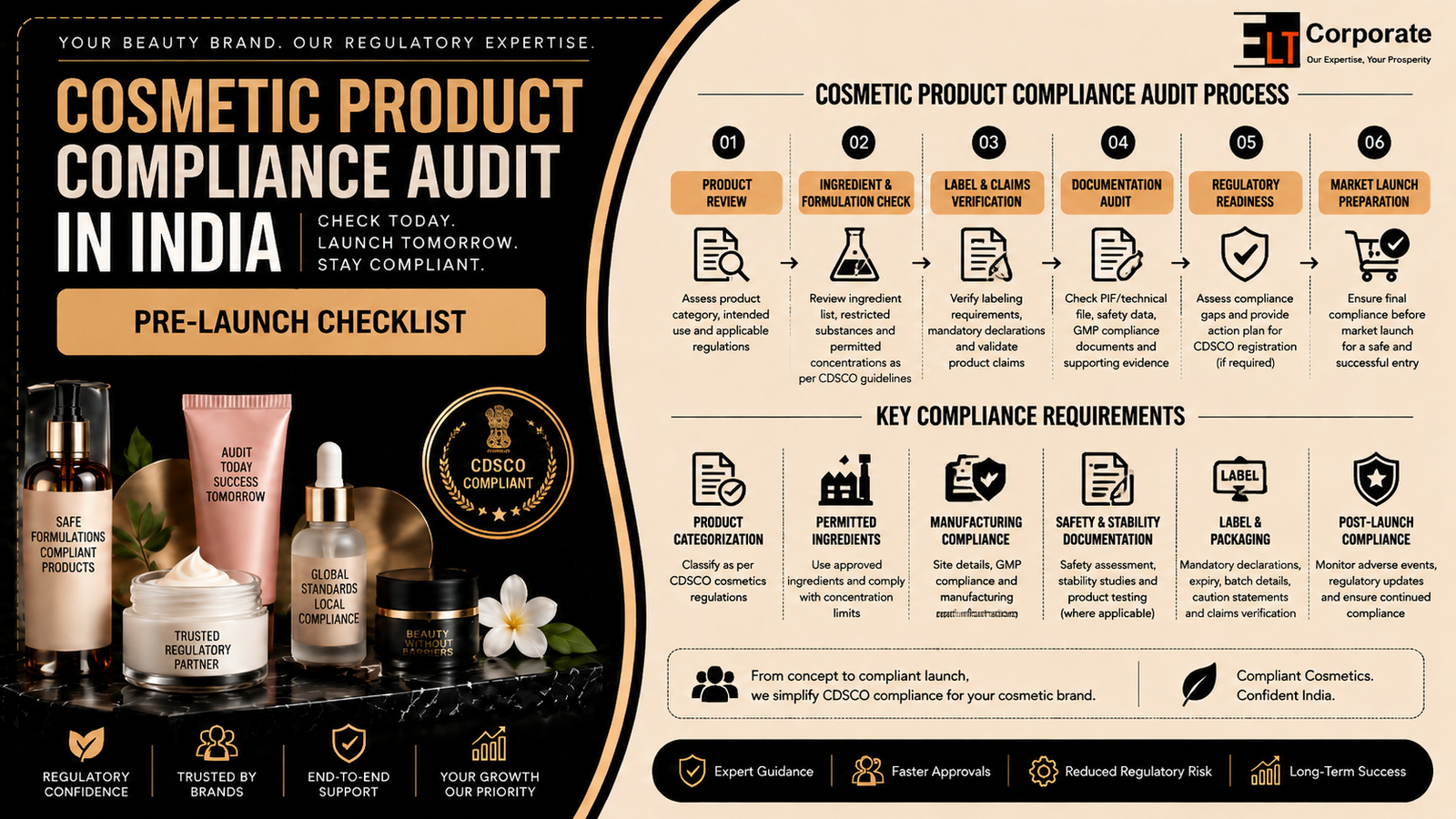
2. Product and Ingredient Compliance Check: Before applying, carefully review all K beauty product formulations against Indian cosmetic regulations. Pay special attention to prohibited ingredients, permitted colorants, and maximum concentration limits for certain substances. Specific categories like Korean sunscreens with unique UV filters may require particular scrutiny.
3. Understanding Product Categorization: Accurately categorize your K-beauty products (e.g., is a ‘sleeping pack’ considered a mask or a cream?). Incorrect categorization can lead to delays or rejection.
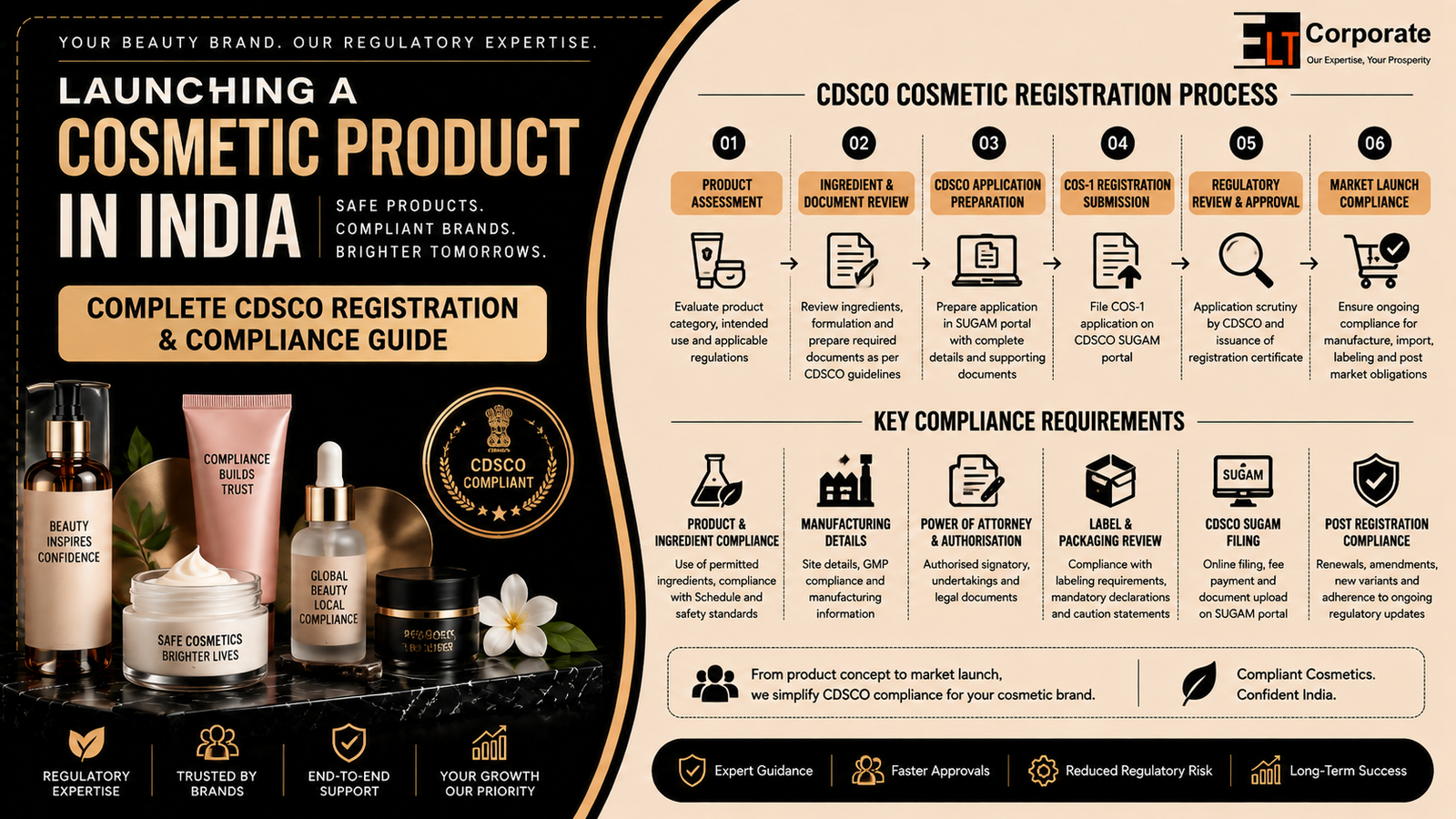
4. Online Application via SUGAM Portal: The entire application process is conducted online through the CDSCO SUGAM portal.
- Create an applicant account (if you don’t have one).
- Fill out Form COS-1 (previously Form 42) accurately. This form requires detailed information about the manufacturer, product, and ingredients.
- Pay the prescribed government fees online.
5. Documentation Submission: Upload all the required documents listed above. Ensure they are clear, legible, and correctly named. Any missing or incorrect document can lead to significant delays.
6. Review and Clarification Phase: CDSCO officials will review your application and submitted documents. They may raise queries or request further clarification or additional information. Responding promptly and accurately to these queries is vital.
7. Grant of Registration Certificate: Upon satisfactory review and approval, CDSCO will issue the Registration Certificate in Form COS-2 (previously Form 43). This certificate allows your Korean beauty products to be imported into India.
8. Import License Requirements: Import permissions for consignments are obtained through Form COS-4A for customs clearance.
Common Mistakes to Avoid for Korean Beauty Brands
Even with a clear process, certain pitfalls can delay or complicate your CDSCO cosmetic registration. Being aware of these common mistakes can save considerable time and resources.
- Ingredient Discrepancies and Prohibited Substances: K-beauty products often contain unique ingredients. A common mistake is not thoroughly checking if all ingredients, especially botanicals or novel compounds, comply with Indian regulations. Some ingredients permissible in Korea might be restricted or prohibited in India.
- Incomplete or Incorrect Documentation: Failing to provide all mandatory documents, or submitting documents with errors or expired dates, is a frequent cause of delays. Ensure all certificates, particularly the Certificate of Free Sale and GMP certificates, are up-to-date and correctly attested.
- Misleading Claims and Labeling Issues: Product claims on K-beauty labels must comply with Indian advertising and cosmetic rules. Claims that imply medicinal properties for a cosmetic product can lead to its reclassification as a drug, which has different regulatory pathways. All mandatory information for Indian consumers must be clearly displayed.
- Delays Due to Inexperienced Agents: Choosing an authorized agent without sufficient experience in CDSCO cosmetic regulations or specific knowledge of K beauty products can prolong the process. An experienced agent understands the nuances and can foresee potential issues.
- Not Maintaining Post-Approval Compliance: Registration is not a one-time event. Brands often overlook ongoing compliance, such as maintaining proper import records, adhering to labeling changes, or reporting adverse events.
What Happens If You Ignore CDSCO Cosmetic Registration?
Ignoring the CDSCO cosmetic registration requirement for your Korean beauty products in India carries significant risks and severe consequences. Attempting to bypass these regulations can lead to substantial financial losses, legal troubles, and irreparable damage to your brand’s reputation.
The authorities can seize unregistered products at customs, preventing them from entering the Indian market. You may face heavy fines and penalties under the Drugs and Cosmetics
Act, 1940, and the New Cosmetics Rules, 2020. This can even lead to prosecution, with legal proceedings against the importer and potentially the manufacturer’s authorized agent.
Beyond legal repercussions, selling unregistered products can severely damage your brand’s credibility. Consumers may lose trust if they discover products are not legally compliant, leading to a permanent market ban for your brand in India. The long-term implications of non-compliance far outweigh the effort and cost of proper registration.
The Cost Involved in CDSCO Cosmetic Registration
The cost associated with CDSCO cosmetic registration for Korean beauty products involves several components. These include government fees, testing charges, and professional service fees if you engage a consultant.
- Official Government Fees: Application Fee for Form COS-1: INR 10,000 for the first category of cosmetics. Additional Category Fee: INR 5,000 for each additional category of cosmetics. Per SKU/Variant Fee: INR 1,000 for each variant (e.g., different shades of the same lipstick). These fees are paid directly to CDSCO through the SUGAM portal.
- Testing Charges: If your products require specific testing in India, or if the provided test reports from Korea are deemed insufficient, you might incur additional costs for laboratory testing. These charges vary based on the type and number of tests required.
- Professional Service Charges: Engaging a regulatory consultant or service provider like ELT is highly recommended. Their fees cover document compilation, application filing, query handling, and overall management of the process. These charges vary based on the complexity of your product portfolio and the services required.
How ELT Can Help You with CDSCO Cosmetic Registration Korean Beauty India?
Navigating the intricacies of CDSCO cosmetic registration, especially for international brands like Korean beauty, can be complex and time-consuming. This is where ELT steps in as your trusted partner. We specialize in simplifying the regulatory landscape for your market entry.
ELT provides end-to-end support, from the initial compliance check of your K-beauty formulations to the final grant of the registration certificate. Our expert team assists with
meticulous document compilation, ensuring all paperwork from your Korean manufacturer is accurate and complete. We act as your dedicated Indian authorized agent, handling all communications with CDSCO and responding to any queries swiftly.
We understand the specific challenges Korean beauty brands face, from ingredient compliance to labeling requirements. Our proactive approach minimizes delays, helping you achieve timely market entry and focus on your business growth in India. Partner with ELT to turn regulatory challenges into seamless opportunities.
Conclusion: Your Gateway to India’s Thriving K-Beauty Market
The Indian market offers immense potential for Korean beauty brands, with an ever-growing appetite for innovative skincare and makeup. However, successful market entry hinges on meticulous adherence to CDSCO cosmetic registration requirements.
By understanding the process, preparing the necessary documents, and avoiding common pitfalls, you can ensure a smooth and compliant journey. This comprehensive checklist empowers you to navigate the regulatory landscape with confidence.
Don’t let regulatory complexities be a barrier to your success. Take the first step towards unlocking the vast opportunities in the Indian K-beauty market by prioritizing your CDSCO cosmetic registration today. Reach out to a trusted partner like ELT to streamline your compliance efforts and launch your brand successfully.
FAQs
Q1: How long does the CDSCO cosmetic registration process take for Korean beauty products, and what are the most common reasons for delays?
The CDSCO cosmetic registration for Korean beauty products usually takes 90–120 days from a complete application. Delays often occur due to incomplete/incorrect documents, discrepancies in ingredient lists, missing Certificates of Free Sale, non-compliant Indian labeling, or slow responses to CDSCO queries.
Q2: As a Korean beauty brand, do I need to establish an Indian entity to get CDSCO registration, or can I work through a local authorized agent? What are the pros and cons of each approach?
Korean beauty brands can register with CDSCO via a local authorized agent, saving cost and effort. The downside is relying on a third party. An Indian entity gives more control but is costly and complex.
Q3: Are there any specific Korean beauty ingredients or product types (e.g., certain sunscreens, fermented ingredients) that face unique restrictions or require special documentation under Indian CDSCO regulations?
Some Korean beauty ingredients, like certain UV filters or botanicals, may face restrictions under Indian CDSCO rules. A thorough ingredient compliance check against the Indian Cosmetic Rules, 2020, helps spot issues early. Expert regulatory guidance is recommended.
Q4: What is the estimated cost breakdown for CDSCO cosmetic registration and related import procedures for a range of Korean beauty products (e.g., 5-10 SKUs)? Are there any hidden fees I should be aware of?
For 5–10 K-beauty SKUs, CDSCO government fees range from INR 20,000–30,000 (application + per SKU charges). Additional costs include agent/consultant fees and possible extra charges for lab tests, translations, or notarization. Clarify all costs upfront to avoid surprises.
Q5: My Korean beauty products have unique packaging and Korean language instructions. What are the specific Indian labeling requirements I need to meet, and can I include both Korean and English on my product labels for the Indian market?
Indian cosmetic labels must show mandatory info in English/Hindi. Korean text is allowed, but key details must be clearly in English to avoid recalls or import issues.