
Planning to manufacture, import or launch an eye cream brand in India? Understand the applicable registration requirements, documents, ingredient review, labelling rules and product claims before launching your product.
Cosmetic Registration for Eye Cream in India depends on the product’s intended use, formulation, manufacturing arrangement and applicable regulatory pathway. Early preparation can help businesses identify documentation gaps before investing in packaging or commercial production.
Eye creams are commonly developed to moisturise the skin around the eyes and improve the appearance of dryness, puffiness, dark circles and fine lines. Businesses should assess the applicable regulatory requirements before manufacturing, importing or marketing these products.
For startups, importers, private-label brands and established skincare companies, Cosmetics Regulatory can help identify relevant compliance steps and organise the documentation required for the selected pathway.
What Is Cosmetic Registration for Eye Cream in India?
Cosmetic Registration for Eye Cream in India means identifying and completing the applicable regulatory formalities for an eye cream before its commercial manufacture or import. The process depends on where the product is manufactured, its intended use and how it will be sold.
Cosmetics in India are primarily regulated under the Drugs and Cosmetics Act, 1940, and the Cosmetics Rules, 2020. Domestic manufacturing and cosmetic imports follow different regulatory procedures.
Domestic Manufacturing
Check the applicable manufacturing licence requirements with the relevant State Licensing Authority before starting production.
Imported Eye Cream
Assess the applicable CDSCO import registration requirements before importing cosmetics for sale in India.
Third-Party Manufacturing
Clarify licence coverage, product records, manufacturing responsibilities and packaging compliance with the manufacturer.
Private-Label Brands
Review the formula, labels, claims and regulatory responsibilities before launching products under your own brand.
These pathways are not interchangeable. A product-specific assessment helps determine which requirements apply to the business.
Why Is Eye Cream Compliance Important Before Launch?
The skin around the eyes is delicate, so formulation, intended use, safety assessment and directions for use deserve careful attention. Cosmetic Registration for Eye Cream in India should form part of the product launch plan, not be treated as a paperwork-only exercise.
- Regulatory readiness: Identify the applicable licence or registration route.
- Ingredient review: Check the formulation against applicable ingredient restrictions.
- Product safety: Identify suitable quality and safety assessments.
- Label accuracy: Review mandatory declarations before packaging is printed.
- Claims compliance: Avoid misleading or unsupported marketing statements.
- Cost control: Reduce avoidable packaging reprints and documentation gaps.
Who Needs Eye Cream Compliance Support?
1. Indian Eye Cream Manufacturers
Businesses manufacturing eye creams in India should check the relevant manufacturing licence requirements. The manufacturing premises, product category, process, quality controls and supporting documents should be reviewed before production begins.
2. Imported Eye Cream Brands
Businesses importing eye creams for sale in India generally need to assess the applicable CDSCO registration process before commercial import. Product details, manufacturer information, variants, pack sizes and supporting documents should be consistent throughout the application.
3. Private-Label and Third-Party Brands
A startup may appoint a cosmetic manufacturer to produce an eye cream under its own brand. The parties should clarify licence coverage, product specifications, ingredient information, packaging responsibilities and recordkeeping arrangements.
4. International Brands Entering India
Overseas brands should assess Indian requirements before shipping products or finalising India-specific packaging. Early review can identify missing manufacturer documents, label changes and claims requiring further assessment.
Documents Required for Eye Cream Compliance
The exact document checklist depends on the product’s origin and selected regulatory route. For Cosmetic Registration for Eye Cream in India, the following documents may be relevant, subject to the current requirements of the applicable authority.
- Product name, brand name and product category.
- Qualitative and quantitative ingredient composition.
- Product specifications and relevant quality and safety information.
- Manufacturer details and manufacturing premises information.
- Manufacturing licence or relevant authorisation, where applicable.
- Free Sale Certificate or market authorisation documents, where required.
- Manufacturer authorisation or power of attorney, where applicable.
- Product labels, packaging artwork and pack sizes.
- Details of product variants, where relevant.
- Applicable testing protocols and supporting reports.
- Prescribed application forms, declarations and undertakings.
- Indian importer or authorised agent details, where applicable.
Imported cosmetics may require an application for an Import Registration Certificate under the Cosmetics Rules, 2020. Review the official guidance before preparing the application. Cosmetics Regulatory can help businesses organise product information and identify potential documentation gaps.
Eye Cream Ingredient and Safety Review
Eye creams may contain moisturisers, emollients, humectants, antioxidants, botanical extracts and other cosmetic ingredients. Their acceptability depends on the ingredient, concentration, applicable restrictions, intended use and overall formulation.
- Ingredient compliance: Check ingredients against applicable restrictions and requirements.
- Intended use: Confirm that the product is presented for its stated cosmetic purpose.
- Quality and safety: Maintain appropriate specifications and supporting evidence.
- Packaging compatibility: Assess whether the container is suitable for the formulation.
- Stability: Evaluate whether the product maintains its required quality during its intended shelf life.
- Microbiological considerations: Assess suitable microbiological quality and preservation testing based on the product.
- Eye-area suitability: Consider intended application and foreseeable use in the safety evaluation.
Do not assume a formulation is compliant simply because similar ingredients are used in other products. The finished formulation and intended use must be assessed before proceeding with Cosmetic Registration for Eye Cream in India.
Labelling Requirements for Eye Cream in India
Eye cream labels should be reviewed against the applicable Cosmetics Rules, 2020, and other relevant packaging and declaration requirements. Exact requirements may differ according to the product and whether it is manufactured domestically or imported.
- Product name and identity.
- Name and address of the manufacturer.
- Importer or responsible entity details, where required.
- Batch or lot identification.
- Manufacturing licence details, where applicable.
- Net contents.
- Manufacturing and expiry or use-before information, as applicable.
- Ingredient declaration in the required format.
- Directions for use and necessary warnings or precautions.
- Maximum retail price and other applicable packaged-commodity declarations.
- Country of origin and import-related information, where required.
- Registration certificate details on imported cosmetic labels, where applicable.
Confirm the declarations that apply to your specific product and packaging format. Avoid printing large quantities of packaging until the label has been reviewed.
Can Eye Cream Claims Affect Compliance?
Yes. Product claims should accurately describe the product and be supported by appropriate evidence. Rule 36 of the Cosmetics Rules, 2020, addresses false or misleading cosmetic claims.
Examples of claims requiring careful review include:
- Helps moisturise the under-eye area.
- Improves the appearance of dark circles.
- Helps reduce the appearance of puffiness.
- Helps improve the appearance of fine lines.
- Brightens the look of tired-looking skin.
The evidence required depends on the claim. Avoid absolute promises, unsupported clinical statements or claims suggesting a medical treatment effect without assessing the product’s regulatory classification.
Claims about curing eye diseases or treating medical conditions may raise issues beyond ordinary cosmetic compliance. Obtain an appropriate regulatory assessment if the intended purpose suggests another regulated category.
Therefore, Cosmetic Registration for Eye Cream in India should include review of product labels, website descriptions, advertisements and other promotional materials—not just application documents.
Need Expert Help With Eye Cream Compliance?
Get guidance on the applicable registration route, product documentation, labelling and claims before launching your eye cream brand.
Call: +91 85859 19582
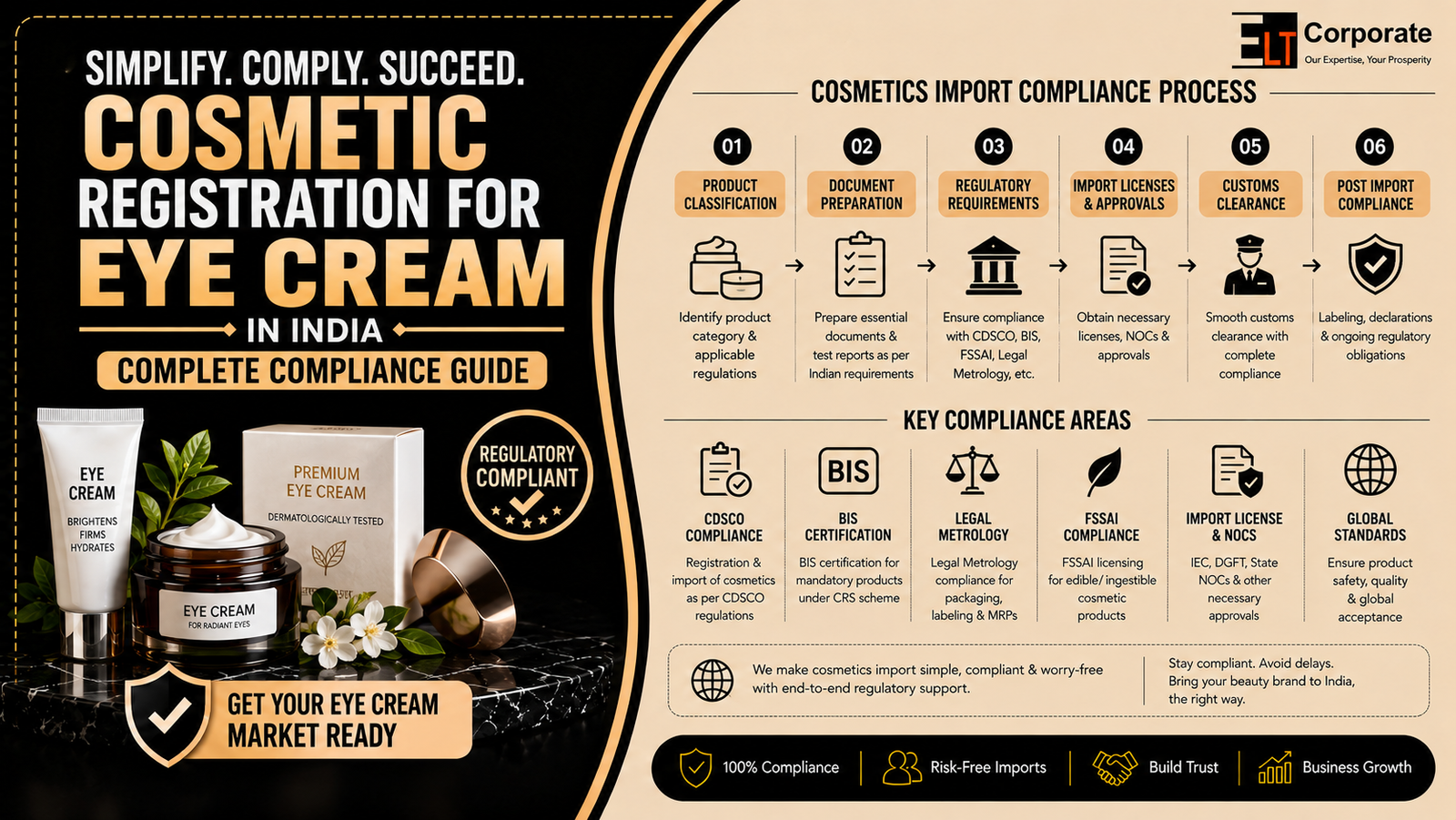
Step-by-Step Process for Eye Cream Compliance
- Identify the product category. Review the intended use, formulation, claims and product presentation.
- Determine the applicable licence or registration. Domestic manufacturers should check State Licensing Authority requirements; importers should assess the applicable CDSCO procedure.
- Prepare the documents. Collect manufacturer details, ingredient composition, product specifications, labels and authorisations.
- Review formulation and claims. Check ingredient information, specifications, safety support and marketing claims.
- Review label artwork. Verify declarations, ingredient information, batch details and warnings.
- Submit the applicable application. Follow the prescribed procedure, provide required documents and fees, and respond to authority queries as applicable.
- Confirm launch readiness. Verify applicable requirements before manufacture, import or marketing and maintain relevant records.
This process can help organise Cosmetic Registration for Eye Cream in India, although timelines and outcomes depend on the application, documentation and relevant authority.
Common Mistakes to Avoid
- Incomplete manufacturer documents: Missing or inconsistent details can delay review.
- Incorrect product classification: Not every eye-area product follows the same regulatory route.
- Unverified ingredient information: Incomplete composition details can create documentation gaps.
- Unreviewed packaging: Printing labels before checking declarations can increase costs.
- Unsupported claims: Marketing promises without adequate evidence can create compliance concerns.
- Ignoring product changes: Changes to formulation, manufacturing site or other details may require assessment.
- Confusing import registration with manufacturing licensing: These are distinct regulatory processes.
A pre-launch review by Cosmetics Regulatory can help identify potential issues and organise the next steps before launch.
How Cosmetics Regulatory Can Help Your Eye Cream Business
Whether you are a startup, importer, private-label brand or established skincare company, professional compliance support can help you understand the process before investing in production and packaging.
Regulatory Route Assessment
Understand the potential manufacturing licence or import registration pathway for your business.
Documentation Review
Identify missing information and organise product documentation for the applicable process.
Labelling & Claims Review
Review packaging declarations and product claims for potential compliance issues.
Pre-Launch Guidance
Understand the steps to address before commercial manufacture, import or launch.
The scope of assistance depends on your product and business requirements. Regulatory support cannot guarantee approval, but appropriate preparation can help identify issues before submission.
Frequently Asked Questions
Q1. Is registration required for eye cream in India?
Requirements depend on the product and business model. Imported cosmetics generally require applicable import registration, while domestic manufacturing is subject to relevant licensing requirements.
Q2. Which authority handles imported eye cream registration?
CDSCO’s Central Licensing Authority handles the applicable import registration process for cosmetics. Check the current requirements before applying.
Q3. What documents are needed for eye cream registration?
Depending on the route, documents may include ingredient composition, product specifications, manufacturer details, labels, authorisations and other supporting information.
Q4. Can I sell eye cream under my own brand through a third-party manufacturer?
A private-label arrangement may be possible subject to applicable licensing, manufacturing, documentation, labelling and other requirements.
Q5. Do eye cream labels need to be reviewed?
Yes. Review applicable declarations, manufacturer or importer information, ingredient lists, batch details and other required information before printing final packaging.
Q6. Can I claim that my eye cream removes dark circles permanently?
Avoid absolute or unsupported claims. Statements should be accurate, appropriate for the product category and supported by suitable evidence.
Q7. How can I get help with eye cream compliance?
Contact Cosmetics Regulatory or submit the free assistance form to discuss your requirements.
Conclusion
Launching an eye cream involves more than developing a formula and designing attractive packaging. Businesses should assess the product category, applicable licence or registration route, ingredient information, safety documentation, labelling and marketing claims.
Cosmetic Registration for Eye Cream in India should be planned early to help prevent avoidable documentation gaps and packaging changes. Domestic manufacturers, importers and private-label brands should identify the requirements relevant to their products before starting commercial activities.
For help preparing a compliance checklist, reviewing product information and understanding the next steps, Cosmetics Regulatory can guide you through the process.
Ready to Launch Your Eye Cream Brand?
Discuss your product, documents and applicable compliance requirements with our regulatory team before launch.
Official Regulatory Resources
- CDSCO – Cosmetics Rules, 2020
- CDSCO – Cosmetics Division
- Department of Consumer Affairs – Legal Metrology Resources
Disclaimer: Regulatory requirements may change. Confirm the current rules, official application checklist and relevant authority requirements before filing or launching the product.