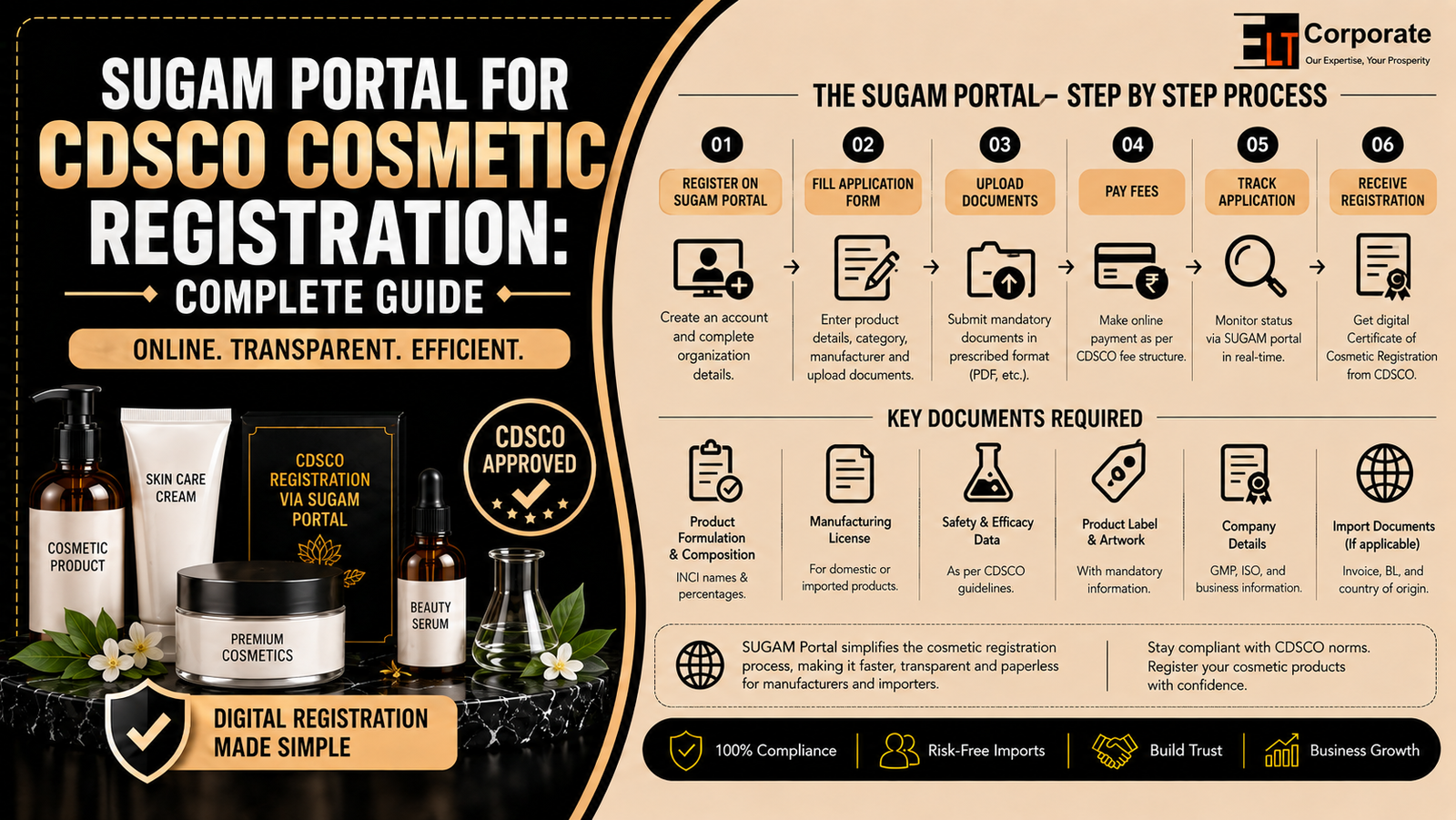
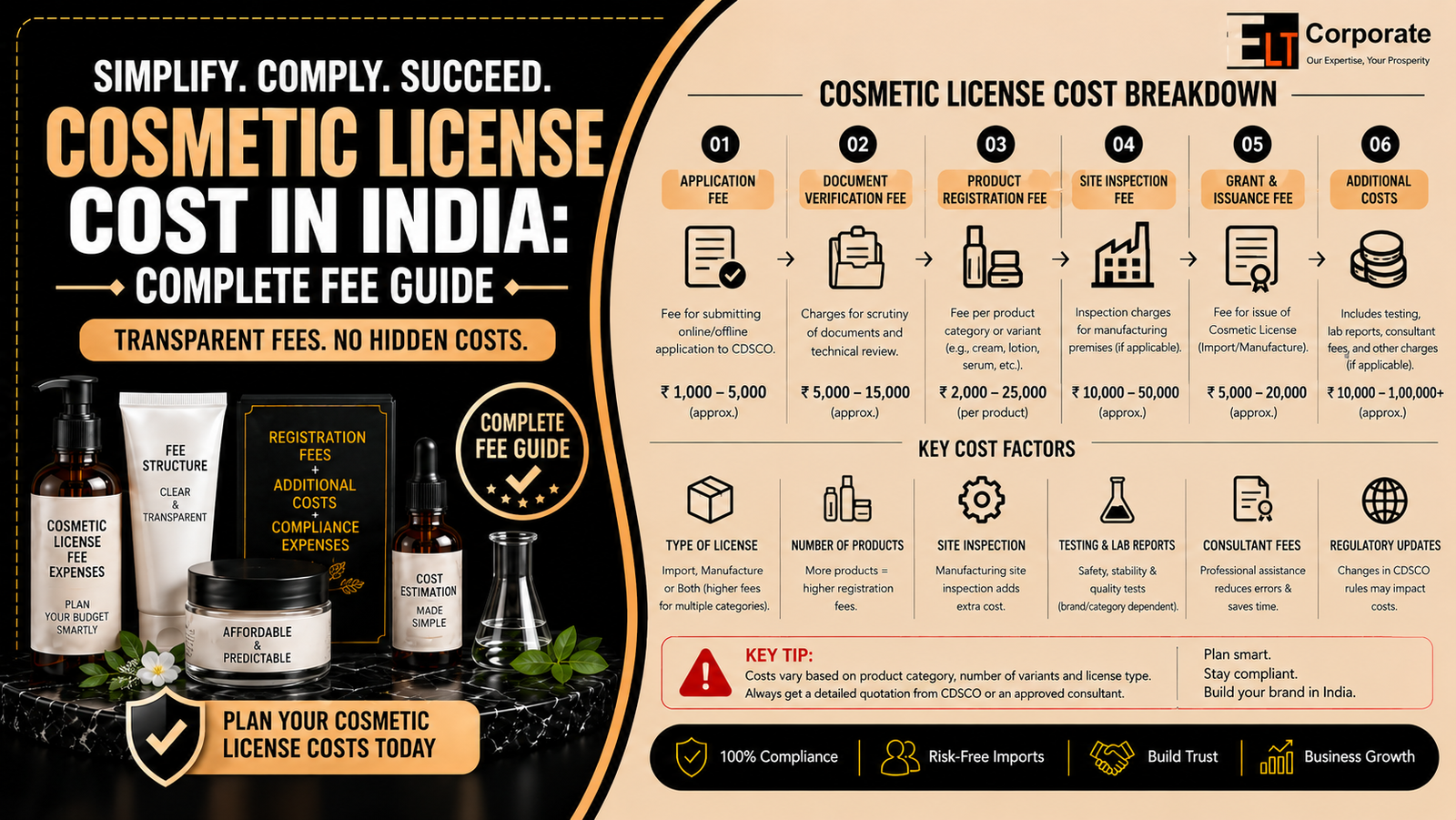

Starting a cosmetic manufacturing or import business in India requires more than developing a good product. Businesses must also understand the applicable licensing, registration, and compliance costs before launching products in the market. The cosmetic license cost in India depends mainly on the type of activity, number of products, product categories, manufacturing arrangements, and whether the cosmetics are manufactured in India or imported from another country.
The Cosmetics Rules, 2020, provide specific government fees for manufacturing licenses, loan licenses, cosmetic registration certificates, and new cosmetic permissions. These statutory fees are separate from other expenses such as testing, documentation, professional consultancy, laboratory facilities, premises, and packaging compliance.
This guide explains the major cosmetic license fees in India, including COS-8 manufacturing license fees, COS-9 loan license fees, CDSCO import registration fees, additional product fees, and other possible regulatory expenses.
What Is a Cosmetic License in India?
A cosmetic license is a regulatory approval required for certain activities involving cosmetics in India. The applicable license depends on whether a business manufactures cosmetics domestically, manufactures through another licensed facility, or imports cosmetics from a foreign manufacturer.
For domestic manufacturing, the Cosmetics Rules, 2020, provide the licensing framework through the State Licensing Authority. A manufacturing license is granted in Form COS-8, while a loan license is granted in Form COS-9.
For imported cosmetics, registration is handled under the Central Licensing Authority framework. The fee structure for imported cosmetics is separately provided in the Third Schedule. Therefore, there is no single fixed “cosmetic license cost” applicable to every business.
Cosmetic License Cost in India: Quick Overview
The following table gives an overview of the major statutory fees prescribed under the Cosmetics Rules, 2020:
| Type of Approval | Prescribed Government Fee |
| COS-8 manufacturing license, up to 10 items of each category | ₹10,000 |
| Each additional item in a category under COS-8 | ₹500 |
| 10 items of each additional category under COS-8 | ₹10,000 |
| COS-9 loan license, up to 10 items of each category | ₹10,000 |
| Each additional item under COS-9 | ₹500 |
| Cosmetic registration for each category | US$1,000 |
| Additional cosmetic category for registration | US$1,000 |
| Each cosmetic variant for registration | US$50 |
| Each manufacturing site for registration | US$500 |
| Permission for a new cosmetic | US$500 |
| Inspection of each overseas manufacturing site | US$5,000 |
These figures are prescribed in the Third Schedule of the Cosmetics Rules, 2020.
The applicable government fee should always be checked against the current regulatory requirements before filing an application.
COS-8 Cosmetic Manufacturing License Cost
If a business plans to manufacture cosmetics in India for sale or distribution, the applicable manufacturing license is generally Form COS-8.
The Third Schedule prescribes a fee of ₹10,000 for a COS-8 license covering up to ten items of each category of cosmetics. If additional items are included within a category, the prescribed fee is ₹500 for each additional item. For ten items of each additional category, the prescribed fee is ₹10,000.
For example, a manufacturer planning to produce several skincare products should calculate the number of products and categories before filing the application.
The government license fee is only one component of the total setup cost. A manufacturer may also need to invest in:
- Manufacturing premises
- Machinery and equipment
- Laboratory facilities
- Qualified technical staff
- Product testing
- Raw material documentation
- Product development
- Packaging and labeling
- Regulatory documentation
- Professional compliance services
Therefore, businesses should not consider ₹10,000 as the complete cost of starting a cosmetic manufacturing facility.
COS-9 Loan License Cost
Businesses that manufacture cosmetics through another licensed manufacturer’s premises may need to evaluate the loan license route.
The Cosmetics Rules, 2020, prescribe a fee of ₹10,000 for a COS-9 loan license covering up to ten items of each category. An additional item in a category attracts a prescribed fee of ₹500, according to the Third Schedule.
The loan license structure can be useful for businesses that want to launch their own cosmetic products but do not operate an independent manufacturing facility.
However, the commercial arrangement and regulatory responsibilities should be reviewed carefully before selecting this route.
CDSCO Cosmetic Registration Cost for Imported Cosmetics
Businesses importing cosmetics manufactured outside India follow a different regulatory route.
Under the Third Schedule, the fee for grant or retention of a cosmetic registration certificate is US$1,000 for each category of cosmetic. An additional category also attracts a fee of US$1,000.
Additional fees may apply depending on the number of variants and manufacturing sites.
The prescribed fees include:
- US$1,000 for each cosmetic category
- US$1,000 for an additional category
- US$50 for each cosmetic variant
- US$500 for each manufacturing site
- US$500 for permission for a new cosmetic
- US$5,000 for inspection of each overseas manufacturing site
These charges make it important for importers to prepare their product portfolio carefully before submitting an application.
Cosmetic Registration Fee for Each Variant
Product variants can affect the overall registration cost.
The third schedule specifies a fee of US$50 for each variant of a cosmetic for grant or retention of the registration certificate.
For businesses importing products in multiple shades, fragrances, flavors, or other variants, the applicable classification should be checked carefully.
The number of variants should be declared accurately according to the applicable regulatory requirements rather than simply grouping all products together.
Fee for Additional Manufacturing Sites
Imported cosmetics can involve more than one foreign manufacturing location. The Cosmetics Rules, 2020, stipulate a charge of US$500 per manufacturing facility to grant or retain a registration certificate.
If, for instance, an international cosmetic company manufactures products in several overseas factories, the cost for registration can rise based on the number of manufacturing facilities on the form. So, applicants must create a detailed list of the manufacturing site prior to filing.
New Cosmetic Permission Fee
A product that falls under the regulatory definition of a new cosmetic may require a separate permission rather than being treated exactly like an ordinary cosmetic registration.
The Third Schedule prescribes a fee of US$500 for the grant of permission for new cosmetics.
Whether a product qualifies as a new cosmetic depends on the applicable regulatory provisions, product composition, and other relevant factors. Businesses should assess this before finalizing their application strategy.
What Is Included in the Total Cosmetic License Cost?
When businesses search for the cosmetic license cost in India, they often expect one government fee. In practice, the total project cost can be considerably different from the statutory application fee.
A complete compliance budget may include:
Government Fees
These are the fees prescribed under the Cosmetics Rules for the relevant license, registration, or permission.
Testing Charges
Depending on the product and compliance requirements, businesses may need laboratory testing or other technical evaluations.
Documentation Cost
Manufacturers and importers may require formulation documents, product specifications, technical documents, declarations, authorizations, and other supporting records.
Manufacturing Setup
For businesses applying for a manufacturing license,
Premises, equipment, utilities, storage, and quality-control arrangements can represent a substantial part of the investment.
Technical Staff
Cosmetic manufacturing requires appropriate technical supervision. Qualified personnel and their documentation should therefore be considered when calculating the overall business cost.
Professional Consultancy
Businesses may appoint regulatory professionals for classification, documentation, application filing, label review, and handling regulatory queries.
Cosmetic Manufacturing License Cost vs. Import Registration Cost
The cost structure differs significantly between domestic manufacturing and importing.
| Factor | Domestic Manufacturing | Imported Cosmetics |
| Main approval | COS-8 | Cosmetic Registration |
| Authority | State Licensing Authority | Central Licensing Authority |
| Basic statutory fee | ₹10,000 for up to 10 items/category | US$1,000 per category |
| Additional product fee | ₹500 per additional item | US$50 per variant |
| Manufacturing site fee | Depends on licensing structure | US$500 per site |
| Facility required in India | Yes, for own manufacturing | No Indian manufacturing facility |
| Overseas manufacturer documents | Generally not applicable | Required |
| Testing/compliance costs | Applicable | Applicable depending on product and requirements |
The correct route depends on the business model and product source.
Other Costs Businesses Should Consider
The statutory fee should not be the only figure used while preparing a cosmetic business budget.
A new manufacturer may need to consider:
- Factory rent or purchase
- Facility development
- Manufacturing machinery
- Storage areas
- Laboratory equipment
- Water and utility arrangements
- Quality-control systems
- Technical personnel
- Product testing
- Packaging development
- Label compliance
- Stability or supporting studies where applicable
- Documentation
- Regulatory consultancy
- License retention or related compliance fees
For an importer, the budget may additionally include:
- Foreign manufacturer documentation
- Free Sale Certificate or equivalent documentation
- Authorization documents
- Product labels
- Import-related expenses
- Customs and logistics costs
- Product testing where applicable
- Regulatory consultancy
- Registration-related government fees
These expenses are separate from the statutory license fee.
Cosmetic License Renewal and Retention Fees
Businesses should also consider continuing compliance after receiving an approval.
The Cosmetics Rules, 2020, prescribe retention fees for relevant licenses and registration certificates. For manufacturing licenses, the Third Schedule provides retention fee provisions corresponding to the applicable license and product category.
CDSCO has also published information specifically concerning retention of manufacturing license numbers issued under COS-8 for renewal-related requirements under the Cosmetics Rules, 2020.
Therefore, businesses should maintain a compliance calendar instead of treating the license as a one-time expense.
How to Calculate Your Cosmetic License Cost
A simple cost calculation can help businesses estimate their regulatory budget.
For Domestic Manufacturing
Start with:
Base COS-8 fee + additional product fees + additional category fees + testing + facility + documentation + professional costs
For example, if the application covers up to ten items of one category, the prescribed COS-8 government fee is ₹10,000. Additional products or categories can increase the statutory fee.
For Imported Cosmetics
Use:
Category fee + variant fees + manufacturing-site fees + applicable new cosmetic fee + documentation + testing + professional costs
An importer should calculate the number of categories, variants, and foreign manufacturing sites before filing.
Common Mistakes When Calculating Cosmetic License Cost
Looking Only at the Government Fee
The license fee is not the same as the complete compliance cost.
Ignoring Product Categories
Additional categories can increase the applicable government fee.
Not Counting Variants
For imported cosmetics, each applicable variant can attract an additional fee.
Forgetting Manufacturing Sites
Foreign brands with multiple manufacturing locations should account for the applicable site fee.
Confusing Manufacturing and Import Licenses
COS-8 is associated with domestic cosmetic manufacturing, while imported cosmetics follow the registration framework.
Using Outdated Fee Information
Regulatory requirements can change. CDSCO maintains official pages for the Cosmetics Rules and related notices, so businesses should verify the applicable fee before filing.
How to Reduce Unnecessary Regulatory Expenses
Businesses can control avoidable costs by preparing the application properly.
First, identify the exact products and categories before filing. Second, verify the manufacturing sites and variants. Third, prepare complete documents before submission. Finally, review labels, product information, and regulatory classifications in advance.
A complete application can help reduce avoidable delays, repeated documentation, and unnecessary professional or operational expenses.
Why Professional Cosmetic Regulatory Support Is Useful
Understanding the statutory fee is easy; determining the complete compliance pathway can be more complicated.
A regulatory consultant can help businesses assess:
- Applicable license type
- Product classification
- Product categories
- Number of variants
- Manufacturing arrangements
- Required documents
- Testing requirements
- Label compliance
- Application requirements
- Regulatory queries
- Retention and continuing compliance
This can be particularly valuable for startups, private-label brands, importers, and manufacturers launching several cosmetic products.
Cosmetic License Cost Checklist
Before applying, businesses should confirm:
| Cost/Requirement | Checked |
| Applicable license identified | ✓ |
| Product categories identified | ✓ |
| Number of products calculated | ✓ |
| Variants identified | ✓ |
| Manufacturing sites confirmed | ✓ |
| Government fee calculated | ✓ |
| Testing budget prepared | ✓ |
| Documentation budget prepared | ✓ |
| Technical staff cost is considered. | ✓ |
| Facility cost considered | ✓ |
| Label compliance reviewed | ✓ |
| Professional support budget considered | ✓ |
| Retention/compliance costs considered | ✓ |
Conclusion
The cost of a cosmetic license in India depends on the nature of the regulatory process and the number of categories and products as well as the number of manufacturing sites involved. In the Cosmetics Regulations, in 2020, COS-8’s manufacturing permit begins at a pre-approved government cost of Rs10,000 for 10 items or more in each category.
In addition, additional categories and products require additional fees. For cosmetics imported from the United States. The registration fee for imported cosmetics typically is US$1,000 per category, plus additional charges for variations, manufacturing sites, and other regulatory actions that are applicable.
However, the government fee should not be confused with the complete cost of cosmetic compliance. Businesses must also consider testing, documentation, premises, technical staff, packaging, labelling, professional assistance, and continuing compliance expenses.
Prior to launching a cosmetics product in India, companies must determine the appropriate regulatory pathway and then prepare a full cost estimate based on their current product range and business model. Making sure you are aware of the latest cosmetics regulations and CDSCO updates prior to filing can assist in avoiding inaccurate fee calculation and compliance mistakes.
Frequently Asked Questions
Q1. What is the cosmetic license cost in India?
The cost depends on the type of license. For a COS-8 manufacturing license, the prescribed fee is ₹10,000 for up to ten items of each category, with additional fees for extra items and categories.
Q2. What is the COS-8 license fee?
The prescribed COS-8 fee is ₹10,000 for the manufacture of up to ten items of each category of cosmetics. Each additional item attracts ₹500, while ten items of an additional category attract ₹10,000.
Q3. How much does CDSCO cosmetic registration cost?
The Third Schedule prescribes US$1,000 for grant or retention of registration for each category of cosmetic, with additional fees for variants and manufacturing sites.
Q4. Is cosmetic registration the same as a COS-8 license?
No. COS-8 relates to manufacturing cosmetics in India, while imported cosmetics are covered under the applicable CDSCO registration framework.
Q5. Is ₹10,000 the complete cost of a cosmetic manufacturing license?
No. ₹10,000 is the prescribed government fee for the specified COS-8 category/product coverage. Businesses may also incur costs for premises, equipment, testing, technical staff, documentation, and professional compliance services.
Q6. Does the number of cosmetic products affect the fee?
Yes. Under the Third Schedule, additional items within a category can attract an additional ₹500 fee for COS-8 applications.
Q7. Does an imported cosmetic have additional registration costs?
Yes. Depending on the application, fees can apply for additional categories, variants, manufacturing sites, and new cosmetic permissions.
Q8. Can the cosmetic license cost change?
Regulatory fees and procedures may be amended through government notifications or changes to the applicable rules. Applicants should verify the current requirements before submitting an application.
Q9. What other costs should a cosmetic business budget for?
Businesses should consider testing, manufacturing premises, machinery, technical staff, documentation, packaging, labelling, professional consultancy, and continuing compliance in addition to statutory government fees.
Q10. How can I calculate my exact cosmetic license cost?
Start by identifying whether you are manufacturing or importing, then calculate the number of categories, products, variants, and manufacturing sites. Add the applicable government fees and your expected testing, documentation, and compliance expenses.