
SUGAM Portal for CDSCO Cosmetic Registration: The SUGAM portal for the CDSCO cosmetic registration is an online platform used by applicants to submit and manage their applications that concern registration and importation of cosmetics into India. For cosmetics manufacturers from abroad, Indian importers, authorized agents, subsidiary companies, and cosmetic companies planning to bring imported products to India, understanding the Indian market and knowing the SUGAM process is an essential element of ensuring compliance with the regulatory requirements.
The Central Drugs Standard Control Organization (CDSCO) regulates imports of cosmetics in accordance with the Drugs and Cosmetics Act, 1940, as well as the Cosmetics Rules, 2020. CDSCO offers online procedures, including application forms, checklists, and documents of guidance for cosmetic registration using their SUGAM system.
This guide will explain how to use the SUGAM Portal, who can access it, the registration forms for cosmetics included, the required documents and the application process online costs, the application fee, common mistakes, and the most important things companies should take into consideration prior to applying.
What Is the SUGAM Portal?
SUGAM is an online regulatory portal developed by CDSCO to provide electronic services for various regulatory applications. According to CDSCO, the SUGAM Portal was launched as part of its e-governance initiatives and includes services related to the registration of cosmetics, among other regulatory activities.
For cosmetic businesses, the portal provides an online route for submitting applications and supporting documents to the Central Licensing Authority.
Instead of submitting the entire application process manually, applicants can use the portal to:
- Create an applicant account
- Submit cosmetic registration applications
- Upload supporting documents
- Submit application checklists
- Make or upload payment-related information
- Track application status
- Respond to discrepancies
- Receive regulatory communications
- Access approval documents through the dashboard
CDSCO’s cosmetic section also provides a SUGAM user manual, registration checklists, FAQs, and guidance documents to help applicants understand the process.
Is the SUGAM Portal Mandatory for Cosmetic Registration?
For applications covered by the CDSCO cosmetic registration process, online submission through SUGAM is the prescribed route.
CDSCO’s guidance document states that an application for an Import Registration Certificate for cosmetics intended to be imported into India is submitted online in Form COS-1 through the SUGAM Portal. The application may be submitted by the foreign manufacturer, its authorized agent or importer in India, or an authorized Indian subsidiary, as applicable.
Therefore, businesses planning to import foreign-manufactured cosmetics should understand the SUGAM workflow before preparing their application.
Who Needs CDSCO Cosmetic Registration?
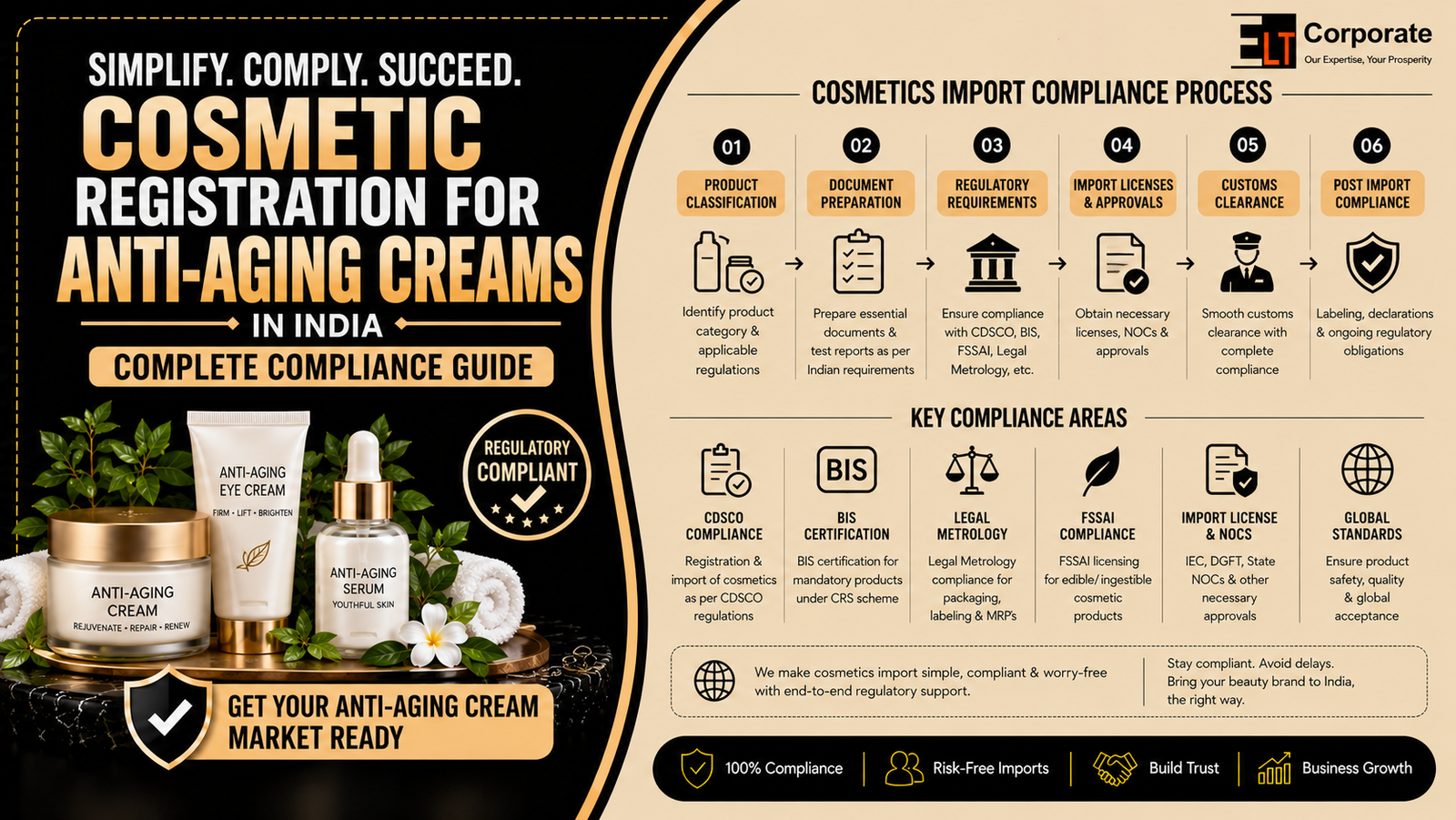
Cosmetic registration requirements are particularly relevant to businesses importing cosmetics manufactured outside India.
The CDSCO FAQ explains that for the import of cosmetics into India, the cosmetic products and manufacturing site are to be registered with CDSCO by submitting an application in Form COS-1 for an Import Registration Certificate in Form COS-2.
This can affect:
- Foreign cosmetic manufacturers
- Indian importers
- Authorized Indian agents
- Indian subsidiaries of foreign manufacturers
- Private-label cosmetic businesses
- International cosmetic brands
- Korean cosmetic brands
- Imported skincare brands
- Imported haircare brands
- Imported makeup and beauty products
The exact regulatory route depends on the nature of the product, manufacturing arrangement, and proposed import activity.
Important Forms for Cosmetic Registration
Understanding the relevant forms is essential before starting a SUGAM application.
Form COS-1
Form COS-1 is the application for the grant of an Import Registration Certificate for cosmetics imported into India.
The applicant submits the required product, manufacturer, manufacturing site, and supporting information through the prescribed online process. CDSCO’s FAQ identifies COS-1 as the application form for registration of cosmetics for import into India.
Form COS-2
Form COS-2 is the Import Registration Certificate issued for the import of cosmetics into India.
The CDSCO FAQ identifies COS-2 as the Import Registration Certificate under the Cosmetics Rules, 2020.
Form COS-4 and COS-4A.
These forms can become relevant where a cosmetic product is already registered and another applicant seeks the applicable Import Registration Number for importing that registered cosmetic.
CDSCO explains that a cosmetic manufactured at a foreign site and already registered under the applicable Cosmetics Rules, 2020 framework, may be imported by another person or entity through an online application in Form COS-4 for grant of an Import Registration Number in Form COS-4A, subject to the prescribed requirements.
Form COS-12
CDSCO also provides an online checklist for applications concerning permission for new cosmetics in Form COS-12. New cosmetic products can therefore involve a different regulatory pathway from ordinary import registration.
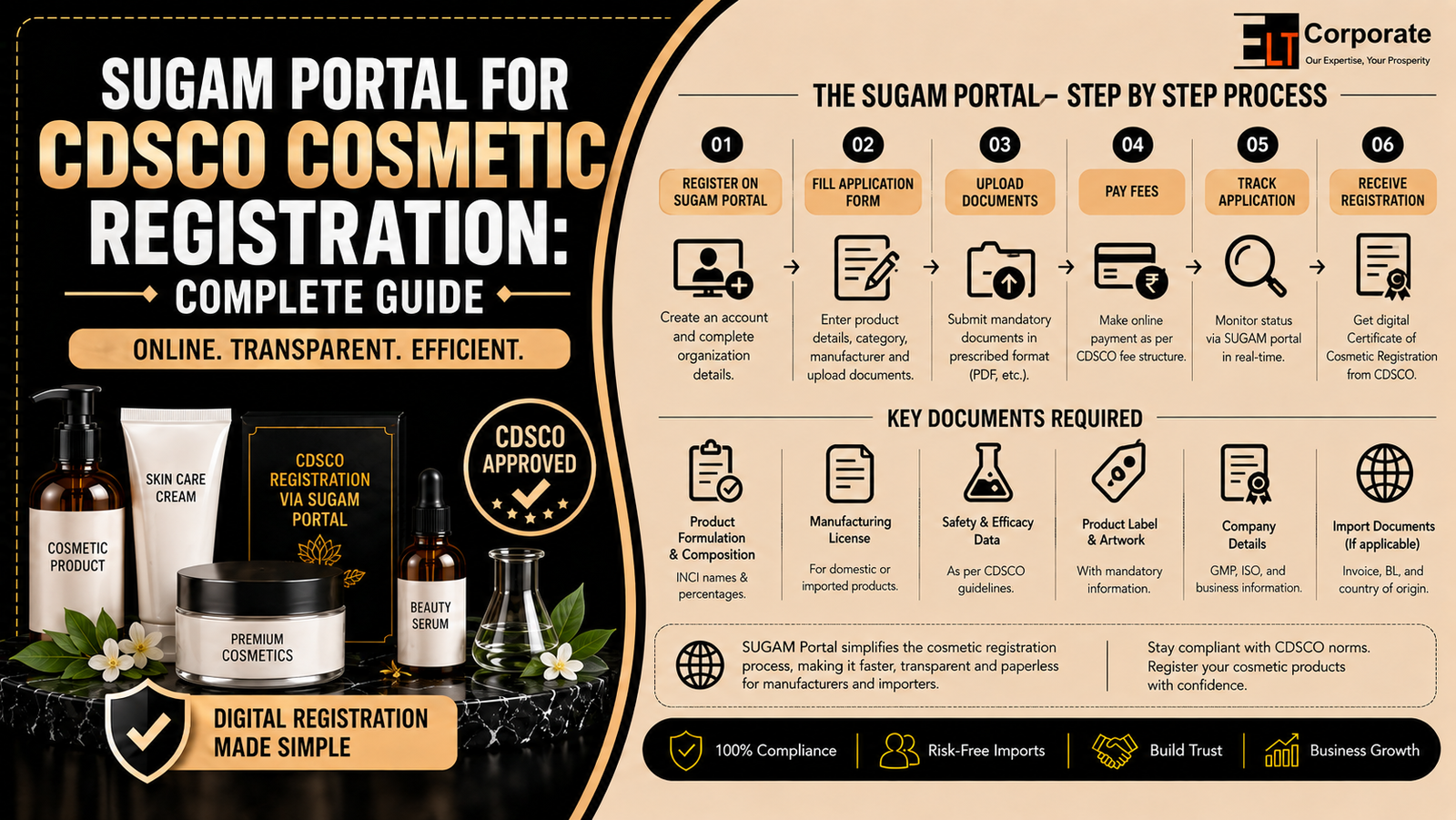
Documents Required for SUGAM Cosmetic Registration
Preparing documents correctly before starting the application can significantly reduce avoidable delays.
CDSCO’s guidance document provides detailed requirements for applications in Form COS-1. Depending on the application, documents may include:
- Authorization from the foreign manufacturer
- Details of the manufacturing site
- Product details
- Product variants
- Free Sale Certificate or equivalent supporting documentation
- Product composition information
- Labels and packaging information
- Manufacturing-related documents
- Undertakings and declarations
- Power of Attorney or authorization documents
- Indian applicant or authorized agent details
- Payment-related documents
- Other documents specified in the applicable checklist
The authorization from the manufacturer must contain appropriate details relating to the manufacturer, manufacturing premises, authorized Indian agent, products, and variants. CDSCO’s guidance also specifies authentication requirements for the authorization document.
The exact documents can vary depending on the type of application, product category, manufacturing site, and regulatory circumstances.
SUGAM Portal Cosmetic Registration Process
The general online process can be understood in the following stages.
Step 1: Create a SUGAM Account
The applicant first needs to create an account on the SUGAM Portal.
CDSCO’s process guidance states that users can access the portal, select the signup option, and provide the required details, including a valid email address and mobile number for alerts.
Applicants should ensure that organization and authorized-person details are entered consistently.
Step 2: Select the Appropriate Applicant Role
The SUGAM user manual identifies different registration purposes and roles.
For cosmetics, applicants can register for the applicable cosmetics registration purpose. The SUGAM manual also indicates that corporate organizations can register and manage relevant organizational units through the portal.
Selecting the correct role is important because the forms and services available through the account depend on the selected purpose.
Step 3: Select the Relevant Application
After login, the applicant proceeds to the form submission section and selects the appropriate department and form.
For imported cosmetics, the applicable registration application is generally submitted using Form COS-1, subject to the circumstances of the application.
Applicants should determine whether the submission is:
- Fresh application
- Endorsement
- Additional product
- Additional manufacturing site
- Pack-size-related application
- Additional sourcing location
- Re-registration
- Other applicable post-registration activity
The correct application type should be selected before proceeding.
Step 4: Enter Product and Manufacturer Details
The applicant needs to provide relevant information concerning:
- Cosmetic product
- Product category
- Variants
- Manufacturer
- Manufacturing premises
- Indian authorized entity
- Packaging or pack size
- Other applicable product information
The information entered into the portal should match the supporting documents.
A mismatch between the application, authorization letter, free sale certificate, labels, and product information can result in queries or discrepancies.
Step 5: Upload the Required Documents
After entering the application details, the applicant reaches the checklist stage.
CDSCO explains that once an applicant proceeds to the checklist page, further modifications to the application form are not allowed. The required documents are uploaded electronically against the relevant checklist points. This makes document preparation particularly important.
Before moving to the checklist, applicants should carefully verify:
- Names
- Addresses
- Product names
- Manufacturing site details
- Product categories
- Variants
- Authorization information
- Document validity
- Signatures
- Attestation or apostille requirements
- File readability
Step 6: Submit Payment Details
The applicable registration fee must be paid according to the prescribed requirements.
CDSCO’s FAQ states that the fee structure is specified in the Third Schedule of the Cosmetics Rules, 2020. The FAQ lists fees of USD 1,000 or equivalent Indian rupees for grant or retention of a Registration Certificate for each category, USD 500 for each manufacturing site, USD 50 for each variant, and USD 1,000 for an additional category, subject to the applicable rules and fee provisions.
Applicants should verify the current applicable fee requirements before making payment because regulatory procedures and instructions can change.
CDSCO’s FAQ also states that fees are paid through the Bharatkosh gateway under the specified account head, and the acknowledgement is submitted with the application.
Step 7: Generate and Submit the Application
After completing the required details and payment process, the applicant reviews the application and generates the relevant PDF.
CDSCO’s online process explains that applicants can generate a PDF of the completed form, upload the required form, and submit the application electronically. A reference number is generated after successful submission and should be retained for future tracking.
Step 8: CDSCO Review
After submission, the application is reviewed by the designated officer.
The application may be checked for:
- Completeness
- Regulatory compliance
- Document adequacy
- Product information
- Manufacturing-site information
- Authorization
- Payment
- Labeling and supporting information
If the application is satisfactory, it proceeds toward approval by the Licensing Authority.
If discrepancies are identified, CDSCO can communicate them through the SUGAM Portal. The applicant must respond to the discrepancies and provide the required compliance before the application can proceed.
How Long Does SUGAM Cosmetic Registration Take?
There is no single fixed timeline that can be guaranteed for every application.
The processing period can depend on factors such as
- Completeness of the application
- Number of products
- Number of manufacturing sites
- Product categories
- Quality of supporting documents
- Regulatory queries
- Discrepancies raised by CDSCO
- Time taken by the applicant to submit compliance
An application with incomplete or inconsistent documentation may require additional correspondence and therefore take longer to process.
For this reason, businesses should focus on first-time-right submission rather than simply submitting the application as quickly as possible.
Common SUGAM Portal Mistakes
Several avoidable mistakes can create delays in cosmetic registration.
Incorrect Applicant Information
The company name and address should be consistent across the application and supporting documents.
Wrong Product Category
Cosmetic products should be appropriately categorized according to the applicable regulatory classification.
Inconsistent Product Names
The product name should match the relevant documents, labels, and authorization information.
Missing Authorization
For imported cosmetics, manufacturer authorization is an important part of the application documentation.
Poor-Quality Documents
Scanned documents should be complete, readable, and properly signed or authenticated where required.
Incorrect Variants
Variants should be identified accurately. CDSCO’s FAQ provides specific clarification regarding unit packs containing different colors, shades, flavors, or fragrances sold as a single retail unit.
Ignoring the Checklist
The SUGAM checklist should be reviewed carefully before submission because required documents vary according to the application.
Important Compliance Points After Registration
Obtaining a registration certificate is not the end of cosmetic compliance.
Businesses should continue to ensure that imported cosmetics comply with applicable requirements concerning:
- Product quality
- Safety
- Labeling
- Packaging
- Claims
- Manufacturing information
- Import requirements
- Applicable Indian standards
- Post-registration changes
CDSCO’s cosmetics division continues to release guidelines, notices, and updates on compliance. For example, CDSCO issued a June 2026 circular concerning compliance for imported/manufactured hair-color cosmetic products under the Cosmetics Rules, 2020, and applicable BIS standards.
This is a reason why companies should be aware of any changes to the regulatory framework instead of using only the information that was prepared at the time that the initial registration was filed.
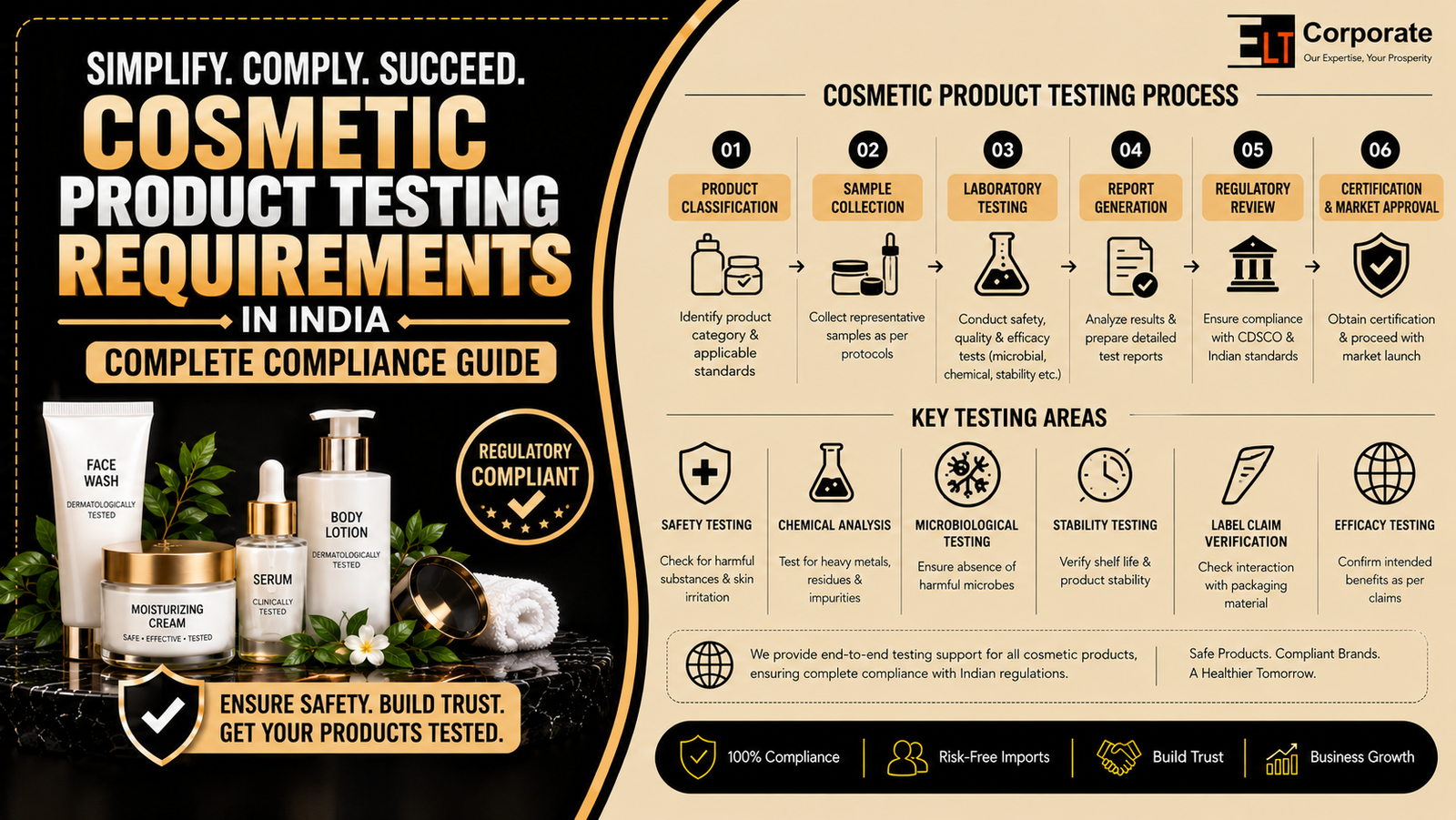
Is Cosmetic Testing Mandatory Before Registration?
Not every cosmetic must undergo mandatory testing before registration simply as a condition of filing.
CDSCO’s FAQ states that cosmetics do not have to be mandatorily tested before registration under the Cosmetics Rules, 2020. However, applicable quality, safety, and regulatory requirements still need to be satisfied.
The requirement for supporting evidence should therefore be evaluated based on the product and applicable regulatory requirements rather than assuming that every product follows the same testing pathway.
Benefits of Using the SUGAM Portal
The online system provides several practical advantages for applicants.
Online Submission
Applications and supporting documents can be submitted electronically.
Application Tracking
Applicants receive a reference number and can monitor regulatory communication through the portal.
Digital Document Submission
The checklist allows documents to be uploaded electronically.
Discrepancy Management
Applicants can receive and respond to regulatory discrepancies through the online system.
Centralized Application Records
Important application information and approval-related communication can be managed through the applicant dashboard.
Why Professional Support Can Help
SUGAM is an online platform, but successful cosmetic registration involves more than simply filling out an online form.
The applicant must first determine:
- Whether the product qualifies as a cosmetic
- Which registration pathway applies
- Which form should be used
- How the product should be categorized
- Which documents are required
- Whether foreign documents require authentication
- How variants should be declared
- Whether product labels meet Indian requirements
- Whether claims are appropriate
- Whether the manufacturer authorization is correctly prepared
Professional regulatory assistance can help businesses identify documentation gaps and reduce avoidable application discrepancies.
This can be especially useful for foreign manufacturers, Indian importers, and private-label businesses and brands launching multiple cosmetic products.
SUGAM Portal Cosmetic Registration Checklist
Before submitting an application, review the following:
| Requirement | Status |
| SUGAM account created | ✓ |
| Correct applicant role selected | ✓ |
| Correct application form selected | ✓ |
| Manufacturer details verified | ✓ |
| Manufacturing site details verified | ✓ |
| Product category checked | ✓ |
| Product variants reviewed | ✓ |
| Manufacturer authorization prepared | ✓ |
| Product documents prepared | ✓ |
| Labels reviewed | ✓ |
| Supporting documents authenticated where required | ✓ |
| Applicable fee verified | ✓ |
| Checklist reviewed | ✓ |
| Application information cross-checked | ✓ |
| Reference number retained after submission | ✓ |
Conclusion
The SUGAM Portal for CDSCO Cosmetic Registration offers an online method to fill out cosmetic registration forms and coordinate regulatory communications with CDSCO. To import cosmetics It is generally a matter of the submission of Form COS-1 for an Import Registration Certificate using Form COS-2, together with the product’s manufacturer, manufacturing facility, and any the necessary documents. CDSCO offers guidance in the form of official documents and checklists, FAQs, and the SUGAM guide for users to help applicants throughout the application procedure.
But a successful application depends not just on completing the online application but also on the preparation of accurate documents, choosing the right method of application, maintaining uniformity across documents, and reacting appropriately to any issues that arise when reviewing. Companies who plan for the import of cosmetics to India must therefore draft the required documents prior to applying for SUGAM.
Frequently Asked Questions
Q1. What is the SUGAM Portal for CDSCO cosmetic registration?
SUGAM is CDSCO’s online regulatory portal used for various services, including registration of cosmetics and related applications.
Q2. Which form is used for imported cosmetic registration?
For an Import Registration Certificate, the application is submitted in Form COS-1, with the resulting certificate issued in Form COS-2, subject to applicable requirements.
Q3. Who can apply for cosmetic registration through SUGAM?
Depending on the applicable circumstances, a foreign manufacturer, authorized Indian agent, importer in India, or authorized Indian subsidiary may submit the application.
Q4. What documents are required for SUGAM cosmetic registration?
Documents can include manufacturer authorization, product details, manufacturing-site information, labels, the Free Sale Certificate, and other supporting documents specified in the applicable CDSCO checklist.
Q5. Can I track my cosmetic registration application on SUGAM?
Yes. After submission, a reference number is generated, and regulatory communication, including discrepancies, can be managed through the SUGAM Portal.
Q6. What happens if CDSCO finds a discrepancy?
The discrepancy is communicated through the SUGAM Portal. The applicant must provide the required compliance or clarification before the application can proceed.
Q7. Is SUGAM registration enough to sell any cosmetic product in India?
No. Registration is one part of regulatory compliance. Businesses must also comply with applicable requirements relating to product quality, safety, labeling, packaging, claims, import and other applicable provisions.
Q8. Can another importer import an already registered cosmetic?
Under the applicable framework, another person or entity may apply through Form COS-4 for an Import Registration Number in Form COS-4A for a cosmetic already registered under the Cosmetics Rules, 2020, subject to the prescribed conditions.