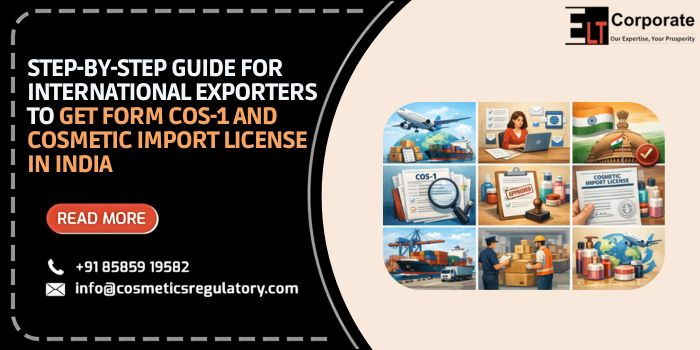


The cosmetic import license process for Korean and Chinese exporters is becoming increasingly important as Bengaluru’s organic cosmetics market grows rapidly. Korean and Chinese skincare brands are highly popular among Indian consumers, who prefer gentle, natural, and high-performance cosmetic products.
However, before selling in Bengaluru, exporters must complete the CDSCO import approval process under the Cosmetics Rules, 2020.
This guide explains the end-to-end COS-1 and COS-2 licensing procedure in simple words—covering steps, documents, rules, and timelines.
What Is a Cosmetic Import License in India?
A cosmetic import license is an approval issued by CDSCO that allows foreign brands to legally sell cosmetic products in India.
For most skincare and organic cosmetics, the Indian importer must apply using Form COS-1.
This process ensures that imported cosmetics meet India’s safety, purity, and labeling standards.
Why Bengaluru’s Organic Cosmetics Market Is Attractive?
Bengaluru has a fast-growing consumer base for organic and natural skincare. Korean and Chinese beauty brands fit strongly into this segment.
Exporters choose Bengaluru because:
- Consumers prefer chemical-free, gentle formulations
- High demand for K-beauty and C-beauty
- Strong influence of dermatologists and premium salons
- A large e-commerce-driven customer base
This makes the import license process essential for entering this profitable region.
Who Needs to Follow the Import License Process?
Any Korean or Chinese manufacturer exporting cosmetics to India must complete the process through an authorised Indian importer, because foreign companies cannot apply directly on the CDSCO portal.
This includes:
- Private label exporters
- OEM/ODM manufacturers
- K-beauty brands
- C-beauty organic skincare and haircare brands
- Indian importers representing Korean & Chinese manufacturers
Types of Cosmetics Covered Under the License
India’s cosmetic import rules apply to all categories, such as:
- Organic face creams
- Sunscreens
- Toners and serums
- Natural cleansers
- Herbal shampoos
- Hair oils
- Sheet masks
- Herbal body lotions
Any cosmetic intended for consumer use must follow the licensing process.
Step-by-Step Process
Step 1: Appoint an Indian Authorized Importer
Exporters must partner with an Indian importer who will file the license application.
Step 2: Register on the CDSCO Sugam Portal
The importer must create a login ID on the CDSCO portal and submit all applications digitally.
Step 3: Prepare Technical Documents
Korean and Chinese exporters must provide:
- Free Sale Certificate (FSC)
- Ingredient list with percentage
- Product specifications
- Test reports
- Manufacturing license
- Label artwork
- Pack size details
These form the core of the COS-1 submission.
Step 4: Submit Form COS-1
The importer uploads:
- COS-1 application
- Government fees
- Brand list
- Product variants
- Safety data
Step 5: CDSCO Review & Queries
CDSCO may ask for clarifications regarding ingredients, safety data, or label wording.
Quick responses help speed up the approval process.
Step 6: Grant of License – Form COS-2
After approval, CDSCO issues Form COS-2, which authorises the importer to bring Korean and Chinese cosmetic products into India.
Labeling Rules for Organic Cosmetics
Labels must include:
- Product name
- Ingredient list
- Manufacturer details
- Importer details
- Batch number
- Best before date
- Directions for use
- Net content
- Country of origin
Incorrect labels may lead to rejection.
Common Mistakes to Avoid
Delays mainly happen due to:
- Missing ingredient list
- No FSC
- Wrong label format
- Failure to declare colors or fragrances
- Using medicinal claims (e.g., “treats acne” or “cures dandruff”)
Avoiding these errors ensures smooth approval.
How Long Does It Take?
- Document preparation: 1–2 weeks
- CDSCO review: 4–8 weeks
Total time: 6–10 weeks
Why Bengaluru Importers Prefer Korean & Chinese Organic Cosmetics?
- Strong demand for clean beauty
- Preference for plant-based ingredients
- Korean gentle formulations
- Chinese herbal blends
This makes India’s cosmetic import licensing crucial for entering this high-value market.
How ELT Regulatory Consultancy Can Help
A regulatory consultant can:
- Prepare documents
- Review label compliance
- File Form COS-1
- Handle CDSCO queries
- Speed up approvals
Conclusion
The cosmetic import license process for Korean and Chinese exporters is essential for entering Bengaluru’s fast-growing organic cosmetics market. With proper documentation, compliant labeling, and a reliable Indian importer, brands can secure COS-2 approval and launch their products smoothly in India.
What license is required for importing cosmetics into India?
Form COS-2 issued after submitting Form COS-1.
How long does approval take?
Around 6–10 weeks depending on documentation.
Do Korean and Chinese organic products need separate licenses?
No separate license, but each product variant must be listed in COS-1.
Who files the application?
An authorised Indian importer.
Is animal-tested cosmetics import allowed?
No, India bans import of animal-tested cosmetics.