
Every year, hundreds of cosmetic brands — D2C startups, international beauty companies, private label importers — attempt to navigate India’s CDSCO cosmetic registration process on their own. And every year, a significant number of them discover the same painful truth: the process is not complicated in theory, but it is unforgiving in execution.
A missing comma in the Authorization Letter format. A Free Sale Certificate where the product list does not precisely match the COS-1 form. An ingredient name in a slightly different INCI format than what CDSCO expects. A label that looks compliant but has a therapeutic claim buried in the product description. Each of these seemingly minor issues triggers a formal CDSCO query — and each query adds 4–8 weeks to your timeline.
This guide gives you an honest, specific answer to whether a CDSCO cosmetic registration consultant is worth it for your situation — what a consultant actually does, where the process breaks down without expert support, and how to evaluate whether the investment makes sense for your brand.
What Is CDSCO Cosmetic Registration — and Why Is It Mandatory?
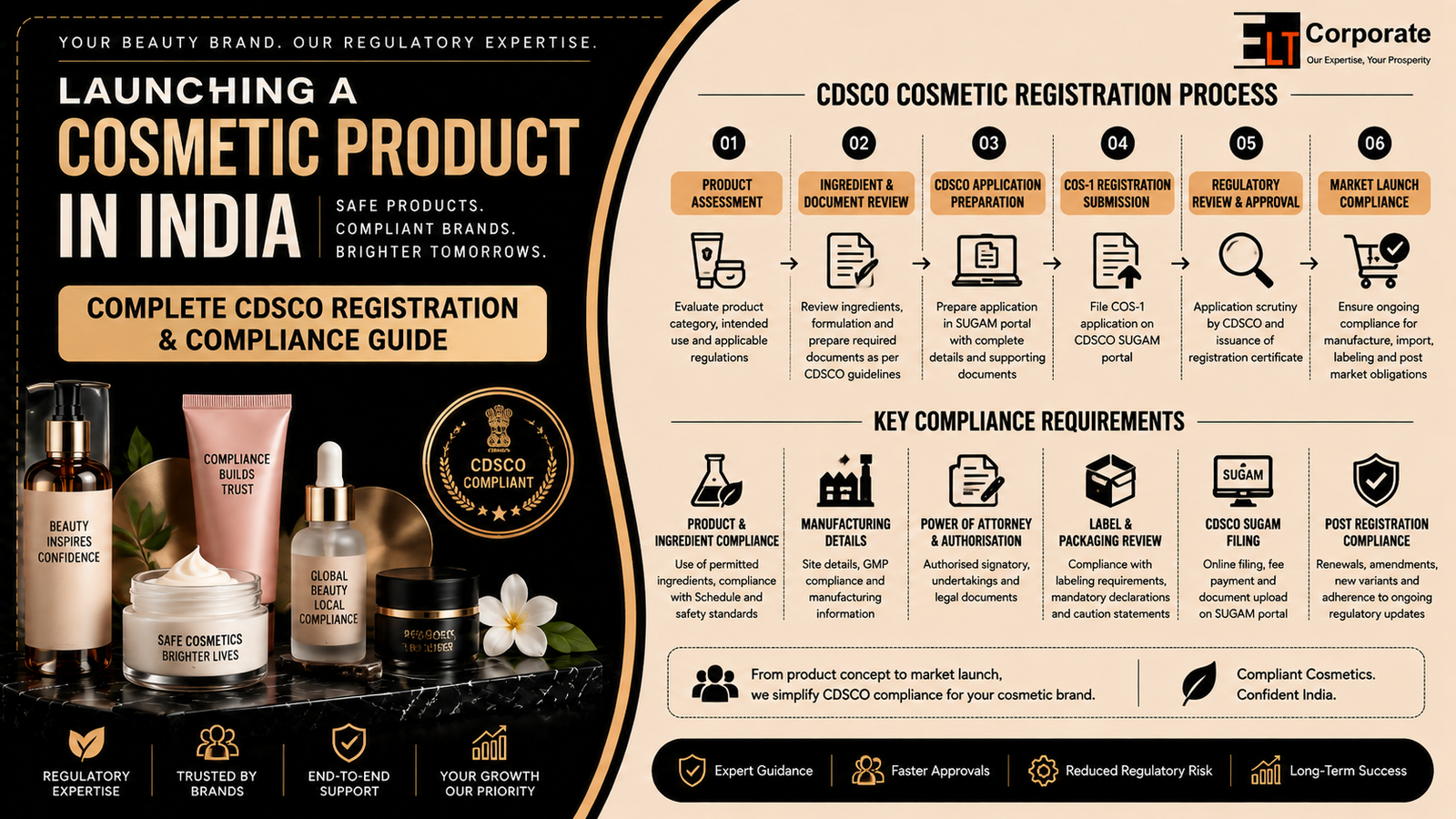
No cosmetic shall be imported into India unless the product is registered under the rules by the Central Licensing Authority. This is not a guideline or a best practice — it is a legal requirement under the Cosmetics Rules, 2020. The registration process works as follows:
- Form COS-1 — the application submitted on the SUGAM portal (cdscoonline.gov.in) by the Indian importer or authorized agent
- Form COS-2 — the Import Registration Certificate issued by CDSCO after review and approval
Indian customs authorities treat any cosmetic consignment imported without prior CDSCO approval as non-compliant and may detain, reject, or confiscate it. This means:
- No COS-2 = no legal import, regardless of how good your product is
- No COS-2 = no marketplace listing on Nykaa, Amazon, or Myntra
- No COS-2 = no brand launch, no revenue, no India market entry
The government fee is non-refundable. A rejected or abandoned application means financial loss on top of timeline loss.
The Reality: Why Most Rejections Are Avoidable
Most rejections happen due to basic mistakes, lack of understanding, and poor documentation. CDSCO application rejections are not random — they happen due to specific, avoidable mistakes. The problem is that most businesses do not understand regulatory expectations, leading to delays, financial losses, and missed market opportunities.
Here is what the data tells us about why COS-1 applications fail:
| Rejection / Query Reason | How Often It Occurs | Avoidable With Expert Support? |
| Incomplete or incorrect documentation | Most common reason | Yes — with proper dossier preparation |
| Authorization Letter formatting or authentication error | Very common — CDSCO carefully reviews PoA formatting | Yes — with correct format and authentication pathway |
| Free Sale Certificate product list mismatch | Common — product names/variants must match exactly | Yes — with pre-submission cross-check |
| Ingredient compliance issue (IS 4707) | Increasing with 2025 IS 4707 revisions | Yes — with IS 4707 compliance check |
| Label non-compliance | Common — wrong labels are a primary rejection reason | Yes — with label compliance review |
| Wrong or unpaid fees | Occasional | Yes — with fee calculation verification |
| Delayed response to CDSCO query | Very common — significantly extends timelines | Yes — with active query management |
The pattern is clear: almost every common failure point is avoidable with the right preparation and expertise. The question is whether you have that expertise in-house — or whether building it from scratch on your first application is worth the risk.
What a CDSCO Cosmetic Registration Consultant Actually Does
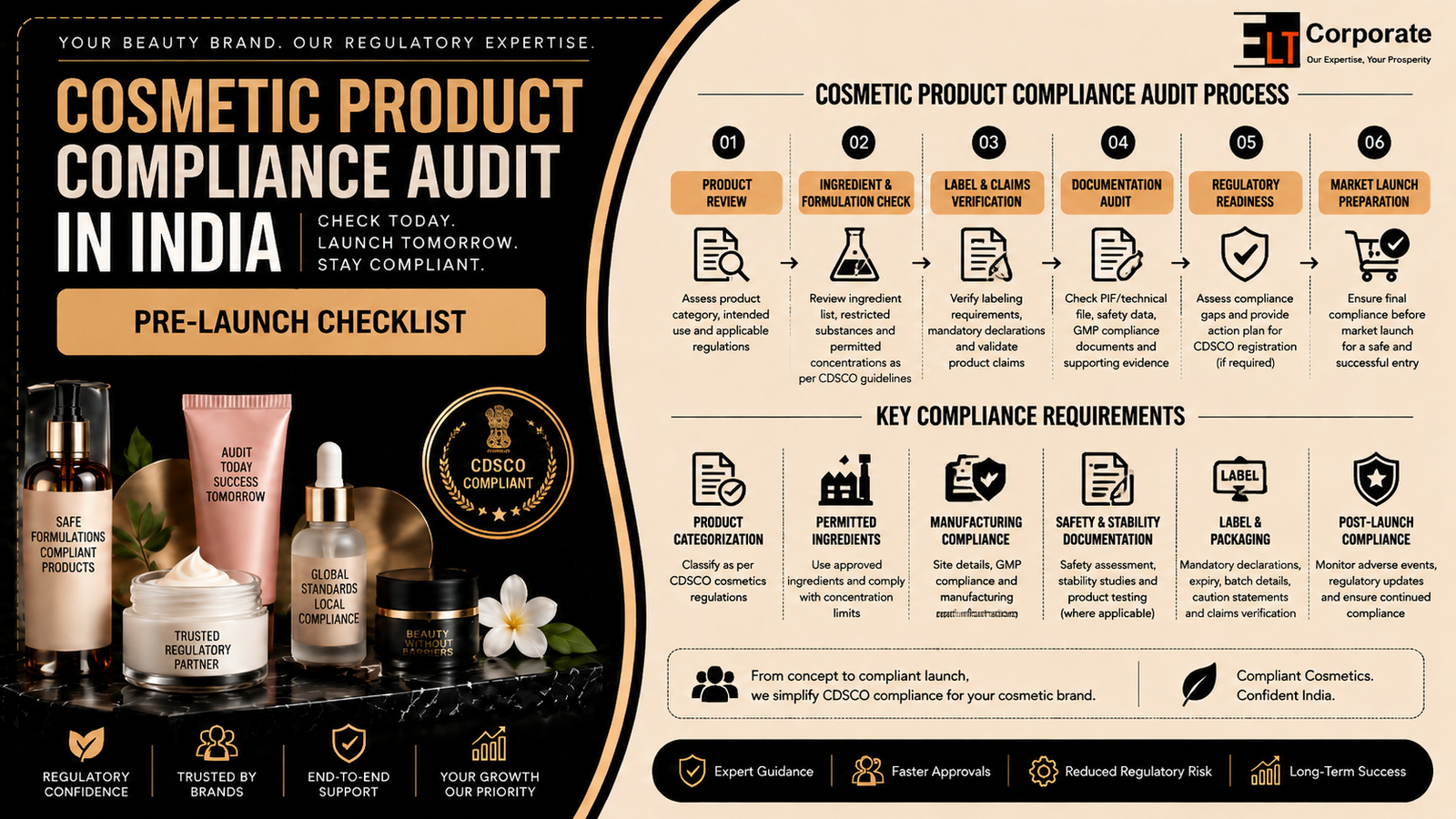
Most discussions of consultants are vague — “we help you navigate the process.” Here is what professional CDSCO cosmetic registration support specifically involves, and why each piece matters:
1. Product Classification Under CDSCO’s 80 Product Families
CDSCO has defined approximately 80 product families for cosmetic registration. Identifying the correct product family for each of your products determines the applicable fee per category, the scope of your application, and how CDSCO evaluates your dossier. Misclassification leads to wrong fee calculation, which can result in query or rejection. A consultant maps every product to its correct category before a single document is drafted.
2. Authorization Letter Preparation and Authentication Guidance
The Authorization Letter (Power of Attorney) from your overseas manufacturer is the most scrutinised document in the entire COS-1 dossier. CDSCO carefully reviews PoA formatting and execution — any error at this stage often leads to rejection. A consultant prepares the authorization in the correct mandatory format per the First Schedule of Cosmetics Rules, 2020, and advises on the precise authentication pathway for your country of origin — whether Indian Embassy attestation, Apostille, or Chamber of Commerce authentication.
3. Free Sale Certificate Review and Correlation
The Free Sale Certificate must be issued by the competent authority in the country of origin, properly authenticated, and — critically — must list every product and variant in your COS-1 application with exactly matching names. Product names and variants mentioned in the FSC must exactly match the COS-1 application — otherwise CDSCO may raise objections. A consultant cross-references the FSC product list against your COS-1 application before submission, catching mismatches that would otherwise trigger a query weeks after filing.
4. IS 4707 Ingredient Compliance Check
Every ingredient in every product must be checked against BIS IS 4707 (Part 2): 2025 — the updated list of prohibited, restricted, and GNRAS (Generally Not Recognised As Safe) ingredients — and IS 4707 (Part 3): 2025 — the new permitted preservatives standard, both published in August–September 2025. Non-compliance with ingredient requirements may lead to withdrawal of product from the registration process. A consultant runs a systematic compliance check against these updated 2025 standards before any other document preparation — not as an afterthought.
5. Label Compliance Review
Your Indian market label must comply with both Cosmetics Rules, 2020 and Legal Metrology (Packaged Commodities) Rules, 2011. Wrong labels — not following rules set by BIS and Cosmetics Rules — are a primary rejection reason. A consultant reviews every mandatory element, checks for therapeutic or drug-like claims that would flag your product, and ensures your label accurately reflects what is in your COS-1 application. Accurate labels are essential — and every detail must match the FSC and application.
6. Complete Dossier Cross-Check
Before submission, a consultant conducts a final cross-check of the entire dossier: manufacturer name spelling consistent across all documents, product names matching across FSC, COS-1 form, and label, all PDFs within SUGAM’s file size limits, fee payment correctly calculated and confirmed, and all mandatory declarations and undertakings included and signed. Missing paperwork is the #1 reason Form COS-1 gets rejected — a systematic cross-check eliminates this risk.
7. SUGAM Portal Filing
The SUGAM portal has specific technical requirements — file formats, field completion rules, and upload sequencing. Navigating COS-1 and COS-2 requirements requires technical accuracy and regulatory experience. A consultant manages the submission process, ensuring every field is correctly completed and every document is uploaded in the correct format — eliminating the technical errors that cause unnecessary delays at acceptance stage.
8. CDSCO Query Response Management
If CDSCO raises queries post-submission, the importer must respond within the specified timeframe. Delayed or incomplete responses often slow down approval. A consultant prepares complete, evidence-backed query responses that address every point CDSCO raises — because partial responses are the primary driver of repeat query cycles, each adding 4–8 weeks to your timeline.
The Timeline and Financial Case for Using a Consultant
What Happens Without Expert Support
| Stage | Self-Application (First Timer) | With Professional Support |
| Understanding the process and requirements | 2–4 weeks of research | Day 1 — consultant knows the framework |
| Authorization Letter preparation | Multiple iterations — format often wrong first time | Correct format, first time |
| FSC authentication | Wrong pathway chosen — weeks lost | Correct pathway identified immediately |
| IS 4707 ingredient check | Often skipped — discovered during CDSCO query | Done before any document is prepared |
| CDSCO queries (average) | 2–3 rounds (+3–6 months) | 0–1 rounds (complete first submission) |
| Total timeline to COS-2 | 9–18 months | 3–6 months |
The Financial Reality
The government fee for COS-1 is USD 250 per product category — non-refundable. A rejected application means this fee is forfeited. Additionally:
- Every month of delay is a month of lost India revenue
- Nykaa, Amazon, and Myntra listing requires COS-2 — no registration means no marketplace revenue
- Inventory held pending registration incurs warehousing costs
- If goods are imported before COS-2 is issued, they may be detained or confiscated at customs — a potentially catastrophic financial loss
Against these costs, professional cosmetic regulatory consulting typically costs ₹30,000–₹1,50,000 depending on portfolio size and complexity. For most brands with even a modest India revenue target, the consulting fee pays for itself in a single month of recovered revenue that a faster approval enables.
Who Needs a Consultant Most — and Who Might Manage Without
You Almost Certainly Need a Consultant If:
- This is your first CDSCO application — the learning curve on the first application is steep and the cost of errors is high
- You are an international brand (based outside India) — document authentication pathways are country-specific and complex without local expertise
- Your products include functional or bioactive ingredients — IS 4707 compliance becomes more complex and consequential
- You are importing multiple product categories — fee calculation, product family classification, and FSC correlation multiply in complexity
- You have a fixed launch deadline — marketplace listing, retail partner timelines, or seasonal launches leave no room for query cycle delays
- Your products make organic, natural, or efficacy claims — label review is critical to avoid triggering drug-like claim issues
- Your government fee budget is meaningful — with non-refundable fees, professional support is an insurance policy against forfeiture
You May Manage Without If:
- You have previously completed a COS-1 application successfully and understand the process well
- You have dedicated in-house regulatory affairs expertise with CDSCO cosmetics experience
- Your products are simple general cosmetics with straightforward formulations and no novel claims
- You have abundant time (12+ months) and can absorb query cycles without commercial consequence
What to Look for in a CDSCO Cosmetic Registration Consultant
Not all consultants are equal. When evaluating support, ask specifically:
- Have they done COS-1 applications before? Ask for specific examples — product categories, countries of origin, and timelines
- Do they do the work or just advise? You need someone who prepares documents, checks your label, runs the IS 4707 compliance check, and files on the portal — not someone who tells you what to do
- Do they handle query responses? This is where timelines live or die — confirm they manage CDSCO queries through to COS-2 issuance, not just up to submission
- Are they current on 2025 regulatory updates? IS 4707 (Part 2 & 3): are new standards — your consultant must be checking against these, not older versions
- What is their fee structure? Fixed fee per application is preferable to hourly — aligns incentives toward getting your COS-2 issued efficiently
- Can they act as your Authorized Agent? For international brands without an Indian entity, a consultant who can serve as your Authorized Agent (holding the COS-2 on your behalf) provides a complete market entry solution
Updates That Make Expert Support More Important Than Ever
The CDSCO cosmetic registration landscape has become meaningfully more complex:
- IS 4707 (Part 2): 2025 — Significant revision to prohibited, restricted, and GNRAS ingredients published August 2025. Any consultant using older IS 4707 standards for compliance checks is working with outdated information.
- IS 4707 (Part 3): 2025 — New permitted preservative standard published September 2025. This is an entirely new standard — many consultants are not yet incorporating it into ingredient compliance checks.
- Mandatory BIS Certification (proposed) — The Government of India is considering mandatory BIS QCO certification for certain cosmetic categories. Consultants tracking this development can advise clients on preparedness before it becomes mandatory.
- CDSCO Application Backlog Policy — CDSCO has announced that applications with pending queries will receive reminders at fixed intervals, with the fourth notice resulting in rejection and fee forfeiture. Query response management has become more time-critical than ever.
The Bottom Line
The CDSCO cosmetic registration process is free to access, publicly documented, and legally structured. It is not impossible to navigate independently. But the cost of getting it wrong — in government fees forfeited, in months of delayed launch, in inventory held without sales, in Nykaa listings missed — is significantly higher than the cost of getting it right the first time.
Professional CDSCO cosmetic registration support is not a luxury for large brands. It is a practical investment that reduces timeline risk, eliminates the most common failure points, and gets your products to Indian consumers faster — which is the only metric that ultimately matters.
Start with the right support. Get your COS-2 issued once, correctly, on the first application. And focus your energy on building your brand in India’s $25 billion beauty market — not on re-filing regulatory paperwork.
How We Help — CDSCO Cosmetic Registration Services
We provide end-to-end CDSCO cosmetic registration support for D2C brands, international beauty companies, private label importers, and distributors:
- Product classification under CDSCO’s 80 product families
- Authorization Letter preparation in correct format + authentication pathway guidance (country-specific)
- Free Sale Certificate review and correlation check against COS-1 application
- IS 4707 (Part 2 & 3): 2025 ingredient compliance check
- Indian market label compliance review — Cosmetics Rules, 2020 + Legal Metrology
- Complete COS-1 dossier preparation and SUGAM portal filing
- CDSCO query response management until COS-2 issued
- Authorized Indian Agent services for international brands