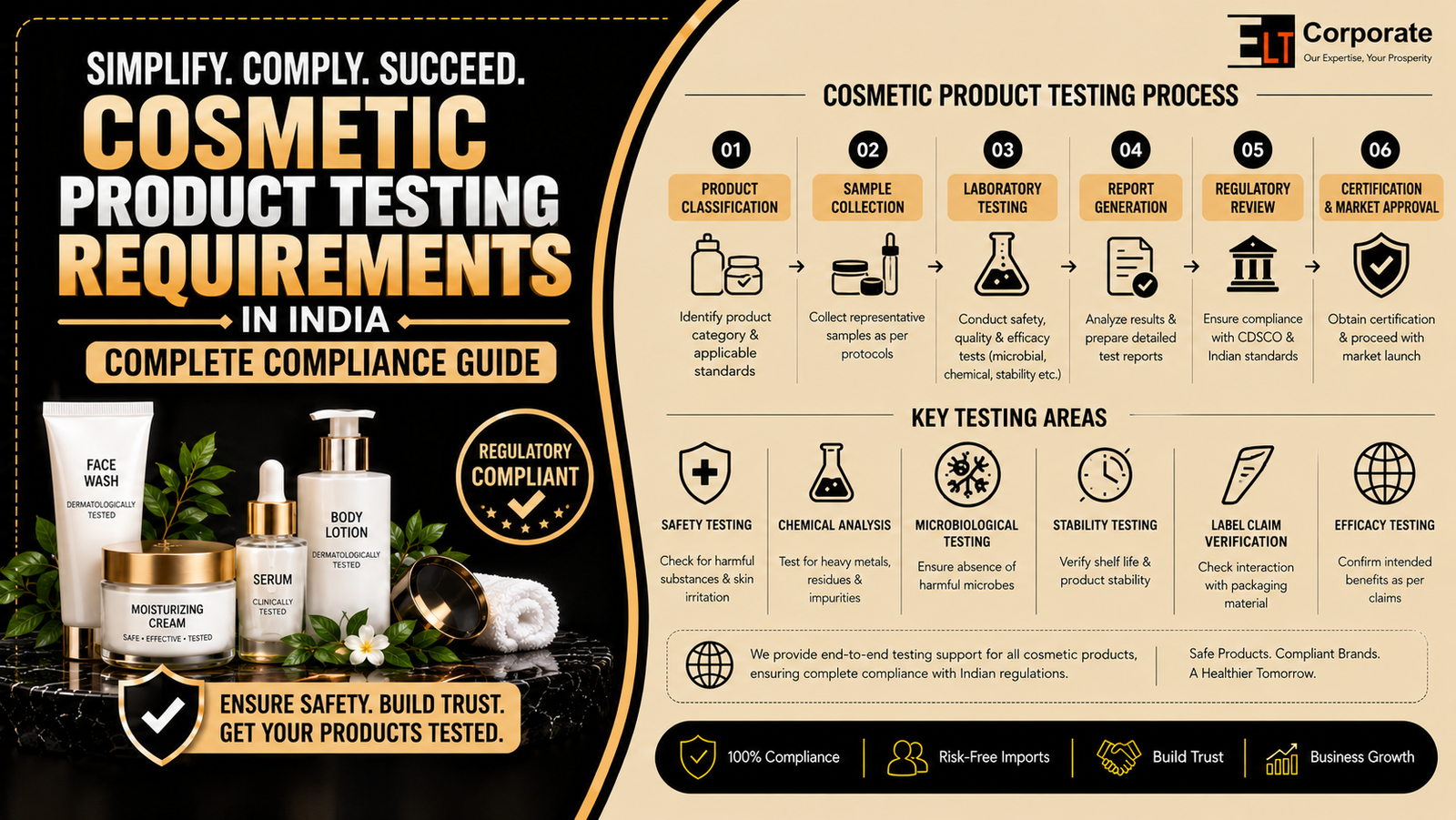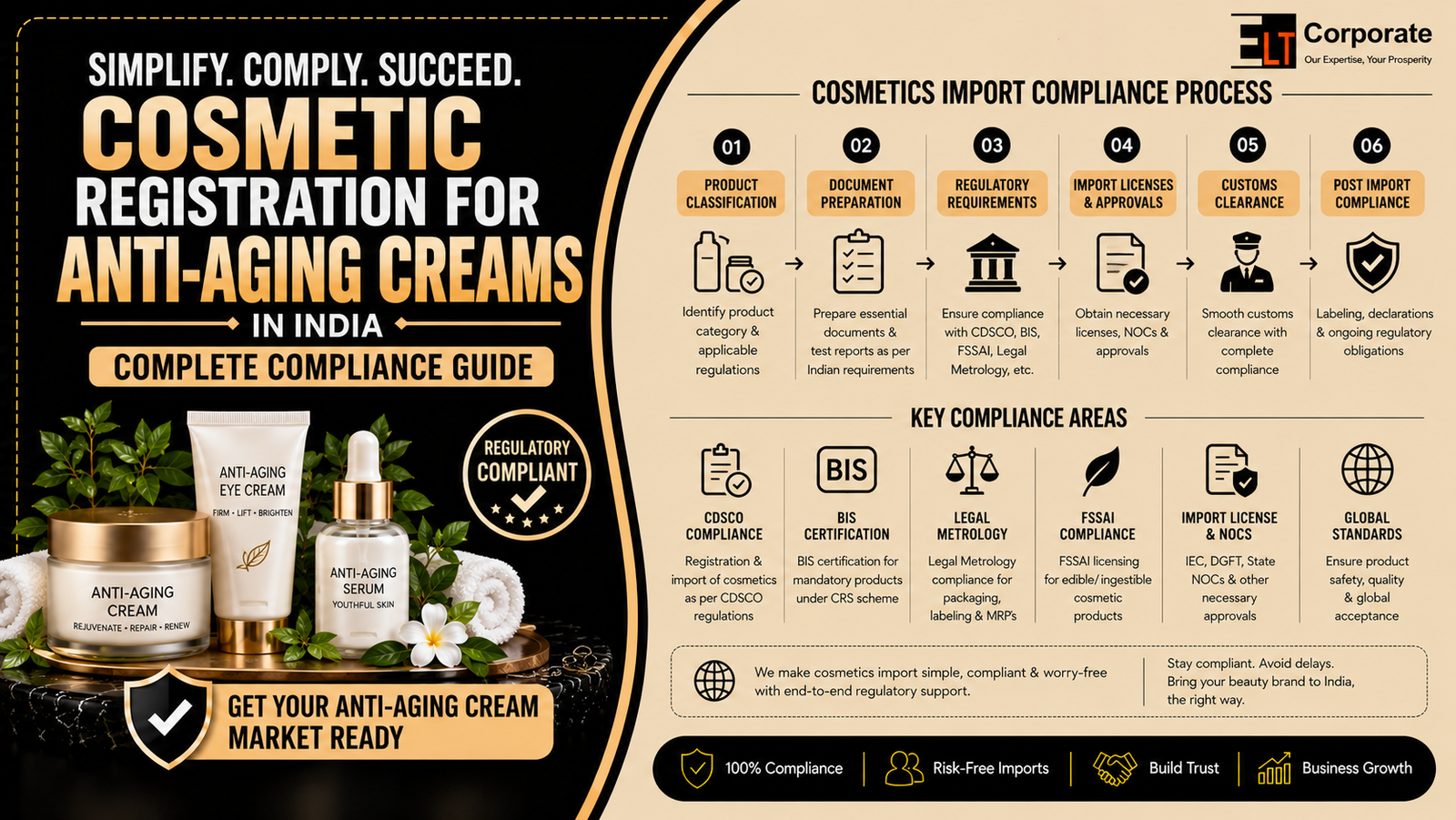
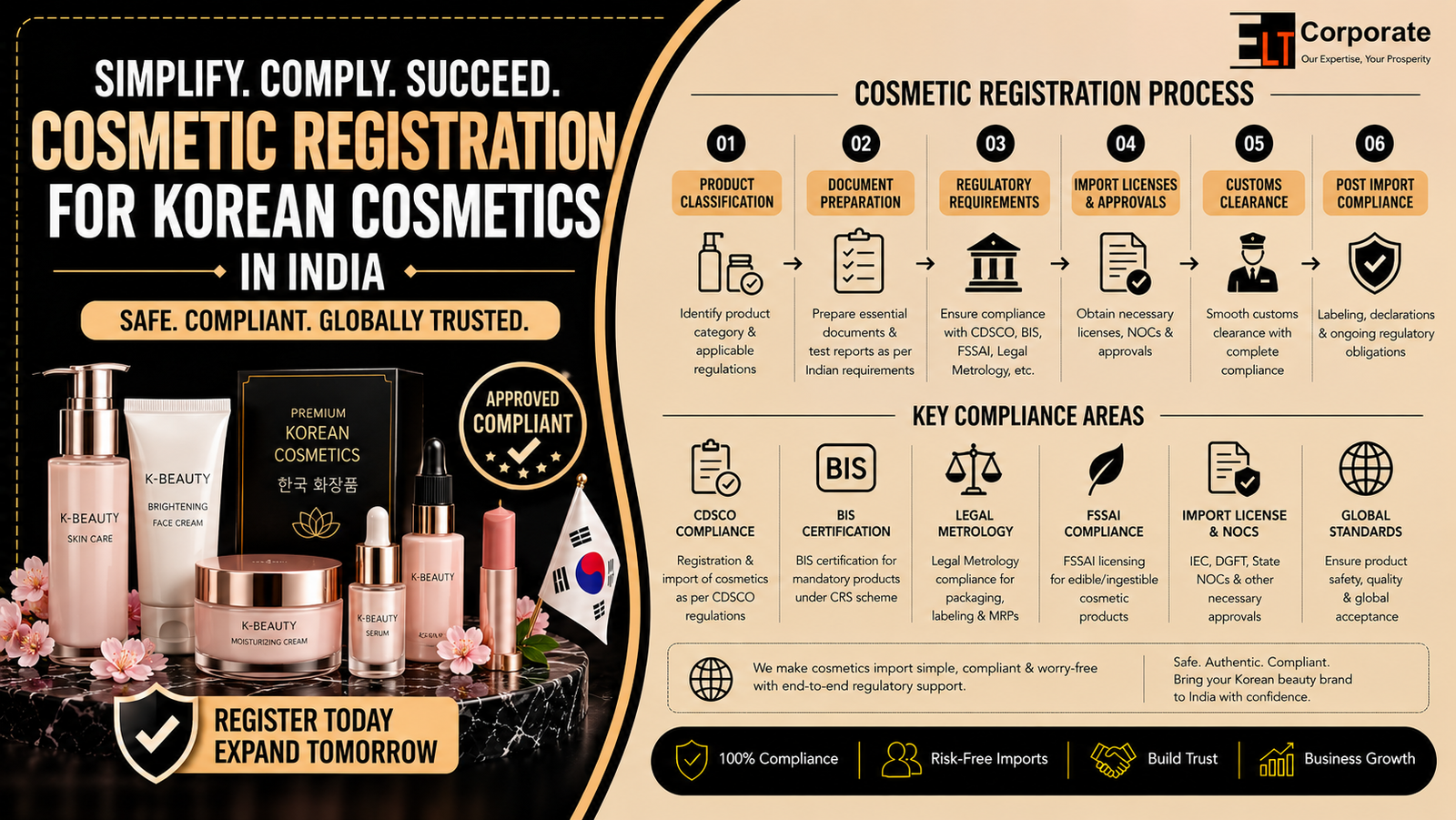

Korean cosmetics are gaining popularity in India, especially skincare products such as essences, serums, sheet masks, toners, and sunscreens; moisturizing products; and cleanser masks for the face, as well as other products from K-beauty. The rising consumer demand for Korean cosmetics has opened new opportunities for Korean cosmetics manufacturers as well as private label manufacturers, distributors, importers, and distributors and Indian companies who want to bring Korean products and cosmetics as well as other items to Indian customers. Indian market.
However, the selling of Korean cosmetics to India is more complicated than simply shipping items to South Korea. Imported cosmetics have to meet the regulations of India before they are brought into India. In the Cosmetics Rules of 2020, cosmetics destined to be imported into India need to have a registration with the Central Licensing Authority.
An application for the import registration certificate is filed on Form COS-1, and it is then issued on Form COS-2, following regulatory review. This guide provides information on the registration procedure for Korean cosmetics imported into India and the documents required. Labeling requirements and fees, as well as the typical compliance issues that are encountered by Korean cosmetics brands as well as Indian importers.
What Is Korean Cosmetic Registration in India?
Korean cosmetic registration refers to the regulatory process required for importing Korean-manufactured cosmetic products into India.
There is no separate registration category simply because a product is manufactured in Korea. Instead, Korean cosmetics are treated as imported cosmetics and must comply with the applicable provisions of the Drugs and Cosmetics Act, 1940, and Cosmetics Rules, 2020.
CDSCO states that imported cosmetics must be registered along with relevant pack sizes, variants, and manufacturing premises before import into India.
This means that a Korean brand planning to sell products in India should evaluate its:
- Product category
- Korean manufacturer
- Manufacturing site
- Product variants
- Pack sizes
- Ingredients
- Product labels
- Free Sale Certificate
- Manufacturing authorization
- Indian authorized agent or importer
before beginning the registration application.
Who Needs Cosmetic Registration for Korean Products?
Korean cosmetic registration may be relevant to businesses such as
- Korean cosmetic manufacturers exporting to India
- Korean skincare brands
- K-beauty brands entering the Indian market
- Indian importers
- Indian distributors
- Private-label cosmetic businesses
- E-commerce sellers importing Korean cosmetics
- Indian subsidiaries authorized by Korean manufacturers
- Businesses introducing Korean beauty products through retail stores
Under Rule 12 of the Cosmetics Rules, the application can be submitted by the manufacturer, its authorized agent in India, an importer in India, or an authorized Indian subsidiary, as applicable.
Is CDSCO Registration Mandatory for Korean Cosmetics?
Yes, imported Korean cosmetics generally require registration before they are imported into India.
CDSCO specifically states that no cosmetic falling within the applicable definition can be imported into India unless it has been registered under the applicable rules. Registration covers the product as well as relevant pack sizes, variants, and manufacturing premises.
Therefore, the fact that a product is
- Manufactured in South Korea
- Already legally sold in Korea
- Popular internationally
- Available on Korean e-commerce websites
- Approved or compliant under Korean regulations
Does not by itself replace the Indian cosmetic import registration requirement. Indian regulatory compliance needs to be assessed separately.
Cosmetic Registration Process for Korean Cosmetics in India
The registration process involves preparing product and manufacturer information and submitting the application through the applicable CDSCO online system.
Step 1: Identify the Korean Manufacturer
The first step is to establish the exact legal identity of the Korean manufacturer.
The following information should be checked:
- Legal manufacturer name
- Complete manufacturing address
- Manufacturing premises
- Country of origin
- Product manufacturing location
- Manufacturer’s regulatory status
The information should remain consistent across the application and supporting documents.
Step 2: Appoint an Indian Authorized Agent
A Korean manufacturer may need an authorized Indian agent to handle the registration process.
The manufacturer authorization should clearly identify the manufacturer, manufacturing premises, Indian authorized agent, products, and applicable variants.
CDSCO’s guidance states that manufacturer authorization must be appropriately authenticated. Depending on the circumstances, authentication may be completed in India, in the country of origin, through the Indian Embassy, or by apostillation where applicable.
Step 3: Prepare the Product List
The Korean brand should prepare a complete list of products intended for import.
For example:
- Korean facial cleanser
- Korean toner
- Korean serum
- Korean moisturizer
- Korean sunscreen
- Korean sheet mask
- Korean sleeping mask
- Korean eye cream
- Korean essence
- Korean haircare products
Each product should be reviewed individually for its applicable cosmetic category and regulatory requirements.
Step 4: Check Product Variants and Pack Sizes
Pack sizes and variants are important during registration.
For example, a brand may want to import:
- 30 ml serum
- 50 ml serum
- 100 ml serum
or multiple fragrance, shade, formulation, or product variants.
These should be assessed and correctly represented in the registration application.
CDSCO specifically notes that cosmetics are required to be registered along with pack size and variants, in addition to manufacturing premises.
Step 5: Prepare Product Documents
The Korean manufacturer and Indian applicant should collect the relevant product documentation.
Common documents may include:
- Product details
- Ingredient list
- Percentage composition
- Proposed labels
- Product specifications
- Testing methods
- Pack insert, where applicable
- Free Sale Certificate
- Manufacturing license or applicable undertaking
- Manufacturer authorization
- Required declarations
The exact documentation can depend on the product and application.
Step 6: Review the Ingredients
Ingredient compliance is particularly important for imported Korean cosmetics.
Korean formulations may contain ingredients or combinations that are commonly used in the Korean market but need to be reviewed against Indian requirements.
The applicant should therefore check:
- Ingredient names
- Percentage composition
- Restricted ingredients
- Prohibited ingredients
- Colouring agents
- Preservatives
- Product-specific requirements
- Applicable quality and safety standards
CDSCO states that imported cosmetics must comply with applicable specifications and standards under the Cosmetics Rules. Where a cosmetic is not covered by the Ninth Schedule, the rules also refer to applicable standards and specifications in the country of origin.
Documents Required for Korean Cosmetic Registration
A Korean cosmetic registration application may require several supporting documents.
1. Manufacturer Authorization
The Korean manufacturer should provide an appropriate authorization in favor of the Indian authorized agent or relevant applicant.
2. Free Sale Certificate
A free sale certificate is an important document for imported cosmetic registration.
It should accurately identify the relevant product and manufacturer information.
3. Ingredient List
The ingredient list should include the product’s ingredients and applicable percentage composition.
4. Product Labels
Proposed labels should be submitted and reviewed for Indian regulatory compliance.
5. Product Specifications
The applicant should provide applicable product specifications and testing methods.
6. Manufacturing License or Undertaking
Relevant manufacturing regulatory documentation from Korea may need to be provided, depending on the circumstances.
7. Non-Animal Testing Declaration
The required declaration concerning animal testing should be prepared as applicable.
8. Heavy Metal and Hexachlorophene Declaration
The applicable declaration concerning heavy metals and hexachlorophene should also be prepared.
9. Pack Insert
Where applicable, the pack insert should be submitted along with the application.
10. Fee Payment Receipt
The prescribed registration fee must be paid through the applicable payment mechanism and the required receipt submitted with the application.
Korean Cosmetic Label Requirements in India
Labelling is one of the areas Korean brands should review carefully before launching products in India.
A Korean product may have packaging designed primarily for the Korean market. Korean-language packaging alone may not be sufficient to satisfy all applicable Indian labeling requirements.
Depending on the product, businesses should review information such as
- Product name
- Manufacturer information
- Imported product information
- Net contents
- Batch or lot information
- Manufacturing information
- Use-before/expiry information
- Ingredient declaration
- Directions for use
- Warnings and precautions
- Other mandatory declarations
The final label should be reviewed against the applicable Indian requirements before commercial import.
Korean Skincare Products Commonly Imported into India
The K-beauty category covers a wide range of products.
Some commonly marketed categories include
Korean Serums
Serums containing ingredients such as hyaluronic acid, niacinamide, vitamin C, peptides, or other cosmetic ingredients are popular among Indian consumers.
Korean Toners and Essences
Hydrating toners and essences are frequently marketed as part of Korean multi-step skincare routines.
Korean Sheet Masks
Sheet masks are another popular K-beauty category and may be imported in multiple variants and formulations.
Korean Sunscreens
Korean sunscreens are highly popular in the skincare market. Their formulation, claims, ingredients, and labelling should be reviewed before import.
Korean Cleansers
Foaming cleansers, gel cleansers, oil cleansers, and other facial cleansing products may require registration as applicable imported cosmetics.
Korean Moisturizers
Creams, gels, lotions, emulsions, and sleeping masks should be assessed according to their formulation and intended cosmetic use.
What About Korean Cosmetic Claims?
Product claims should also receive attention before registration and marketing.
A cosmetic claim should not create a misleading impression about the product.
For example, businesses should carefully review claims involving:
- Skin whitening
- Treatment of acne
- Removal of pigmentation
- Treatment of scars
- Cure of skin conditions
- Medical or therapeutic effects
- Permanent changes to the skin
CDSCO states that a cosmetic must not make claims that are false or misleading to the intended user.
Therefore, Korean marketing material should not simply be translated into English and used in India without a regulatory review.
Korean Cosmetic Registration Fees in India
The applicable registration fee is prescribed under the Third Schedule of the Cosmetics Rules, 2020.
CDSCO’s FAQ states that the fee structure includes:
- USD 1,000 or equivalent for registration/retention for each category of cosmetics
- USD 500 for each manufacturing site
- USD 50 for each variant
- USD 1,000 for an additional cosmetic category
The applicable fee should be calculated based on the specific application and current regulatory requirements.
For a Korean brand with multiple product categories, variants, and manufacturing sites, the total regulatory fee can therefore vary considerably.
What Happens If a Korean Cosmetic Is Imported Without Registration?
Importing cosmetics without the required registration can create serious regulatory and commercial problems.
Potential consequences can include:
- Customs-related difficulties
- Regulatory queries
- Delays in product launch
- Difficulty distributing products legally
- Regulatory action
- Product-related compliance issues
- Financial losses from held inventory
The Cosmetics Rules state that cosmetics cannot be imported into India unless registered under the applicable rules.
It is therefore better to complete the applicable registration and compliance assessment before arranging commercial imports.
Important Compliance Points for Korean Brands
Before launching a Korean cosmetic product in India, brands should verify:
Manufacturer
- Is the Korean manufacturer correctly identified?
- Is the manufacturing site documented?
Product
- Is the product correctly classified?
- Are all variants and pack sizes identified?
Ingredients
- Does the formulation comply with applicable Indian requirements?
- Is the percentage composition available?
Documents
- Is the Free Sale Certificate available?
- Is the manufacturer authorization correctly prepared?
- Are supporting declarations available?
Label
- Has the Indian label been reviewed?
- Are mandatory declarations included?
Claims
- Are the marketing claims appropriate for a cosmetic?
- Are any claims potentially misleading or therapeutic?
Application
- Does the information in Form COS-1 match all supporting documents?
Common Mistakes Korean Cosmetic Brands Should Avoid
Using Only Korean Regulatory Approval
A Korean product being legally marketed in South Korea does not automatically mean it can be imported into India without Indian registration.
Submitting Korean Labels Without Review
Labels designed for the Korean market should be checked against applicable Indian requirements.
Ignoring Product Variants
Different variants or pack sizes should be properly assessed rather than assuming that one registration automatically covers every version.
Mismatch in Documents
The manufacturer name, address, product name, variant, and other details should remain consistent throughout the application.
Making Therapeutic Claims
Claims copied directly from Korean marketing material may create compliance concerns in India.
Waiting Until Shipment
Registration and document preparation should ideally be completed before commercial import arrangements are finalized.
How Cosmetics Regulation Can Help Korean Cosmetic Brands
Entering the Indian beauty market can be commercially attractive, but regulatory preparation should be completed before products reach the market.
Cosmetics Regulatory can assist Korean cosmetic manufacturers, Indian importers, distributors, and K-beauty businesses with the regulatory process for imported cosmetics.
Professional support may include:
- Korean cosmetic registration assessment
- CDSCO registration assistance
- Manufacturer document review
- Product document preparation
- Ingredient compliance review
- Label compliance review
- Product variant assessment
- Application preparation
- Regulatory query assistance
- Import compliance guidance
This can help businesses identify documentation and compliance gaps before submitting their application.
Conclusion
The growing popularity of K-beauty cosmetics in India has opened up huge opportunities for Korean cosmetics manufacturers as well as Indian companies. However, importation of Korean cosmetics requires a thorough legal plan.
The cosmetic registration to Korea Cosmetics in India process requires identifying the brand and product, selecting the proper Indian applicant or authorized agent, preparing the supporting documents, and examining the ingredients as well as labels. Then, you pay appropriate fees and then file the application to register via the CDSCO system.
In the Cosmetics Rules, 2020, cosmetics imported from the United States must be registered prior to importation, and the specific product, its variants, pack dimensions, and manufacturing facilities must be adequately secured.
For Korean companies that are planning to expand into India, making sure they complete the review of compliance prior to importation can help minimize any regulatory risks that could arise and aid in the smoother process of entering markets.
Frequently Asked Questions
Q1. Do Korean cosmetics need CDSCO registration in India?
Yes. Korean cosmetics intended for commercial import into India generally need to comply with the applicable cosmetic import-registration requirements under the Cosmetics Rules, 2020.
Q2. What form is used for Korean cosmetic registration?
The application for an Import Registration Certificate is submitted in Form COS-1, while the Import Registration Certificate is issued in Form COS-2.
Q3. Can a Korean manufacturer apply for registration?
Yes. The Cosmetics Rules allow the manufacturer, its authorized agent in India, an importer in India, or an authorized Indian subsidiary to submit the application, subject to the applicable requirements.
Q4. Is an Indian authorized agent required?
A Korean manufacturer may use an authorized agent in India for the registration process. The manufacturer authorization must meet the applicable authentication and documentation requirements.
Q5. Are Korean skincare products treated differently from other imported cosmetics?
Korean origin does not itself create a separate cosmetic registration pathway. Korean products are generally assessed under the applicable Indian rules for imported cosmetics.
Q6. Can Korean cosmetics be imported without CDSCO registration?
Imported cosmetics generally cannot be imported into India without the required registration under the applicable Cosmetics Rules.
Q7. Are Korean cosmetic labels valid in India?
A Korean-market label should be reviewed against applicable Indian labeling requirements before the product is commercially imported and sold in India.
Q8. How much does Korean cosmetic registration cost in India?
The fee depends on factors including cosmetic category, manufacturing site, and variants. CDSCO’s FAQ lists fees under the Third Schedule, including USD 1,000 per category, USD 500 per manufacturing site, and USD 50 per variant.
Q9. Can a Korean private-label brand register its products in India?
Yes, subject to meeting the applicable requirements. The manufacturer, product, manufacturing site, documentation, labelling, and authorised Indian applicant should be appropriately covered.
Q10. Where can I check the official Indian requirements?
The CDSCO Cosmetics Division publishes the Cosmetics Rules, guidance documents, FAQs, checklists, and other regulatory information for cosmetic imports.