
The Indian cosmetics industry is expanding quickly as international brands, private label distributors, companies, and importers are offering haircare, skincare cosmetics, makeup, personal care, and other beauty products to the country. But the process of bringing cosmetics to the Indian market requires more than simply arranging for import and distribution.
For cosmetics imported from India, compliance with the Cosmetics Rules 2020 is a vital regulation condition. The Central Drugs Standard Control Organization (CDSCO) regulates the importation of cosmetics from India, and also cosmetics together with their manufacturing locations, packaging sizes, and variants generally require registration prior to their import.
A major and crucial element of registering is preparing the right documents. Incorrect, inconsistent, or unauthenticated documents or those that are not authentic could hinder the registration process or cause cosmetics regulatory questions.
This guide will explain the necessary documents to register cosmetics in India, specifically to obtain an Import Registration Certificate by CDSCO.
What Is Cosmetic Registration in India?
Cosmetic registration is the regulated procedure through which cosmetics that are intended to be imported to India have been registered by India’s Central Licensing Authority.
According to the rules of Rule 12 of the Cosmetics Rules, 2020, it is illegal to import a cosmetic into India without being registered as per the requirements applicable to it. The registration application is made online using Formula COS-1, while the certificate of registration is given in the form COS-2 after a review by the regulatory authorities.
The application can be made through:
- The manufacturer from abroad
- Authorized agent for India
- Importer from India
- An authorized Indian affiliate of the company
The registration documents are based on various aspects, such as the company’s name, product type, manufacturing location, and variations of the product, as well as the status of the regulation in the country.
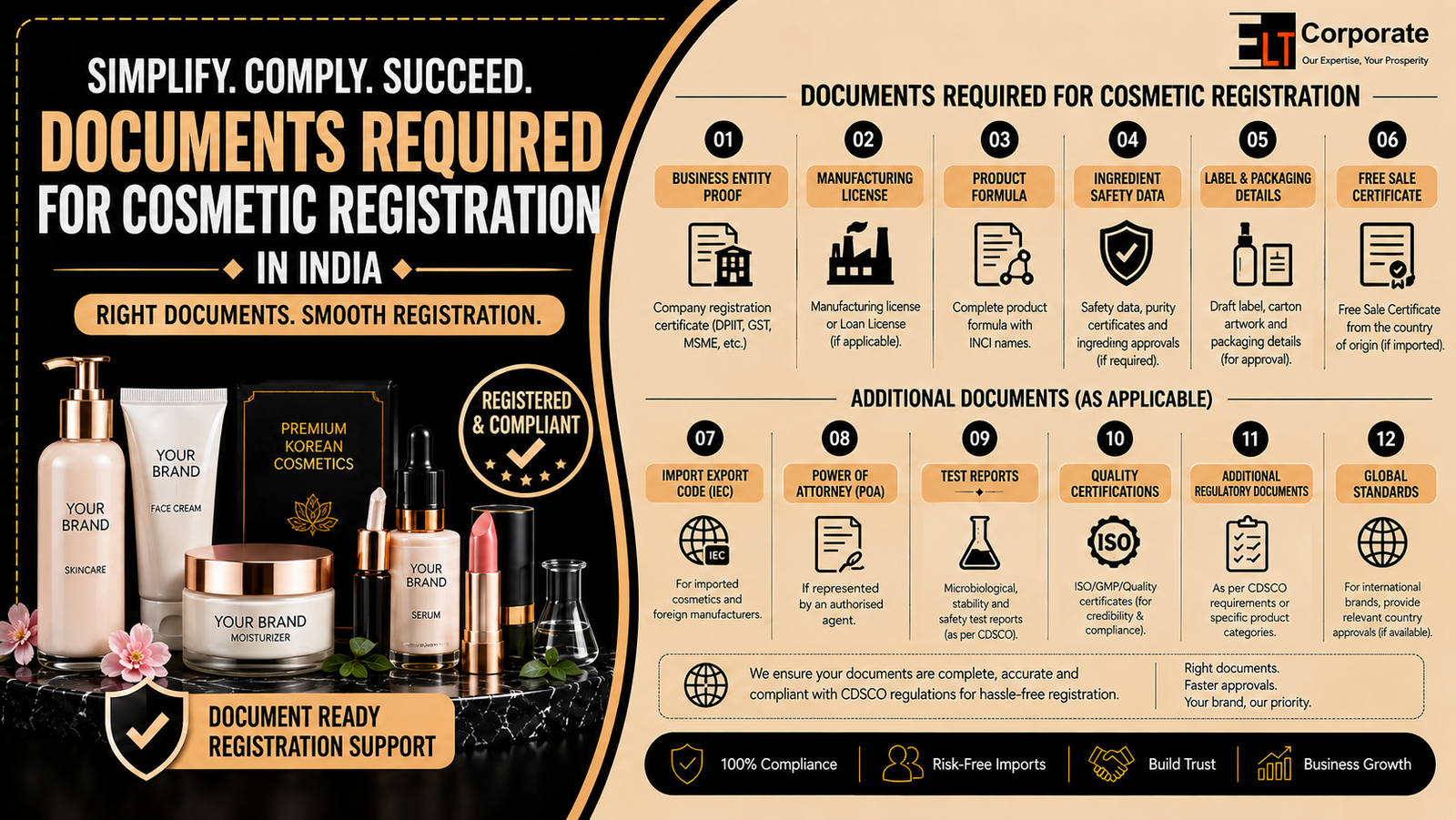
Documents Required for Cosmetic Registration in India
According to the CDSCO’s documentation checklist, candidates must create a variety of key documents and declarations in order to get an import registration certificate.
1. Covering Letter
A cover letter should be included with the application and clearly explain the reason for the application.
It could contain details like
- Name of the person who is applying
- Manufacturer’s name
- Production site
- Product category
- A large number of products
- The purpose of the application
- Information on the relevant application or registration in the event that they are relevant
If the request is for an endorsement, packaging size, product variant, manufacturing location, or another change in regulation, the reason for the application should be clearly defined.
A well-written covering letter will also assist CDSCO to link the documents submitted with the information contained in the COS-1 Form.
2. Autorization from the Foreign Manufacturer
A crucial document to note is an authorization granted by the manufacturer of the foreign country for its Indian agent or distributor, importer, and/or authorized representatives.
The authorization should include pertinent information such as
- Address and name of manufacturer
- The complete address of the manufacturing site
- Address and name of the Indian authorized agent
- Cosmetic names of products
- The product variants are, in the event that they are applicable.
- Manufacturing premises
- The scope and validity of the validity of the
- Signatures and authentications in accordance with the requirements
CDSCO’s guidelines state that the authorization must be authenticated in accordance with the relevant requirements, which include authenticating in India or, where the origin country is, apostilling if applicable.
3. Manufacturer and Manufacturing Site Details
The applicant should provide information about the manufacturer as well as the manufacturing facilities.
This could comprise:
- Legal name of the manufacturer
- Address of the entire manufacturing facility
- Contact details
- The names of directors and partners
- The details of the authorized Indian distributor, importer, or agent
- Profile of the company’s business
- Relevant manufacturing site information
The second schedule specifically calls for specifics on the manufacturing facility and its manufacturer in the data provided with the registration for import.
4. Product Details
Information about the product is among the most crucial parts of the cosmetic registration application.
The applicant should generally be able to provide:
- Name of the product
- Brand name
- Cosmetic category
- Size of the pack
- Variants
- Production site
- Country of origin
- Relevant product authorizations, or documents that regulate the use of products or
- The intended use, in the event that it is appropriate
The information on the product must remain constant across applications, labels, sale certificates, manufacturer’s authorizations, and other documents.
Minor variations in the names of products, manufacturers’ names, product names, pack sizes, or variations can result in an unnecessary need for clarification.
5. List of Ingredients and Percentage Composition
A complete list of ingredients and percent contents is another essential document to register cosmetics.
The ingredients information should typically comprise:
- Ingredient names
- Nomenclature of the standard applicable
- The percentage of every ingredient
- Information on the specific formulation of a product
CDSCO’s checklist explicitly identifies the ingredient list along with the percentage contents as a mandatory document.
The applicants should make sure that the information provided to register is consistent with the product’s actual formulation and the regulatory documents.
6. Proposed Product Labels
The proposed label for the cosmetic product has to be submitted to the FDA for review.
Based on the specific product, the label may contain:
- Name of the product
- Brand name
- Manufacturer details
- Information about the importer, if relevant
- Net quantity
- Information about lots or batches
- Information on manufacturing
- Information that expires or is used before
- Ingredient information
- The proper warnings or directions should be provided.
- Additional legally required statements
The proposed label must be evaluated against the current Indian cosmetic labeling regulations prior to making the submission.
CDSCO’s checklist is specifically requiring the labels for any products that are proposed.
7. Specifications and Testing Methods
Candidates should submit the specifications for the product as well as testing methods.
These documents show that the cosmetic is in compliance with applicable standards for safety and quality.
Based on the product, the manual may include important parameters like
- Physical characteristics
- Specifications for chemicals
- The requirements for microbiology
- Purity parameters
- Specific requirements for testing specific to the product
- Other quality standards applicable to the industry
The specifications and test methods must match the specifications and testing methods of the registered product.
8. Pack Insert
If applicable, the insert of the pack is also required.
The inserts of packs can include information, like
- Product use
- Instructions for application
- Warnings
- Precautions
- Conditions of storage
- Other consumer-related instructions for consumers
CDSCO has pack inserts in the required documents in its checklist.
9. Manufacturing License or Appropriate Undertaking
The applicants may be required to submit documents pertaining to the status of the cosmetics producer in their country of origin.
This may comprise:
- Manufacturing license
- Manufacturing authorization
- Permission to use the product
- Relevant regulatory approval
- In the event that the country of origin has not issued a manufacturing license for the cosmetic in question
The CDSCO checklist specifically mentions manufacturing licenses/undertakings for cases where there is no provision for a manufacturing license.
10. Free Sale Certificate
A Free Sale Certificate (FSC) is an important document for cosmetic import registration.
The certificate usually provides proof about the product’s sales or status as a product for the origin country or on the relevant market.
FSC should be consistent with: FSC should be in line with:
- Name of the product
- Brand
- Manufacturer
- Site for manufacturing
- Variations of the product
- Dimensions of packs, when applicable
CDSCO’s most recent document checklist includes the validly authenticated purchase certificate.
11. Non-Animal Testing Declaration
The non-animal testing declaration is also part of the CDSCO checklist to register cosmetic imports.
Applicants must ensure that the declaration is written in the correct format and accurately portrays the position of the manufacturer regarding animal testing.
The document must also be consistent with information that is provided in other documents regulating the industry.
12. Declaration Regarding Heavy Metals and Hexachlorophene
The applicants are required to submit a statement on the presence of heavy metals and hexachlorophene levels according to the relevant regulatory documents.
This declaration is part of the documents for compliance that are submitted along with the registration form.
13. Form COS-1
The COS-1 Form is the form to submit an application to get an Import Registration Certificate for cosmetics in India.
The application can be submitted online using the CDSCO’s system. The CDSCO guidance specifies SUGAM as the preferred online platform for submitting the application.
The information entered in COS-1 should be consistent with the supporting documents.
Particular attention must be paid to:
- Manufacturer details
- Site for manufacturing
- Names of the product
- Categories of products
- Pack sizes
- Variants
- Indian agent/importer information
14. Fee Payment Receipt
The application should also be accompanied by fee payment documentation.
CDSCO’s checklist is specifically requesting that you submit the original Bharatkosh electronic receipt for the amount to be paid.
The price applicable to you is contingent on various factors, including the type of cosmetic production site, its category, and variations.
In accordance with CDSCO’s FAQ, the fee structure in the Third Schedule comprises charges for each category of cosmetics manufacturing site, variant, and other category.
Additional Documents May Be Required
The following list is the most important document typically required for cosmetic import registration. The specific documentation will vary based on the type of application.
Additional documents could be needed in certain situations, such as
- New cosmetics
- Additional variants of the product
- Additional sizes of packs
- Other manufacturing facilities
- Manufacturers’ changes
- Changes in the authorized agent
- Additional sources of sourcing
- Certain product categories
- Clarifications to the regulations
- Special formulations
- Bulk-finished formulations, ready to be filled
For instance, the Cosmetics Rules provide additional documentation requirements for certain bulk-finished formulations that are ready for filling.
Why Document Consistency Matters
The preparation of the documents is just one element of cosmetic registration. Congruity between documents is equally crucial.
For instance, this information does not have to be in conflict:
| Document | Information to Check |
| COS-1 | Manufacturer and product information |
| Manufacturer Authorization | Agent, manufacturer, and products |
| Free Sale Certificate | Information about the manufacturer and product |
| Product Label | Manufacturer, product, and other declarations |
| Ingredient List | Formulation of the product |
| Manufacturing License | Manufacturing and manufacturing site for manufacturers |
| Specifications | Quality and product criteria |
A mismatch in the company’s name or address, the product’s name variation, pack size, or any other crucial information could result in questions or demands for clarification.
Common Mistakes in Cosmetic Registration Documents
Many applicants experience delays due to issues with documentation rather than the product itself.
Common mistakes comprise:
- Incomplete Manufacturer Authorization: The authorization might not include all the necessary product or manufacturing-site information.
- Mismatch in Product Names: The product’s name in the Free Sale Certificate may differ from the name that is entered in COS-1.
- Incorrect Manufacturing Address: The address listed in various documents should be scrutinized to ensure consistency.
- Missing Authentication: Foreign documents could require authentication or notarization, apostillation, or other formalities, depending on the nature of the document and its specific circumstances.
Incorrect Ingredient Information
The ingredient list must be in line with the formulation of the product.
- Label Non-Compliance
Sending an international label to a foreign country without examining any applicable Indian regulations can lead to issues with compliance.
- Missing Fee Receipt
The proof of payment for the fee must be attached to the application.
How to Prepare for Cosmetic Registration in India
An effective approach is to write a list that lists the steps to take before you begin your online registration.
Step 1: Identify the Manufacturer
Verify the legal address, name, and manufacturing location of the manufacturer from abroad.
Step 2: Finalize the Product List
Create a complete list of all products, such as categories, sizes, packs, and variations.
Step 3: Collect Manufacturer Documents
Get the manufacturer’s authorization, manufacturing license, or any other undertaking that is applicable, and get an official sale receipt for free.
Step 4: Prepare Product Documents
Create ingredient lists, labels, and specifications, as well as testing methods, along with pack inserts.
Step 5: Prepare Required Declarations
Arrange the non-animal testing declaration and heavy metal/hexachlorophene declaration along with any other applicable declarations.
Step 6: Review Document Consistency
Check the manufacturer’s name, product name, information, addresses, variations, and sizes for packs on all papers.
Step 7: Submit Form COS-1
Send the application via the appropriate CDSCO online system, along with all required documents, as well as the receipt of payment.
Step 8: Respond to Regulatory Queries
If CDSCO raises a question during review, give the necessary clarification or documentation as per the process in effect.
How Cosmetics Regulation Can Help
The process of preparing a cosmetic registration application may be difficult when documents are from various countries’ manufacturers, as well as regulatory authorities.
At Cosmetics Regulation Professionals from the Cosmetics Regulatory help businesses with documentation and the procedure for registering cosmetics in India.
Support could comprise:
- Assessment of the document requirement
- Manufacturer document review
- Product document preparation
- Document review of labeling and ingredients
- Application preparation
- CDSCO registration assistance
- Support for regulatory questions
- Guidelines for compliance with imported cosmetics
For companies that plan to import cosmetics from India, making sure that the paperwork is prepared properly prior to submission will help minimize delays that could be avoided and also regulatory concerns.
Conclusion
The documents needed for registration of cosmetics required for cosmetic registration in India include the letter of cover authorizing the manufacturer, manufacturing and manufacturer information, product specifications including ingredient list, suggested label specifications and testing methods, packaging inserts, manufacturing license or relevant undertaking, Free Sale Certificate, Non-animal Testing Declaration, Hexachlorophene and heavy metal declaration in Form COS-1, and the appropriate fee receipt.
CDSCO’s official checklist should be reviewed for the most current requirements for documentation since requirements may differ depending on the specific situation of the application.
If you’re a cosmetics manufacturer from another country, distributor, importer, brand, private label, or Indian agent looking to introduce cosmetics in India The documentation checked prior to filing can help you to get registration more efficient and organized.
Frequently Asked Questions
Q1. What are the documents required to register a cosmetic in India?
The most important documents are the authorization of the manufacturer, the product’s details, the ingredients list, the percentages, the labels that are proposed specifications and testing methods, the Free Sale Certificate, the manufacturing license, the Undertaking Declaration of COS-1 Form, and the payment receipt.
Q2. Do you require a sale certificate for free? needed for registration of cosmetics?
A validly certified validated sale certificate is included in CDSCO’s checklist of the registration of cosmetics for import.
Q3. What is Form COS-1, and what does it mean in cosmetic registration?
Form COS-1 is an application form that is used to apply to obtain the Import Registration Certificate for cosmetics from India. The registration certificate that is issued will be issued as the form COS-2.
Q4. Who is eligible to apply for registration of cosmetics in India?
The application could be made by the manufacturer from abroad or the authorized agent of its in India or by the importer of India or even an Indian subsidiary subject to the requirements applicable.
Q5. Does every cosmetic product require registration prior to import?
Cosmetics that are intended for import to India need to be registered in accordance with specific cosmetics rules before import, depending on the particular regulations and conditions.
Q6. Can incorrect documents delay cosmetic registration?
Yes. Incomplete, inconsistent, non-authenticated, or insufficient documentation can lead to regulatory questions and could delay the process for an application.
Q7. Where can I find the requirements for cosmetic registration?
CDSCO Cosmetics Division publishes the Cosmetics Regulations, Guidance Documents, FAQs, and checklists of documents to register cosmetic imports.