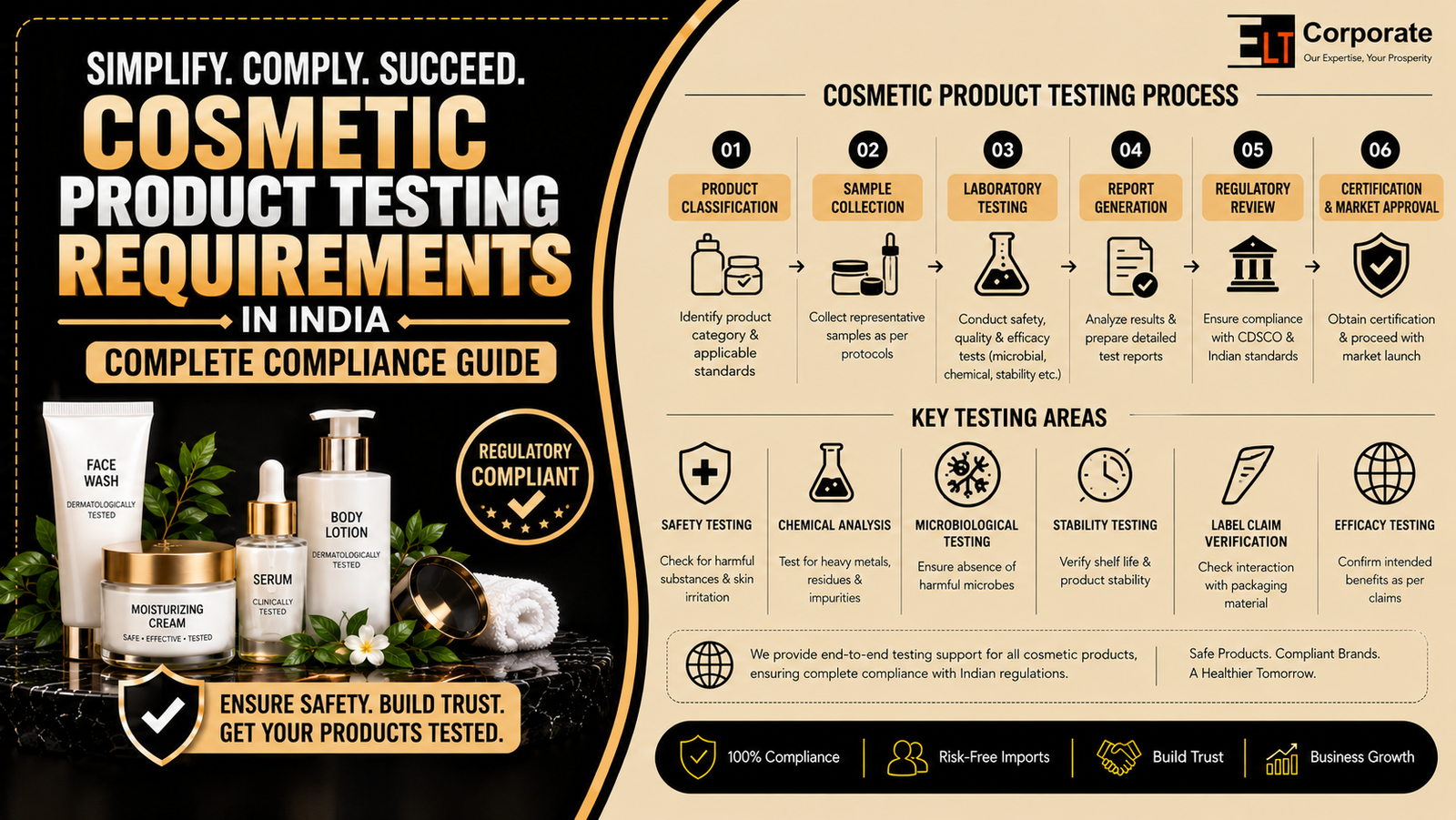

Cosmetic Product Testing Requirements in India are important for cosmetic brands, manufacturers, startups, and private-label businesses planning to launch products in the Indian market. Before introducing a face cream, shampoo, body lotion, serum, soap, or other cosmetic product, businesses should evaluate its applicable quality and safety requirements.
Testing helps manufacturers assess product quality, identify potential safety concerns, and support compliance documentation. The exact tests depend on the product formulation, intended use, applicable standards, and manufacturing process.
At Cosmetics Regulatory, businesses can seek professional guidance on cosmetic compliance, documentation, and product launch requirements to understand the next steps before commercializing their products.
If you are planning to launch a new cosmetic product, this guide explains the key testing considerations, applicable regulations, documents, and common mistakes to avoid.
Need Help with Cosmetic Product Testing?
Understand the testing requirements and compliance documentation applicable to your cosmetic product before launching in India.
What Are Cosmetic Product Testing Requirements in India?
Cosmetic product testing involves evaluating a product against relevant quality, safety, and performance specifications. It may include physical, chemical, microbiological, and stability assessments, depending on the product and its intended use.
Under India’s Cosmetics Rules, 2020, cosmetics manufactured or imported into India must meet the applicable quality and safety standards and other relevant requirements. Rule 39 addresses compliance with the specifications prescribed under the Ninth Schedule or other applicable standards. Where a cosmetic is not covered by the Ninth Schedule, the rule provides for applicable requirements and standards from the country of origin.
Businesses should review the official Cosmetics Rules, 2020, before deciding which tests and standards apply.
Cosmetic product testing requirements in India should be determined according to the specific product rather than by following one identical testing checklist for every cosmetic category.
Why Is Cosmetic Product Testing Important?
Testing can help businesses identify formulation issues before products reach consumers. It can also support quality control and product documentation.
Key benefits include:
- Product quality: Helps evaluate characteristics such as appearance, pH, viscosity, and consistency where relevant.
- Microbiological quality: Assesses microbial quality using suitable methods for the product.
- Safety assessment: Helps identify relevant product-specific safety concerns.
- Stability evaluation: Examines whether product characteristics remain acceptable under defined storage conditions.
- Manufacturing quality control: Supports consistency between batches.
- Regulatory preparation: Helps compile relevant technical records for applicable compliance processes.
Testing does not automatically guarantee regulatory approval, and a laboratory report alone does not replace any license, registration, or other legal requirement applicable to the business.
Types of Cosmetic Product Testing in India
The appropriate testing program depends on the formulation, product type, packaging, and intended application.
1. Physical and Chemical Testing
Physical and chemical tests help assess whether a cosmetic meets its applicable specifications.
Depending on the product, assessments may include:
- pH measurement for relevant water-based formulations.
- Appearance, color, odor, and consistency.
- Viscosity or other physical properties.
- Identification or measurement of specified ingredients where required.
- Evaluation of applicable restricted substances or contaminants.
For example, a face wash and a body lotion have different formulation characteristics. Their test plans should therefore reflect their individual specifications.
2. Microbiological Testing
Microbiological testing evaluates the microbial quality of a cosmetic product using appropriate test methods. It may be particularly relevant for products containing water, products used around sensitive areas, and formulations that may support microbial growth.
Depending on the formulation and applicable requirements, testing may examine specified microorganisms and overall microbial limits.
Products with different formulations, packaging systems, and intended uses may require different approaches. Manufacturers should consult a competent laboratory to identify the appropriate tests and acceptance criteria.
3. Stability Testing
Stability testing evaluates how a cosmetic product changes over time under defined conditions.
Depending on the product, a stability program may examine:
- Changes in color, odor, or texture.
- Separation of creams, lotions, or emulsions.
- Changes in pH or viscosity.
- Compatibility between the product and its packaging.
- Changes in other specified quality parameters.
Stability testing can support decisions about storage conditions, packaging suitability, and the proposed shelf life. The testing protocol and duration should be appropriate to the product and supported by relevant technical evidence.
4. Preservative Efficacy Testing
Preservative efficacy testing may be relevant for formulations that rely on preservatives to control microbial growth during use.
The need for this assessment depends on the formulation, packaging, water content, and applicable technical requirements. It should not be assumed that every cosmetic requires precisely the same preservative testing program.
5. Safety Evaluation
Safety evaluation considers the product’s ingredients, concentration, intended use, exposure, and potential hazards.
Relevant assessments may involve ingredient review, toxicological information, impurity considerations, and product-specific testing where appropriate.
The use of a particular test should be justified by the product’s characteristics and applicable standards. Animal testing is subject to restrictions under Indian cosmetic regulations; businesses should review the applicable legal provisions before planning any safety assessment.
Cosmetic Testing Requirements for Different Products
| Cosmetic product | Testing considerations |
| Face cream and moisturizer | Physical and chemical properties, microbiological quality, stability, and packaging compatibility, where relevant |
| Shampoo and face wash | pH, physical properties, microbiological quality, and stability, as applicable |
| Body lotion | pH, viscosity, emulsion stability, microbiological quality, and packaging compatibility, where relevant |
| Serum | Formulation-specific chemical properties, stability, and microbiological quality, depending on the formulation |
| Handmade soap | Applicable product specifications, physical and chemical characteristics, and relevant quality assessments |
| Sunscreen | Applicable product specifications and substantiation of sun-protection claims using suitable methods |
| Eye-area cosmetics | Product-specific safety considerations, relevant microbiological quality, and applicable specifications |
This table is a general planning guide, not a mandatory test list. The final testing scope must be established for the particular product.
Documents Required for Cosmetic Product Testing
Before approaching a laboratory, prepare the technical information available for your product.
Commonly useful documents include:
- Product name and category.
- Complete qualitative and quantitative formulation, shared securely with the laboratory where required.
- Ingredient specifications and relevant supplier documents.
- Manufacturing process and batch details.
- Product sample and packaging information.
- Proposed product specifications and acceptance criteria.
- Existing test reports, if available.
- Intended use, target consumer, and proposed claims.
- Relevant manufacturing licence or registration details, where applicable.
- Details of any specific regulatory or customer testing requirements.
The laboratory may request additional information depending on the product and test method. This list is a practical preparation checklist, not a universal statutory document list for every laboratory.
Prepare Your Cosmetic Product for Compliance
Need help understanding product documentation, applicable standards or testing considerations? Speak with our regulatory team for guidance on your next steps.
How to Get Cosmetic Products Tested in India
Businesses can follow these steps to organize a suitable testing program.
Step 1: Identify the Product Category
Determine whether the product is a cream, lotion, shampoo, soap, serum, or another cosmetic category. Record its intended use and proposed claims.
Step 2: Review Applicable Standards
Check the relevant provisions of the Cosmetics Rules, 2020, and any applicable product specifications or Indian Standards. The BIS Standards portal can help identify relevant standards.
Step 3: Define the Testing Scope
Prepare a product-specific testing plan covering the quality and safety parameters that apply. Avoid selecting tests solely because they appear on another product’s report.
Step 4: Select a Suitable Laboratory
Confirm that the laboratory has the appropriate technical competence, methods, and scope for the required tests. Where a particular regulatory purpose requires a recognized or approved laboratory, verify the applicable recognition or approval before submitting samples.
The BIS laboratory information portal provides information on BIS-recognized laboratories. Recognition for a particular standard or purpose should be verified rather than assumed.
Step 5: Submit Samples and Technical Information
Follow the laboratory’s sample quantity, packaging, documentation, and submission instructions. Provide accurate formulation and product details so that the laboratory can identify suitable methods.
Step 6: Review the Test Report
Check the product identity, methods, results, units, and acceptance criteria. Investigate any non-conforming results before proceeding with the product launch.
Step 7: Maintain Compliance Records
Keep reports, specifications, batch records, and supporting technical documents organized. Update the testing assessment when significant formulation, manufacturing, or packaging changes occur.
What Is the Cost of Cosmetic Product Testing in India?
There is no single testing fee applicable to every cosmetic product. The total cost depends on the product category, number of parameters, laboratory, method, sample requirements and whether specialized assessments are needed.
Factors that may affect the quotation include
- Number and type of tests.
- Complexity of the formulation.
- Stability study duration and conditions.
- Microbiological testing requirements.
- Packaging compatibility assessments.
- Additional technical documentation or repeat testing.
Request a product-specific quotation after defining the testing scope. Avoid relying on a general online price as the final cost for your formulation.
Common Mistakes to Avoid Before Product Launch
Businesses can reduce delays by addressing common preparation issues.
- Using the same test plan for every product: Different formulations require different assessments.
- Choosing a laboratory without checking its scope: Confirm suitability for the specific method and regulatory purpose.
- Ignoring stability evidence: Product quality can change during storage.
- Making unsupported claims: Claims such as “dermatologically tested,” “clinically proven,” or specific performance claims should have appropriate supporting evidence.
- Overlooking ingredient restrictions: Review applicable requirements for ingredients and their permitted uses.
- Ignoring label compliance: Testing does not replace the need to review product labeling and claims.
- Treating a test report as a license: Testing, manufacturing permissions, and import registration are distinct compliance matters.
For official regulatory information, consult the CDSCO cosmetics section and the applicable rules.
How Cosmetics Regulation Can Help Your Business
Preparing a cosmetic product for the Indian market may involve more than laboratory testing. Businesses may also need guidance on manufacturing permissions, import registration, product documentation, labelling, and claims.
Cosmetics Regulatory can help businesses understand the compliance steps relevant to their product and identify documentation gaps before proceeding.
You can seek assistance with:
- Understanding applicable cosmetic regulatory requirements.
- Reviewing available product and manufacturing documents.
- Identifying testing and compliance documentation gaps.
- Preparing for cosmetic manufacturing or import compliance.
- Reviewing labelling and claims from a regulatory perspective.
The exact support required depends on the product and business model. Laboratory testing and regulatory services may be separate, and any required testing should be arranged with a suitably qualified laboratory.
Get a Free Expert Consultation
Planning to launch a cosmetic product in India? Get guidance on your product category, testing requirements, and compliance documentation before moving ahead.
WhatsApp an Expert: +91 93553 31921
Call Our Regulatory Team: +91 85859 19582
Request assistance: https://cosmeticsregulatory.com/contact-us/
Conclusion
Understanding cosmetic product testing requirements in India helps businesses prepare for product development, quality assessment, and regulatory compliance. The right testing program depends on the formulation, intended use, applicable standards, and product-specific risks.
Before launching a new cosmetic, review the applicable regulations, identify the appropriate testing scope, select a suitable laboratory, and maintain complete technical records.
If you need help understanding your product’s compliance requirements, contact Cosmetics Regulatory for an initial consultation and guidance on the next steps.
COSMETICS REGULATORY
Planning to Launch a Cosmetic Product in India?
Get expert guidance on cosmetic testing considerations, regulatory documentation, manufacturing licences, import requirements and labelling compliance for your product.
Discuss your product requirements with our regulatory team.
Frequently Asked Questions
Q1. Is cosmetic product testing mandatory in India?
Cosmetics must comply with applicable quality and safety standards under the Cosmetics Rules, 2020. The specific testing needed depends on the product, applicable standards, and regulatory purpose.
Q2. Which tests are required for cosmetic products?
Depending on the formulation, tests may cover physical and chemical properties, microbiological quality, stability, packaging compatibility, and specific safety parameters. There is no single test package suitable for every cosmetic.
Q3. How much does cosmetic product testing cost in India?
The cost varies according to the product, test parameters, laboratory, and testing duration. Obtain a quotation based on your product’s actual requirements.
Q4. Can I launch a cosmetic product using only a laboratory report?
Not necessarily. A laboratory report does not replace applicable manufacturing permissions, import registration, labeling obligations, or other regulatory requirements.
Q5. How do I choose a cosmetic testing laboratory?
Check the laboratory’s technical competence, test methods, and scope. If regulatory recognition or approval is required for your specific purpose, verify it before submitting samples.
Q6. Does every cosmetic require stability testing?
Stability evidence is an important part of product quality and shelf-life assessment, but the appropriate program depends on the formulation, packaging, intended shelf life and applicable requirements.
Q7. Can Cosmetics Regulatory help with cosmetic testing and compliance?
You can contact Cosmetics Regulatory to discuss your product and obtain guidance on relevant compliance requirements, documentation, and testing considerations. Confirm the specific services available for your product before proceeding.