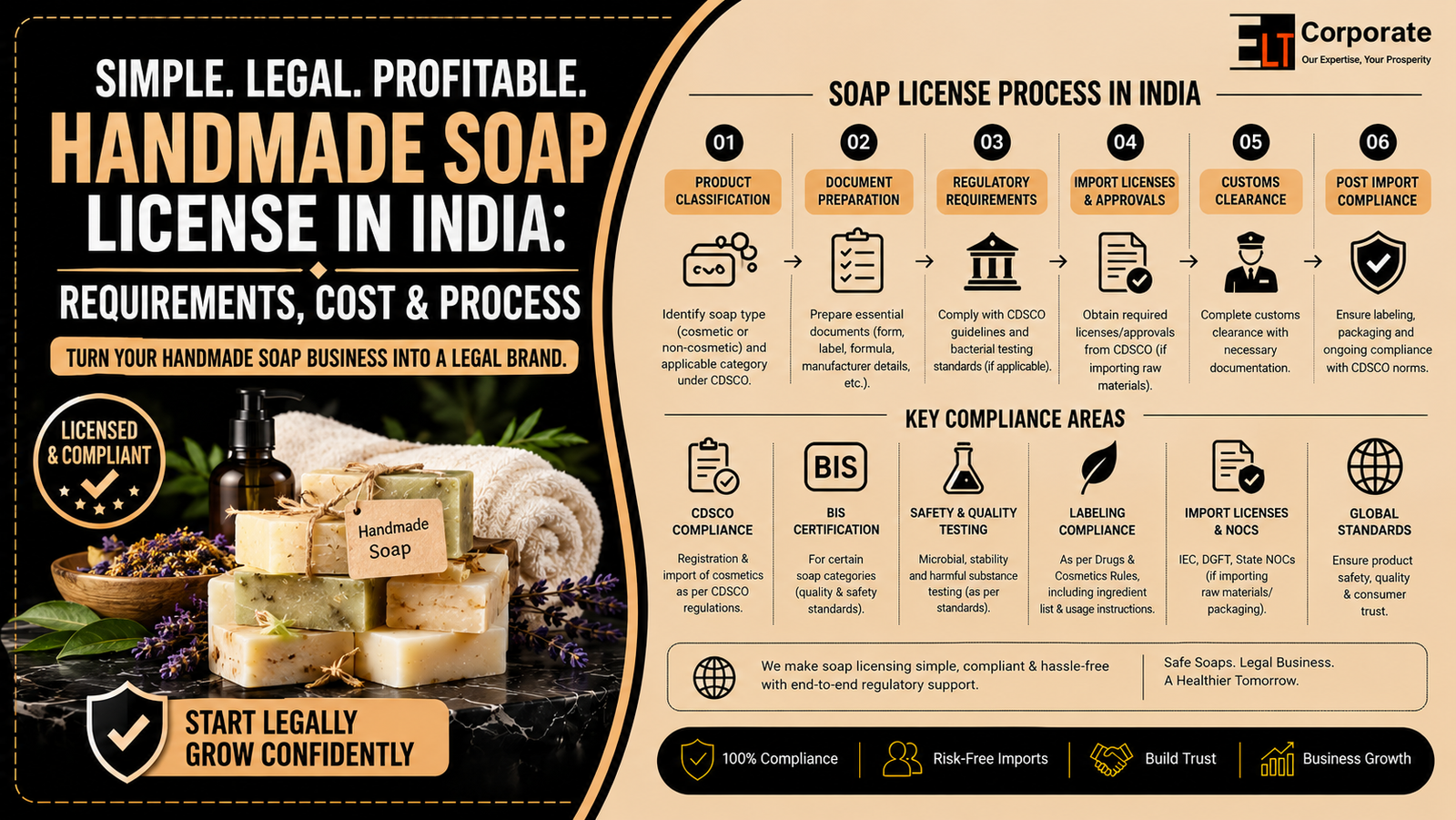

Handmade soap is a huge business opportunity in India as people increasingly search for products for personal care made of natural oils, herbal components, and essential oils and plant-based formulas. Many small-scale businesses and entrepreneurs are now manufacturing and selling handmade soaps on the websites of their companies, online marketplaces, and social media platforms. They also have boutiques, stores, and exhibits.
However, starting a soap-making business is not just about choosing a formula and appealing packaging. If the soap falls within the applicable cosmetic framework, the business must comply with the relevant regulatory requirements before manufacturing and selling it.
The Cosmetics Rules, 2020, regulate the manufacture of cosmetics in India through a licensing system administered by the State Licensing Authorities. CDSCO also states that cosmetics must comply with applicable quality and safety standards and other requirements under the rules.
This guide explains the handmade soap license in India, including when a license may be required, manufacturing requirements, documents, costs, labelling, testing, and the process for starting a compliant handmade soap business.
What Is a Handmade Soap License in India?
A handmade soap license generally refers to the applicable cosmetic manufacturing license required for manufacturing cosmetic soap in India.
There is not necessarily a separate government license called a “Handmade Soap License.” In reality, the requirement of regulation is contingent on the nature of the product, the purpose for which it is intended, and the manufacturing activity.
For companies producing cosmetic soaps, the compliance with Cosmetics Rules, 2020, and the relevant licensing requirements is essential.
The body responsible for regulating the manufacturing of cosmetics in India is usually known as the State Licensing Authority, while CDSCO regulates the importation of cosmetics by the Central Licensing Authority.
Therefore, before starting production, a business should determine:
- Whether the product is a cosmetic
- Where the product will be manufactured
- Whether manufacturing will be done through a third party
- Which license applies
- What product standards apply
- What labelling requirements must be followed
- What testing and documentation are required
Is a License Required to Sell Handmade Soap in India?
If you are manufacturing cosmetic soap for commercial sale, you should not assume that being a small or home-based business automatically removes regulatory requirements. The important distinction is between selling a product and manufacturing a cosmetic product.
If a business manufactures its own cosmetic soap, the applicable manufacturing licensing requirements need to be assessed. If a business purchases finished soap from a licensed manufacturer and sells it under its own brand, the regulatory responsibilities can be different.
This is particularly important for:
- Homemade soap businesses
- Handmade soap startups
- Private-label brands
- Online soap sellers
- Natural skincare brands
- Ayurvedic/herbal-positioned businesses
- Third-party manufactured soap brands
Before launching the product, the business should establish which regulatory model applies to its activities.
Which Authority Regulates Handmade Soap Manufacturing?
Cosmetic production in India is controlled by the system of inspection and licensing conducted by the State Licensing Authorities appointed by the respective states’ governments. CDSCO regulates the importation of cosmetics via its Central Licensing Authority.
It means that an Indian firm that produces hand-crafted cosmetic soap usually has to register with the appropriate State Licensing Authority rather than making an application to CDSCO to obtain an import license simply because the product is made. The specific authority and procedure for application can be based on the site of the manufacturing facility.
Handmade Soap vs Homemade Soap: Is There a Difference?
The terms “handmade” and “homemade” are commonly used interchangeably in marketing; however, they are not necessarily determining the quality of the product. Soaps can be made by hand and be made to be sold commercially.
For example, a business may:
- Make soap manually in small batches
- Use cold-process methods
- Use essential oils
- Use natural colors
- Use herbal ingredients
- Manufacture soap at a commercial facility
- Sell the finished product online
The fact that production is done manually does not by itself mean that the business is outside the applicable cosmetic regulations. The key consideration is the nature of the product and the manufacturing activity.
What Type of Handmade Soap Business Are You Starting?
Before applying for any license, determine your business model.
1. Home-Based Handmade Soap Business
You may manufacture small batches from your own premises and sell them directly to customers. This model requires careful assessment of the applicable manufacturing and premises requirements before commercial production.
2. Commercial Handmade Soap Manufacturing
A business may establish its own compliant manufacturing facility and produce soaps for sale under its own brand. In this model, the business needs to address the applicable manufacturing license, premises, equipment, personnel, testing, documentation, and quality requirements.
3. Private Label Handmade Soap
A brand owner may outsource manufacturing to an existing cosmetic manufacturer. The manufacturer produces the soap while the brand owner markets it under its own brand. This can be a practical option for startups that do not want to establish their own manufacturing facility.
4. Third-Party Manufacturing
A business can work with an existing manufacturer to produce products according to agreed formulations and specifications. The contractual and regulatory responsibilities should be clearly defined before production starts.
Handmade Soap Manufacturing License Requirements
For a business intending to manufacture cosmetic soap, regulatory planning should begin before setting up production. Important areas include:
Manufacturing Premises
The manufacturing premises should meet the applicable requirements for cosmetic manufacturing. The business should consider:
- Suitable manufacturing area
- Hygiene
- Storage
- Raw material handling
- Finished product storage
- Equipment
- Cleaning arrangements
- Quality-control arrangements
Manufacturing Equipment
The equipment should be suitable for the intended production process and product type. Depending on the manufacturing method, equipment may include:
- Mixing equipment
- Heating equipment
- Moulds
- Cutting equipment
- Weighing equipment
- Storage containers
- Filling or packing equipment
- Cleaning equipment
Qualified Technical Personnel
Applicable manufacturing requirements may require appropriate technical personnel and supervision. The business should verify the qualification and staffing requirements applicable to its manufacturing setup before applying.
Quality Control
A handmade product should still have controlled manufacturing and quality procedures. Batch-to-batch consistency is important because customers expect the same product characteristics from every production batch.
What Standards Apply to Handmade Soap?
Cosmetic products have to meet the relevant safety and quality standards as stipulated by the Cosmetics Rules, 2020. Rule 39 stipulates that cosmetics must conform to the standards set out in the Ninth Schedule or other applicable guidelines and requirements within the rules.
The Ninth Schedule includes standards for several finished cosmetic products, including toilet soap, liquid toilet soap, baby toilet soap, shaving soap, transparent toilet soap, and other soap-related products.
Therefore, a handmade soap business should identify the correct product category and applicable standard rather than assuming that “handmade” means there are no product standards.
Documents Required for Handmade Soap License
The exact documents can depend on the manufacturing setup and applicable State Licensing Authority.
Common documentation may include:
- Application forms
- Business constitution documents
- Identity and address documents
- Manufacturing premises documents
- Site plan
- Equipment details
- Product details
- Product formulation
- Ingredient information
- Technical staff details
- Manufacturing process
- Testing arrangements
- Product specifications
- Labels and packaging artwork
- Applicable declarations
- Fee payment proof
- Other documents required by the licensing authority
For a third-party manufacturing arrangement, additional contractual and manufacturer-related documents may be required.
How to Apply for a Handmade Soap License in India
The exact procedure varies according to the state and business structure, but the general process can be approached in the following way.
Step 1: Decide Your Manufacturing Model
First determine whether you will:
- Manufacture yourself
- Establish your own facility
- Use a third-party manufacturer
- Launch a private-label soap brand
This decision affects the regulatory pathway.
Step 2: Finalize the Product
Identify the soaps you intend to manufacture.
For example:
- Neem soap
- Aloe vera soap
- Charcoal soap
- Rose soap
- Lavender soap
- Turmeric soap
- Goat milk soap
- Herbal soap
- Glycerin soap
The formulation and intended claims should be reviewed before finalizing the product.
Step 3: Check the Ingredients
Review all ingredients and their concentrations. The formulation should be assessed against applicable cosmetic requirements and standards.
Step 4: Prepare the Manufacturing Premises
If manufacturing yourself, prepare the premises, equipment, storage, hygiene, and other applicable requirements.
Step 5: Prepare Documents
Collect the required technical, business, premises, formulation, personnel, and product documents.
Step 6: Submit the Application
Submit the applicable application to the relevant State Licensing Authority through the prescribed process.
Step 7: Regulatory Inspection
Where applicable, the manufacturing premises may be inspected by the licensing authority.
Step 8: Obtain the Applicable License
Once the requirements are satisfied, the applicable manufacturing license can be granted according to the regulatory process.
Handmade Soap License Cost in India
There is no single nationwide flat fee that can be quoted for every handmade soap business.
The applicable cost can depend on factors such as
- State
- Manufacturing model
- Product category
- Number of products
- Manufacturing capacity
- Premises
- Testing
- Documentation
- Professional assistance
- Government fees
Therefore, businesses should calculate the cost according to their actual manufacturing setup rather than relying on a generic “handmade soap license fee.”
Handmade Soap Labelling Requirements
Packaging is an important part of cosmetic compliance. Before printing labels, businesses should review the applicable requirements for the particular soap.
Depending on the product and applicable rules, the label may need information such as
- Product name
- Manufacturer details
- Net quantity
- Batch/lot information
- Manufacturing information
- Expiry/use-before information
- Ingredient information
- Directions for use
- Warnings or precautions
- Other mandatory declarations
The label should also be consistent with the product documentation and manufacturing records.
Can Handmade Soap Be Sold Online?
Handmade soap businesses commonly sell through:
- Their own websites
- Amazon
- Flipkart
- Social media
- Online marketplaces
- Beauty stores
- Salons
- Exhibitions
However, selling through an online platform does not automatically remove the applicable product compliance requirements. A business should establish regulatory compliance before commercially manufacturing and marketing the product.
What About Herbal or Natural Handmade Soap?
Terms such as natural, herbal, organic, and chemical-free are commonly used in handmade soap marketing. However, these words do not automatically exempt a product from cosmetic requirements.
If the product is marketed as a cosmetic, the applicable regulatory framework should be considered regardless of whether the formulation contains:
- Natural oils
- Plant extracts
- Herbs
- Essential oils
- Botanical ingredients
- Natural colors
Businesses should also ensure that their claims are not false or misleading. CDSCO specifically states that a cosmetic must not purport or claim to convey an idea that is false or misleading to the intended user.
Can Handmade Soap Make Medical Claims?
This is an important area for small soap businesses.
A handmade soap should not casually be marketed with claims such as
- “Cures eczema”
- “Treats psoriasis”
- “Cures acne permanently”
- “Treats fungal infections”
- “Heals skin disease”
- “Prevents infection”
Such claims can create regulatory concerns because they move beyond ordinary cosmetic positioning.
Instead, businesses should carefully review the intended cosmetic claims before putting them on packaging, websites, marketplaces, advertisements, or social media.
Handmade Soap for Private Label Brands
Private label is one of the easiest ways for a new entrepreneur to enter the cosmetic market without establishing a complete manufacturing facility.
The model generally works like this:
Brand Owner → Licensed Cosmetic Manufacturer → Finished Handmade Soap → Brand Packaging → Sale
The brand owner can focus on:
- Brand development
- Product positioning
- Packaging
- Marketing
- Sales
- Distribution
The manufacturer handles the applicable production requirements. However, the brand owner should still review the manufacturer’s credentials and product documentation instead of assuming that every third-party manufacturer is automatically compliant.
Common Mistakes in Handmade Soap Businesses
Starting Production Before Checking Licensing Requirements
Many small businesses begin manufacturing first and think about regulatory compliance later. This can create problems when the business attempts to scale or enter online marketplaces.
Assuming Handmade Means Exempt
Being handmade does not automatically mean the product is outside cosmetic regulation.
Using Unsupported Claims
Claims copied from social media trends can create compliance issues.
Ignoring Product Standards
Soap products can be subject to applicable quality and safety standards.
Poor Batch Records
Businesses should maintain appropriate manufacturing and quality records. The Cosmetics Rules prescribe manufacturing-record requirements, including product name, batch size, batch number, manufacturing dates, ingredient quantities, production details, and release information.
Printing Packaging Too Early
Businesses should review the label before ordering large quantities of printed packaging.
Handmade Soap License Checklist
Before launching your handmade soap business, check the following:
Business
- Business structure finalized
- Brand name selected
- Manufacturing model identified
Product
- Product category identified
- Formulation finalized
- Ingredients reviewed
- Applicable standard checked
Manufacturing
- Premises assessed
- Equipment identified
- Technical personnel arranged
- Quality-control process established
Documents
- Application documents prepared
- Product information prepared
- Formulation documents prepared
- Testing documents prepared
- Premises documents prepared
Packaging
- Label reviewed
- Ingredients declared appropriately
- Batch information planned
- Net quantity checked
- Applicable warnings reviewed
Marketing
- Product claims reviewed
- Website claims checked
- Marketplace descriptions reviewed
- Advertising claims checked
How Cosmetics Regulation Can Help With Handmade Soap Licensing
Starting a handmade soap business can involve multiple regulatory requirements, particularly when the business plans to manufacture commercially or scale its product range.
Cosmetics Regulatory can assist businesses with:
- Cosmetic manufacturing license guidance
- Handmade soap compliance assessment
- Product documentation
- Formulation review
- Label compliance
- Manufacturing documentation
- Third-party manufacturing guidance
- Private-label cosmetic compliance
- Regulatory application assistance
Getting the regulatory requirements checked before manufacturing can help a business avoid unnecessary compliance problems and packaging or product-related expenses.
Conclusion
Starting a handmade soap business in India can be a promising opportunity, but businesses should not assume that small-scale or handmade production automatically removes regulatory requirements.
If you produce cosmetic soap for commercial use, you must comply with the pertinent Cosmetics Rules, 2020, production requirements, and standards for the product, as well as labelling requirements and State Licensing Authority requirements.
The correct compliance route is determined by whether you make the soap by yourself, operate your own facility, rely on a third-party manufacturer, or create a private label brand. The best way to protect yourself is to identify the relevant licensing requirements prior to making packaging, printing it, or launching the product commercially.
If you’re a business owner looking to establish or expand the soap-making business Professional regulatory support will assist you in identifying the requirements needed and aid in preparing your business to launch successfully.
Frequently Asked Questions
Q1. Is a handmade soap license required in India?
If you manufacture cosmetic soap commercially, the applicable cosmetic manufacturing licensing requirements should be assessed. Being handmade does not automatically exempt the product from regulatory requirements.
Q2. Is handmade soap considered a cosmetic?
It depends on the product’s composition, intended use, presentation, and claims. Where the product falls within the applicable definition of cosmetic, the Cosmetics Rules and relevant requirements apply.
Q3. Can I make handmade soap at home and sell it?
A home-based business should not assume that a commercial sale is exempt from regulatory requirements. The applicable manufacturing and premises requirements should be checked before commercial production.
Q4. Which authority issues a cosmetic manufacturing license in India?
Cosmetic manufacturing is regulated through inspection and licensing by the applicable State Licensing Authority.
Q5. Can I sell handmade soap on Amazon or other marketplaces?
Online sale does not by itself remove applicable cosmetic compliance requirements. The product should be assessed for manufacturing, labeling, quality, and other applicable requirements before commercial sale.
Q6. Can I start a handmade soap business without my own manufacturing facility?
Yes, a business may consider a third-party or private-label manufacturing model, subject to the applicable regulatory and contractual requirements.
Q7. Does handmade soap need testing?
The applicable testing and quality requirements depend on the product and regulatory framework. The product should meet the applicable standards and quality/safety requirements under the Cosmetics Rules.
Q8. Can I use “natural” or “herbal” on handmade soap packaging?
Such claims should be truthful and appropriately supported. Cosmetic claims must not be false or misleading to the intended user.
Q9. What is the cost of a handmade soap license?
There is no single flat cost applicable to every business. The overall cost depends on the state, manufacturing setup, products, testing, documentation, government fees, and other requirements.
Q10. How can I get help with handmade soap licensing?
A regulatory consultant can assess your manufacturing model, product, documents, labelling, and applicable licensing requirements before you begin commercial production.