

If you intend to produce cosmetics in India to sell or distribute, getting the proper manufacturing license is a vital legal obligation. In the Cosmetics Rules of 2020, a permit to produce cosmetics for sale and distribution can be granted on form COS-8 issued by the State Licensing Authority.
The COS-8 License in India applies to cosmetic companies that operate their own production facilities and are planning to produce cosmetics for sale. The license is subject to conditions pertaining to the premises and technical staff manufacturing practices, including testing facilities, documentation, and conformity with the relevant provisions that are in the Drugs and Cosmetics Act, 1940, and Cosmetics Rules, 2020.
This guide will explain COS-8 licensing requirements, the document fee, the application procedure, and technical staff requirements. It also explains retention, validity, and the most common errors businesses must avoid.
What Is a COS-8 License in India?
A COS-8 license is a manufacturing license issued for manufacturing cosmetics for sale or distribution in India. Under Rule 25 of the Cosmetics Rules, 2020, a license or loan license to manufacture cosmetics for sale or distribution is granted in Form COS-8 and Form COS-9, respectively.
The COS-8 license is therefore relevant to businesses that manufacture cosmetic products at their own approved premises.
Examples of products that may fall within the cosmetic manufacturing framework include:
- Face creams
- Moisturizers
- Lotions
- Shampoos
- Conditioners
- Hair oils
- Cleansers
- Face washes
- Makeup products
- Lip products
- Nail products
- Bath products
- Other products falling within the definition of cosmetics
Whether a particular product qualifies as a cosmetic depends on its intended use, composition, claims, and applicable regulatory requirements.
Who Needs a COS-8 Manufacturing License?
A business intending to manufacture cosmetics in India for sale or distribution generally needs the applicable manufacturing license from the State Licensing Authority.
CDSCO explains that manufacturing of cosmetics is regulated through a system of inspection and licensing by the State Licensing Authorities appointed by the respective State Governments, whereas import of cosmetics is regulated through registration by the Central Licensing Authority.
Therefore, businesses should distinguish between:
| Activity | Regulatory route |
| Manufacturing cosmetics in India | COS-8 / applicable state licensing process |
| Manufacturing under a loan license arrangement | COS-9 |
| Importing foreign cosmetics | CDSCO cosmetic registration |
| New cosmetic requiring permission | Applicable new cosmetic process |
A business should select the correct regulatory pathway according to its actual manufacturing and business model.
COS-8 License vs. COS-9 Loan License
One common point of confusion is the difference between COS-8 and COS-9.
COS-8 License
Form COS-8 is used for a license to manufacture cosmetics for sale or distribution at the applicant’s manufacturing premises.
COS-9 Loan License
Form COS-9 relates to a license for manufacturing cosmetics for sale or distribution.
A loan license can be relevant where an applicant intends to use the manufacturing facilities of another licensed manufacturer rather than operating manufacturing through its own independent licensed premises.
The Cosmetics Rules, 2020, separately prescribe the conditions and fees for COS-8 and COS-9.
Who Issues the COS-8 License?
The COS-8 manufacturing license is issued by the State Licensing Authority.
This is different from the regulatory authority responsible for imported cosmetics. CDSCO states that manufacturing of cosmetics is regulated under inspection and licensing by State Licensing Authorities, while import of cosmetics is regulated through registration by the Central Licensing Authority.
Therefore, the exact application portal, procedural steps, and certain administrative requirements may depend on the state in which the manufacturing premises are located.
COS-8 License Requirements in India
Before applying for a COS-8 license, a manufacturer should ensure that the proposed manufacturing facility and organization satisfy the applicable regulatory conditions.
Important requirements include:
1. Suitable Manufacturing Premises
The premises for manufacturing must be in compliance with the specifications and conditions stipulated in the seventh Schedule of the Cosmetics Rules, 2020. The facility must be suitable for the production of cosmetic products. They should have the appropriate facilities for storage, manufacturing and sanitation, quality assurance and other activities that are relevant.
2. Qualified Technical Staff
Manufacturing must be conducted under the direction and personal supervision of competent technical staff. The Cosmetics Rules, 2020, specify that at least one whole-time employee should possess one of the prescribed qualifications, including:
- Diploma in Pharmacy approved by the Pharmacy Council of India
- Registration under the Pharmacy Act, 1948
- Intermediate examination with chemistry as a subject or an examination recognized as equivalent
- Bachelor’s degree in cosmetic technology from a recognized university
These qualifications are specifically provided under Rule 26.
3. Testing Facilities
The manufacturer must have adequate arrangements for testing the cosmetics manufactured and the raw materials used.
The rules allow the manufacturer to either:
- Maintain adequate staff, premises, and laboratory equipment for testing, or
- Arrange testing through an appropriate laboratory approved by the Central Licensing Authority and accredited by NABL, as applicable under the rules.
This requirement is important because cosmetic manufacturing is not limited to production alone. Quality and safety control are also part of the regulatory framework.
4. Compliance With Manufacturing Requirements
The manufacturing facility must comply with the applicable requirements under the Cosmetics Rules, including the prescribed manufacturing practices and relevant schedules.
The manufacturer is also responsible for maintaining the necessary records and complying with the conditions attached to the license.
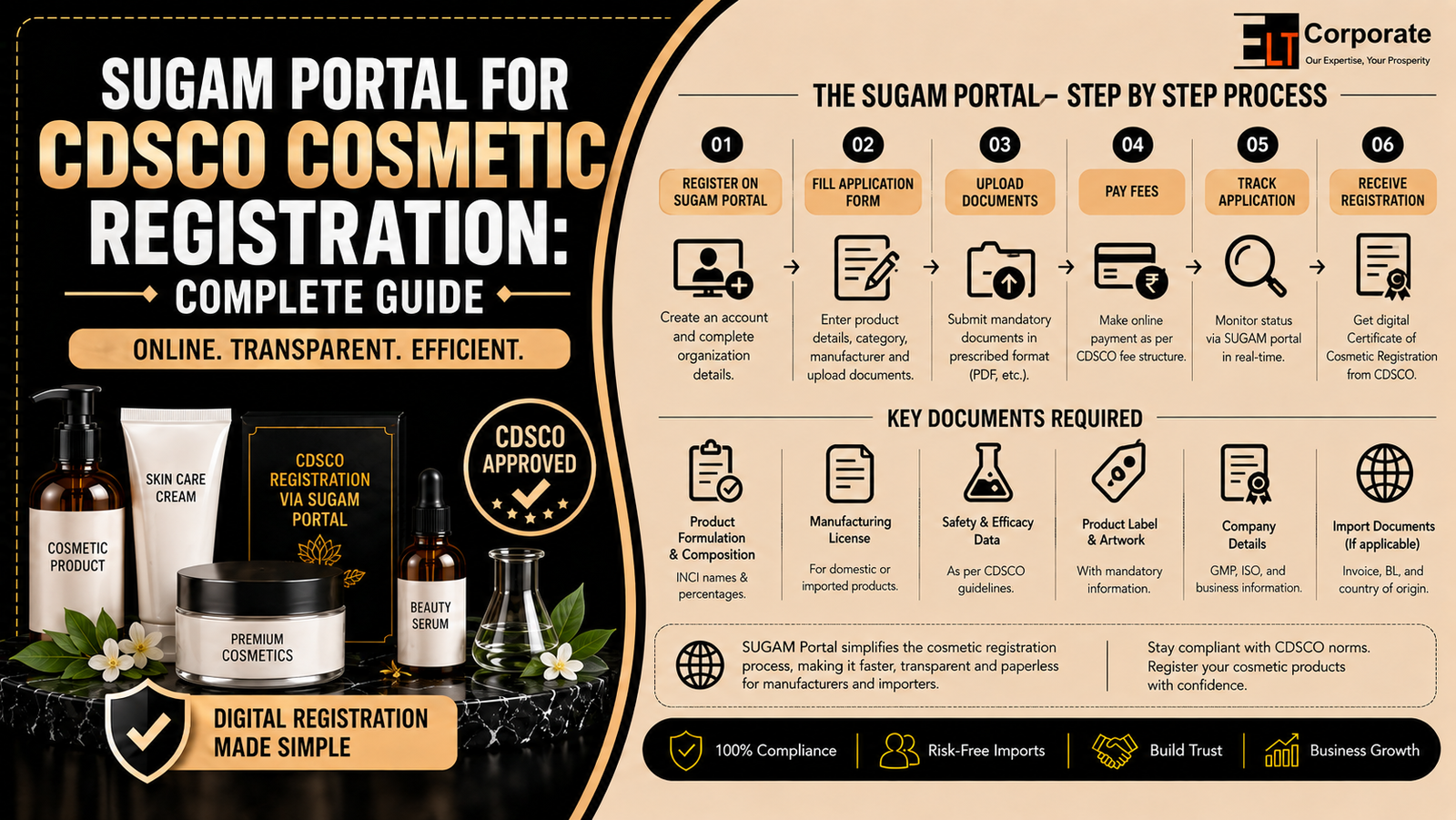
Documents Required for COS-8 License
The exact document checklist can vary depending on the State Licensing Authority and the nature of the application. However, manufacturers should generally prepare documents such as
- Application form
- Applicant/company details
- Proof of constitution of the business
- Ownership or occupancy documents for the premises
- Site plan and layout
- Details of manufacturing premises
- List of proposed cosmetic products
- Product formulations
- Details of ingredients
- Manufacturing process information
- Details of technical staff
- Qualification certificates of technical personnel
- Appointment letters or employment proof
- Laboratory/testing facility details
- Equipment and machinery details
- Water supply details, where applicable
- Storage arrangements
- Product specifications
- Label and packaging details
- Self-declaration or undertakings
- Applicable fee payment proof
- Other documents required by the State Licensing Authority
The Cosmetics Rules specifically require documentary evidence regarding ownership or occupation of the premises and the constitution of the firm, along with other documents that may be required to verify information provided by the applicant.
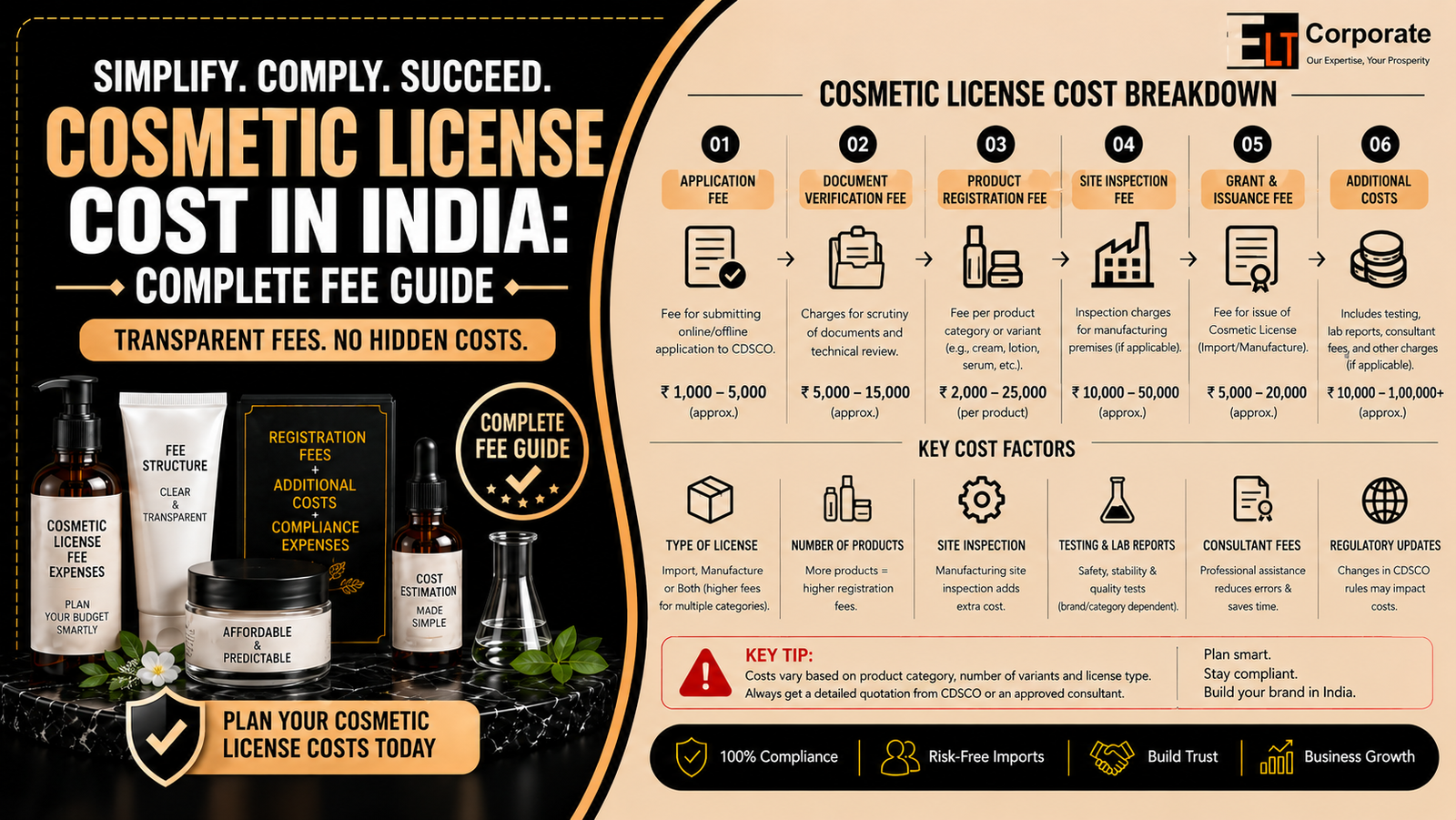
COS-8 License Fees in India
The Third Schedule of the Cosmetics Rules, 2020, specifies the fees for a COS-8 manufacturing license.
The prescribed fee structure includes:
| COS-8 Application | Fee |
| Up to 10 items of each category of cosmetics | ₹10,000 |
| Each additional item in a category | ₹500 |
| 10 items of each additional category | ₹10,000 |
The rules also specify retention fees for the license, including ₹10,000 for up to ten items of each category and ₹500 for each additional item in the category, subject to the applicable provisions.
Is ₹10,000 the Total Cost of a COS-8 License?
Not necessarily.
The statutory license fee is only one part of the overall cost of establishing a compliant cosmetic manufacturing operation.
Additional expenses may include:
- Factory premises
- Machinery
- Laboratory equipment
- Testing
- Technical staff
- Product development
- Documentation
- Packaging and labeling
- Professional consultancy
- State-level administrative requirements
- Other business and compliance expenses
Therefore, businesses should distinguish between the government license fee and the total cost of cosmetic manufacturing compliance.
COS-8 License Application Process
The application process can vary by state, but a typical COS-8 application involves the following stages.
Step 1: Determine Product Category
Begin by identifying the cosmetic products to be produced. The manufacturer should ensure that the proposed products are within the definitions and regulations for cosmetics.
Step 2: Prepare the Manufacturing Premises
The manufacturing facility should be established according to the applicable requirements.
This includes appropriate manufacturing areas, storage, sanitation, equipment, quality-control arrangements, and other requirements under the applicable schedules.
Step 3: Appoint Qualified Technical Staff
A qualified technical person should be appointed according to the requirements of the Cosmetics Rules.
The applicant should keep qualification and employment-related documents ready for submission.
Step 4: Prepare Product Information
Prepare details of every cosmetic product proposed for manufacturing.
This may include:
- Product name
- Product category
- Formula
- Ingredients
- Percentage of ingredients
- Function of ingredients
- Product specifications
- Manufacturing process
- Packaging
- Label information
Form COS-8 itself contains product information fields relating to cosmetic products, ingredients, specifications, percentages, and functions of ingredients, along with technical staff details.
Step 5: Prepare Supporting Documents
Compile the required premises, company, technical staff, laboratory, and product documents.
All information should be consistent across the application and supporting documents.
Step 6: Submit Application to the State Licensing Authority
The completed application and supporting documents are submitted through the applicable state procedure or portal.
The authority reviews the application against the requirements of the Cosmetics Rules.
Step 7: Inspection and Verification
The manufacturing facility can be examined at the direction of the State Licensing Authority or an authorized official. The inspection will determine whether the actual manufacturing facility is in line with the details provided in the application and if the manufacturing facilities meet required requirements.
Step 8: License Grant
If the application and premises satisfy the applicable requirements, the State Licensing Authority grants the manufacturing license in Form COS-8.
The license specifies the cosmetics that the manufacturer is permitted to manufacture.
What Information Is Mentioned on Form COS-8?
Form COS-8 contains important information regarding the license.
The prescribed form includes:
- License number
- Date of issue
- Manufacturing premises
- Details of cosmetic products
- Names of ingredients
- Specifications/standards/grade of ingredients
- Percentage of ingredients
- Function of ingredients
- Names of technical staff
The form also states that the license remains valid unless suspended or cancelled, with compliance with license conditions and the applicable act and rules to be assessed at least once a year.
COS-8 License Validity and Retention
The COS-8 license doesn’t function as a license for a short period that expires following the expiration date of a predetermined time.
The COS-8 form stipulates it is a condition that your license, except if earlier terminated or cancelled, will continue to be valid. But the conformity with the terms and conditions of the license and any applicable requirements is subject to review at least every year.
The manufacturer is therefore required to ensure that they are in compliance with the law instead of using the approval as a one-time approval.
The Cosmetics Rules also prescribe retention charges for manufacturing licenses.
Manufacturing at More Than One Premise
If cosmetics are produced in more than one location, an application for each location will be required for each facility, and a separate license has to be obtained for each location. This is specifically regulated in Rule 24 of the Cosmetics Rules, 2020.
Therefore, a manufacturer operating facilities in different locations should not assume that one COS-8 license automatically covers every manufacturing site.
Common Reasons for COS-8 Application Delays
Manufacturers can face delays when applications contain incomplete or inconsistent information.
Common issues include:
Incomplete Product Information
The product list, formulations, or ingredient information may be incomplete.
Unqualified Technical Staff
The nominated technical person may not meet the prescribed qualification requirements.
Inadequate Premises
The manufacturing facility may not satisfy applicable schedule requirements.
Missing Documents
Ownership, occupancy, company constitution, or technical documents may be missing.
Incorrect Product Category
Products may be incorrectly categorized or described.
Inadequate Testing Arrangements
The manufacturer may not have appropriate testing facilities or an acceptable external laboratory arrangement.
Mismatch in Documents
Company names, addresses, product names, and other information should remain consistent across documents.
COS-8 Compliance After Obtaining the License
Obtaining the license is only the beginning of ongoing compliance.
A COS-8 manufacturer should continue to maintain:
- Manufacturing records
- Batch-related records
- Raw material information
- Product specifications
- Testing records
- Quality-control records
- Technical staff records
- Premises and equipment maintenance
- Appropriate storage conditions
- Product labeling compliance
- Complaint records
- Other records required under applicable rules
The manufacturer must also comply with the conditions of the license and applicable provisions of the Drugs and Cosmetics Act and Cosmetics Rules.
Can a Private Label Brand Use COS-8?
A private-label business does not automatically require its own COS-8 license simply because it owns the brand.
The regulatory route depends on who actually manufactures the product, where it is manufactured, and the contractual/manufacturing arrangement.
If the brand owner operates its own manufacturing premises and manufactures cosmetics for sale or distribution, the applicable manufacturing license requirements should be assessed.
If manufacturing is carried out by another licensed manufacturer, the appropriate arrangement may involve a loan license or another applicable regulatory structure.
Therefore, private-label businesses should determine their licensing structure before starting production.
COS-8 License Checklist
Before submitting a COS-8 application, manufacturers should review:
| Requirement | Status |
| Cosmetic product category identified | ✓ |
| Manufacturing premises ready | ✓ |
| Site/layout documents prepared | ✓ |
| Ownership/occupancy proof available | ✓ |
| Qualified technical staff appointed | ✓ |
| Technical staff qualifications verified | ✓ |
| Product formulations prepared | ✓ |
| Ingredient details prepared | ✓ |
| Manufacturing process documented | ✓ |
| Testing facility arranged | ✓ |
| Laboratory arrangements verified | ✓ |
| Product labels reviewed | ✓ |
| Company documents prepared | ✓ |
| Applicable fee calculated | ✓ |
| Application reviewed before submission | ✓ |
Why Professional COS-8 Support Can Help
The COS-8 application process requires more than filling out the application. Manufacturers should make sure that their facilities as well as their technical staff’s formulas for product lab arrangements and documentation meet the relevant requirements prior to approaching authorities like the State Licensing Authority.
Professional regulatory assistance can assist companies with:
- Product classification
- Documentation
- Formulation review
- Manufacturing license application
- Technical staff documentation
- Premises compliance
- Product list preparation
- Label review
- Regulatory queries
- License retention and compliance
This can be particularly helpful for new cosmetic manufacturers, private-label businesses, and companies setting up a new cosmetic manufacturing facility.
Conclusion
The COS-8 License in India is the prescribed manufacturing license for manufacturing cosmetics for sale or distribution at the applicant’s manufacturing premises. Under the Cosmetics Rules, 2020, the license is granted in Form COS-8 by the State Licensing Authority.
Key requirements include compliant manufacturing premises, qualified technical staff, suitable testing arrangements, appropriate documentation, and compliance with the applicable manufacturing requirements.
The statutory fee for a COS-8 license starts at ₹10,000 for up to ten items of each category, with additional fees applicable for extra products and categories. Retention fees are also prescribed under the Third Schedule.
Since cosmetic manufacturing compliance continues after the license is granted, manufacturers should maintain their premises, documentation, quality systems, and products in accordance with the applicable requirements.
Businesses planning to start cosmetic manufacturing in India should therefore evaluate their licensing requirements and prepare the manufacturing facility and documentation before submitting a COS-8 application.
Frequently Asked Questions
Q1. What is a COS-8 license?
COS-8 is the manufacturer’s license for cosmetics made for distribution or sale in India. It is authorized in accordance with the Cosmetics Rules of 2020 from the State Licensing Authority.
Q2. Which is the COS-8 licensing cost in India?
The fee prescribed is Rs10,000 for the production of as many as ten items in each type of cosmetics. An additional amount of Rs500 is imposed on each item added in one category. The Rs10,000 limit is applicable for ten items in every additional category in accordance with the 3rd Schedule.
Q3. Who issues the COS-8 license?
The COS-8 manufacturing license is issued by the State Licensing Authority responsible for regulating cosmetic manufacturing in the relevant state.
Q4. What is the difference between COS-8 and COS-9?
COS-8 is a license for manufacturing, and COS-9 can be a lending permit to produce cosmetics that are for distribution or sale.
Q5. Is a technical person required for COS-8?
Yes. The Cosmetics Rules require manufacturing to be conducted under the direction and personal supervision of competent technical staff, including at least one whole-time employee meeting one of the prescribed qualifications.
Q6. Is a laboratory required for a COS-8 license?
The manufacturer must have adequate arrangements for testing cosmetics and raw materials. This can be through suitable in-house facilities or an appropriate external laboratory arrangement meeting the requirements specified in the rules.
Q7. How long is a COS-8 license valid?
Form COS-8 states that the license continues to remain valid unless it is suspended or cancelled. However, compliance with the license conditions and applicable provisions is assessed at least once a year, and retention fees apply under the rules.
Q8. Do separate manufacturing premises require separate COS-8 licenses?
Yes. Where cosmetics are manufactured at more than one premises, a separate application and a separate license are required for each premises.
Q9. Can a private-label cosmetic brand manufacture products without its own factory?
A private-label brand may use an appropriate third-party manufacturing arrangement, but the exact regulatory structure should be assessed based on who owns and operates the manufacturing premises and the nature of the arrangement. A loan license under COS-9 may be relevant in certain circumstances.
Q10. Can the COS-8 license be cancelled?
Yes. The license is subject to its conditions and the applicable provisions of the Drugs and Cosmetics Act and Cosmetics Rules. Regulatory deficiencies or non-compliance can result in regulatory action, including suspension or cancellation where applicable.