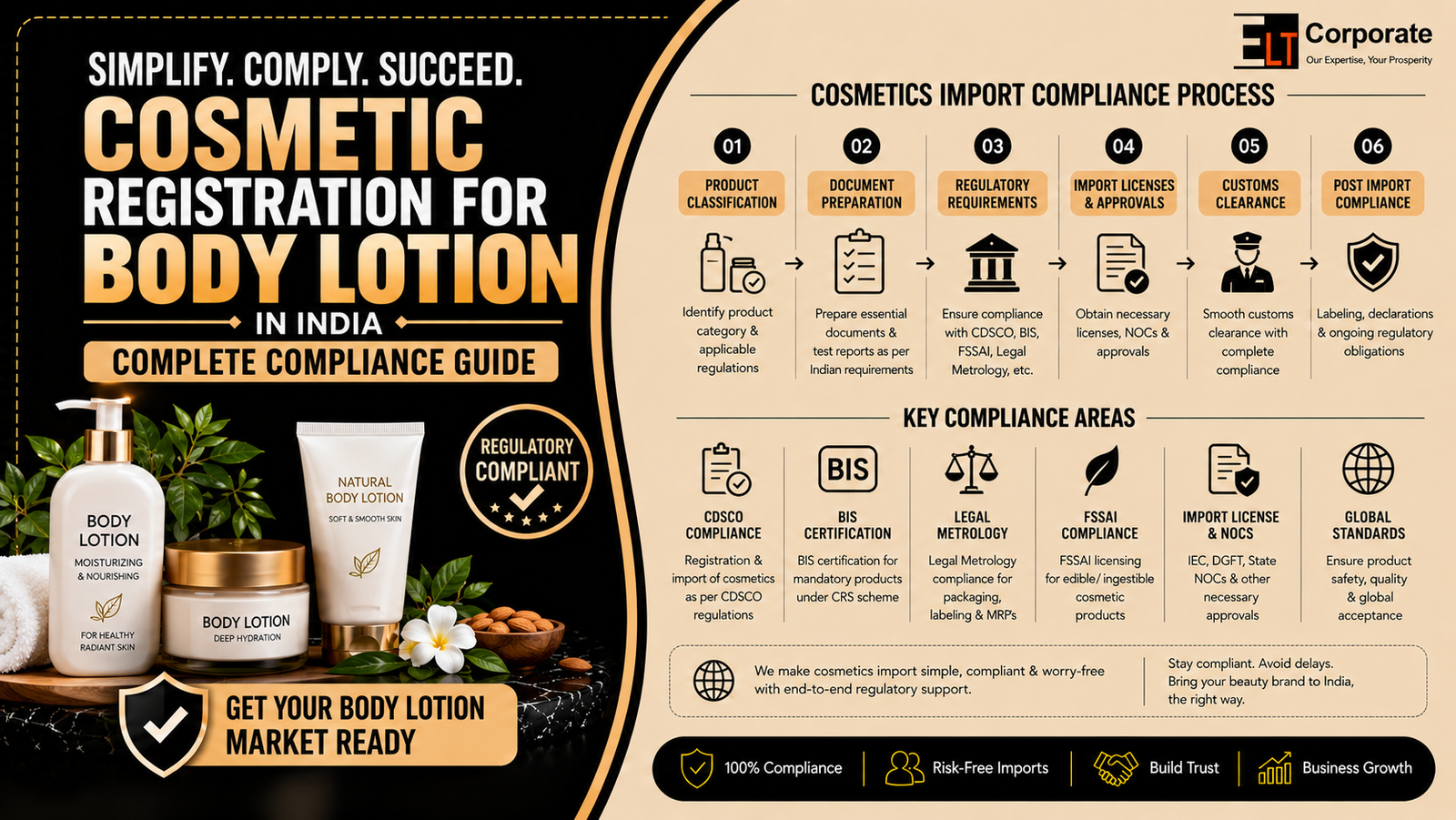

The Indian skincare market offers significant opportunities for businesses planning to launch moisturizing lotions, nourishing body creams, and other personal care products. However, before manufacturing, importing, or selling a body lotion, businesses must understand the applicable cosmetic regulations, product safety requirements, and labelling rules.
Cosmetic registration for body lotion in India is an important topic for startups, skincare brands, private-label businesses, importers, and manufacturers who want to enter the market with a compliant product.
The regulatory process depends on how the body lotion is sourced. Products manufactured in India are generally governed by the Cosmetics Rules, 2020, and the applicable State Licensing Authority’s licensing framework. Imported cosmetic products are subject to the registration requirements administered by the Central Drugs Standard Control Organization (CDSCO).
Cosmetics Regulatory helps businesses understand their regulatory obligations, prepare documentation, and plan their product launch more efficiently. This guide explains the major requirements, documents, labelling considerations, and compliance steps to consider before introducing a body lotion into the Indian market.
Need Help with Body Lotion Registration?
Planning to launch a body lotion brand in India? Get expert guidance on documentation, licensing, product labels, and cosmetic compliance requirements.
Get Free Expert Consultation 💬 WhatsApp an ExpertWhat Is Cosmetic Registration for Body Lotion in India?
Body lotion is generally classified as a cosmetic when it is intended to moisturize, soften, cleanse, or improve the appearance of the skin. Its classification and applicable requirements depend on its ingredients, intended use, formulation, and claims.
Cosmetic Registration for Body Lotion in India should not be treated as one identical procedure for every business. The correct route depends on whether the product is manufactured domestically, imported from another country, or produced by a third-party manufacturer.
Businesses should first identify their operating model and then determine the relevant license, registration, or permission requirements.
For example:
- Domestic manufacturing: The manufacturer must follow the applicable manufacturing licence requirements under the Cosmetics Rules, 2020.
- Imported body lotion: The product generally requires registration with the Central Licensing Authority before import into India.
- Private-label body lotion: The brand owner should verify the third-party manufacturer’s license, product documentation, labeling, and contractual responsibilities.
- New cosmetic formulations: Additional permissions may be applicable if the product falls within the definition of a new cosmetic under the rules.
Official reference: CDSCO Cosmetics Information.
Why Is Compliance Important for Body Lotion Brands?
Regulatory compliance helps businesses establish a reliable foundation for manufacturing, importing, and marketing skincare products. It also helps reduce avoidable documentation errors and product-launch delays.
Key benefits include:
- Legal readiness: Identifying the appropriate licensing or registration pathway before commercial operations begin.
- Product safety: Reviewing ingredients, specifications, and applicable quality standards.
- Correct labelling: Ensuring mandatory product information is included on the packaging.
- Business credibility: Providing distributors, retailers, and business partners with better compliance documentation.
- Reduced risk: Identifying unsupported claims, missing records, and documentation inconsistencies before launch.
Businesses seeking Cosmetic Registration for body lotion in India should review these requirements at the product-planning stage rather than waiting until the packaging or production process is complete.
Documents Required for Body Lotion Compliance
The documents required depend on the product, manufacturing arrangement, and application route. The following checklist covers common records that businesses may need to prepare.
1. Business and Applicant Documents
- Company incorporation or business registration documents, where applicable.
- Identity and address proof of the applicant or authorized signatory.
- Registered office and manufacturing premises details.
- Authorization documents, where an agent or representative submits the application.
- Applicable application forms and declarations.
2. Product and Formulation Documents
- Complete ingredient list and formulation details.
- Product specifications and intended use.
- Manufacturing process information, where required.
- Applicable product quality and safety test reports.
- Details of the product name, variants, and pack sizes.
- Supporting documents for any special ingredients or claims, where applicable.
3. Manufacturing Documents
For products manufactured in India, relevant records may include the manufacturing license, premises information, technical staff details, equipment information, and other documents required by the applicable licensing authority.
Businesses using a third-party manufacturer should obtain and verify the manufacturer’s valid licence and confirm that the proposed product and manufacturing activities are covered.
4. Documents for Imported Body Lotion
Import-related applications may require details of the foreign manufacturer, manufacturing premises, product specifications, product labels, authorization documents, and a Free Sale Certificate or other supporting documents, as applicable.
The precise checklist should be verified against the current CDSCO requirements and the applicant’s specific circumstances.
Important: A general checklist is not a substitute for the official application checklist. Review the applicable requirements before submission to avoid unnecessary delays.
Get Your Body Lotion Compliance Reviewed
Not sure which documents or regulatory route applies to your body lotion? Consult our regulatory team to identify the next steps for your product.
Request a Free Compliance Review →Step-by-Step Process for Body Lotion Compliance
Step 1: Finalize the Product and Business Model
Determine whether the body lotion will be manufactured in India, imported as a finished product, or sourced through a third-party manufacturer.
Confirm the product’s intended use, formulation, target consumers, variants, and proposed packaging. These details help determine the correct regulatory route.
Step 2: Identify the Applicable Regulatory Authority
Domestic cosmetic manufacturing is regulated through the relevant State Licensing Authority. Cosmetic imports are regulated through CDSCO under the applicable provisions of the Cosmetics Rules, 2020.
Do not assume that a domestic manufacturing licence and an import registration certificate are interchangeable.
Step 3: Review Ingredients and Product Safety
Check the formulation against applicable restrictions, prohibited or restricted ingredients, and relevant quality and safety standards. Arrange appropriate testing based on the formulation, product specifications, and applicable requirements.
Products must not be presented with misleading or unsupported claims. A body lotion advertised as moisturizing, for example, should have appropriate support for its stated benefits.
Step 4: Prepare the Application Documents
Compile the applicant’s details, manufacturing information, formulation records, test reports, and label artwork as required for the applicable route.
Ensure that product names, manufacturer details, addresses, variants, and pack sizes remain consistent across all supporting documents.
Step 5: Submit the Relevant Application
Follow the procedure specified by the competent authority. Domestic manufacturers should apply through the applicable state licensing authority process. Import applicants should follow the relevant CDSCO registration procedure and applicable online application requirements.
The application form, fees, and supporting records depend on the specific route.
Step 6: Review Packaging and Labels
Check the product label against the applicable requirements before finalizing commercial packaging. Correct any missing declarations, inaccurate information, or unsupported claims.
Step 7: Maintain Compliance Records
Keep copies of licenses, product specifications, test reports, approved artwork, and relevant supplier or manufacturing records. Review these documents whenever the formulation, packaging, manufacturer, or product claims change.
Labeling Requirements for Body Lotion in India
Labeling is a critical part of cosmetic compliance because consumers must receive accurate information about the product they purchase.
Depending on the applicable rules and packaging, the label may need to include:
- Product name and identity.
- Name and address of the manufacturer.
- Manufacturing licence details, where applicable.
- Net quantity.
- Ingredient declaration in the prescribed manner.
- Batch or lot identification.
- Manufacturing and expiry or use-before details, as applicable.
- Directions for use and necessary warnings.
- Applicable retail price declarations and other legal metrology information.
- Import-related declarations and registration details for imported products, as applicable.
The exact requirements depend on the product category, pack size, manufacturing or import arrangement, and applicable legal provisions.
Businesses should also review claims such as “dermatologically tested,” “natural,” “chemical-free,” “hypoallergenic” or “clinically proven” before using them. Such statements should be accurate and supported by suitable evidence where necessary.
For regulatory reference, review the Cosmetics Rules, 2020, and consult the applicable legal metrology requirements for packaged commodities.
Manufacturing vs Importing: Which Route Applies?
| Business model | Main regulatory consideration |
| Own manufacturing unit in India | Applicable domestic cosmetic manufacturing licence |
| Third-party manufacturing in India | Verification of the manufacturer’s licence and product compliance |
| Finished body lotion imported into India | Applicable CDSCO import registration requirements |
| Private-label brand | Allocation of responsibilities between brand owner and manufacturer |
| New cosmetic formulation | Assessment of whether additional permission is required |
The appropriate route should be determined before production or import commitments are made. Businesses should not rely solely on a supplier’s assurance that a product is ready for sale.
Common Mistakes to Avoid
Businesses planning a body lotion launch should watch out for these common issues:
- Applying under the wrong regulatory route.
- Submitting incomplete or inconsistent product documentation.
- Using packaging that omits mandatory declarations.
- Making unsubstantiated therapeutic or performance claims.
- Failing to verify a third-party manufacturer’s licence.
- Assuming that one product approval automatically covers every formulation, variant, or manufacturing site.
- Ignoring changes to ingredients, labels, or product specifications.
A structured compliance review can help identify these issues before they affect the launch timeline.
How Cosmetics Regulation Can Help
Cosmetics Regulatory can assist businesses in understanding their product’s regulatory pathway and preparing for the relevant compliance process.
Depending on the scope of engagement, support may include:
- Preliminary regulatory assessment for body lotion products.
- Guidance on documentation requirements.
- Manufacturing and import compliance guidance.
- Product label and claims review.
- Third-party manufacturing compliance checks.
- Identification of documentation gaps and next steps.
The exact scope depends on the product and business model. Regulatory support does not guarantee approval, as decisions remain with the competent authority.
If you are planning cosmetic registration for body lotion in India, seeking expert guidance early can help you identify the correct process and avoid preventable errors.
Ready to Launch Your Body Lotion Brand?
Get expert assistance with cosmetic licensing, documentation, labelling, and regulatory compliance for your body lotion product in India.
Get Free Consultation Contact Our AgencyTalk to our regulatory team about your product requirements.
Conclusion
Launching a body lotion brand involves more than choosing a formulation and designing attractive packaging. Businesses must understand the applicable manufacturing or import requirements, prepare supporting documentation, review product safety, and ensure that labels and marketing claims meet the relevant rules.
Cosmetic Registration for Body Lotion in India should be approached according to the product’s actual manufacturing and supply model. Early planning can help businesses identify the correct regulatory pathway, reduce avoidable errors, and prepare for a smoother product launch.
Frequently Asked Questions (FAQs)
Q1. Is registration required for body lotion in India?
The applicable requirements depend on whether the body lotion is manufactured domestically or imported. Domestic manufacturing generally requires the appropriate manufacturing license, while imported cosmetics generally require registration under the applicable rules.
Q2. Which authority regulates body lotion manufacturing in India?
Domestic cosmetic manufacturing is regulated by the relevant State Licensing Authority. Import registration is handled by CDSCO under the applicable Cosmetics Rules, 2020.
Q3. Can I launch a body lotion through a third-party manufacturer?
Yes, subject to applicable requirements. The brand owner should verify the manufacturer’s license, product documentation, labeling, and the responsibilities agreed upon between both parties.
Q4. What documents are needed for body lotion compliance?
Common documents include business details, formulation information, product specifications, manufacturing or import documents, test reports, and label artwork. The final checklist depends on the applicable regulatory route.
Q5. Can I import body lotion from another country and sell it in India?
Imported body lotion generally needs to meet the applicable CDSCO registration, quality, safety, and labelling requirements before import. Verify the requirements for the specific product and manufacturer.
Q6. How can I check whether my body lotion label is compliant?
Compare the proposed label with the applicable Cosmetics Rules, 2020, relevant legal metrology requirements, and any import-specific declarations. A product-specific label review can help identify gaps.
Need Assistance with Body Lotion Compliance?
Get expert guidance on cosmetic manufacturing licences, product documentation and labelling requirements. Connect with Cosmetics Regulatory to understand the compliance steps for your body lotion.