
The cosmetics industry in India is growing at a fast pace, and there has been an increase in demand for international cosmetic brands and imported cosmetic products. Be it skincare products, hair care products, makeup products, perfumes, or even personal care products, one now has a choice of products from many different countries.
Businesses, however, cannot just bring an imported cosmetic product into the country and begin to sell it without taking into account the relevant regulations that exist within the country.
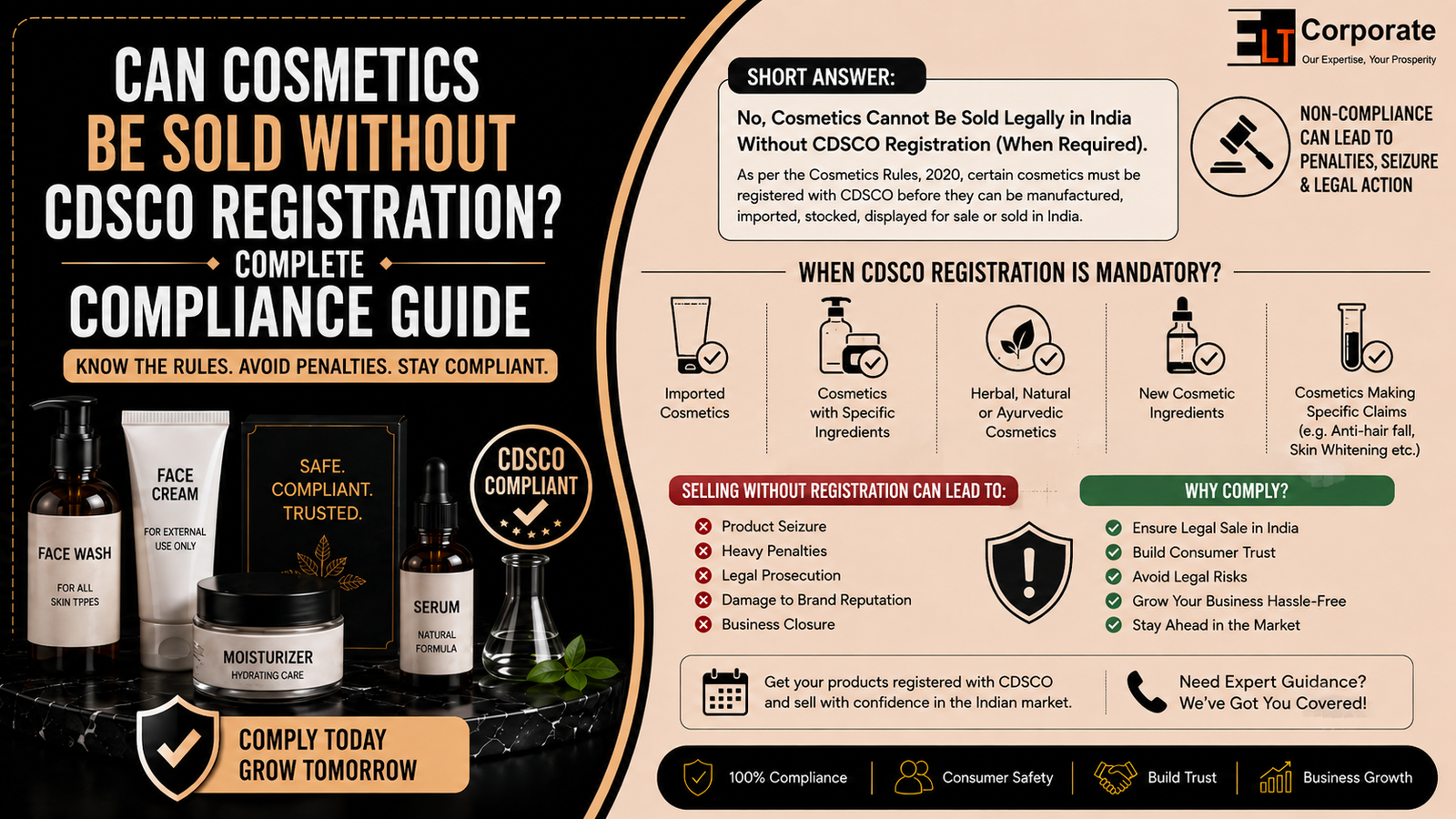
A frequently asked question by importers and distributors as well as brand owners is whether it is possible to sell cosmetics without CDSCO registration in India.
When it comes to importing cosmetics, the answer in most cases is a negative one since the product will need to be registered within the country according to the relevant Indian regulatory system.
This guide will help to understand when a cosmetic product needs to be registered, the consequences of selling a non-conforming product, and how one can prepare the product for the Indian market.
Need Help With CDSCO Cosmetic Registration?
Get expert assistance for cosmetic registration and regulatory compliance in India.
Get Expert Assistance WhatsApp Us Call NowWhat Is CDSCO Cosmetic Registration?
CDSCO cosmetic registration is the regulatory process applicable to cosmetics imported into India.
Under the Cosmetics Rules, 2020, imported cosmetics are subject to regulatory requirements before they can be imported for sale or distribution in India. The regulatory framework covers products such as
- Face creams
- Moisturizers
- Serums
- Cleansers
- Shampoos
- Conditioners
- Hair oils
- Makeup products
- Lip products
- Sunscreens
- Perfumes
- Deodorants
- Body care products
- Other products falling within the definition of cosmetics
The applicable registration process involves submitting prescribed information and documents concerning the product, manufacturer, and other relevant details.
Can Imported Cosmetics Be Sold Without CDSCO Registration?
Generally, imported cosmetics that require registration cannot legally be imported and commercially sold in India without fulfilling the applicable CDSCO requirements.
Registration should be addressed before commercial importation and sale. An importer should not assume that a product is automatically permitted simply because:
- It is legally sold in another country.
- It has approval from a foreign authority.
- It is manufactured by a reputed international company.
- It is already available in other countries.
- It is being sold through an online marketplace.
- The product is considered safe by the manufacturer.
Indian regulatory requirements apply independently. For this reason, businesses planning to introduce an international cosmetic brand into India should conduct a regulatory assessment before shipping products.
Why Is CDSCO Registration Important?
The purpose of India’s cosmetic regulatory framework is to ensure that cosmetics entering the Indian market meet applicable standards relating to safety, quality, labeling, and other regulatory requirements.
For importers, compliance can help establish that:
- The product is appropriately documented.
- The manufacturer is properly identified.
- Product information has been submitted through the applicable regulatory process.
- Labels comply with applicable Indian requirements.
- The product can be legally imported and marketed, subject to applicable requirements.
For businesses building a long-term cosmetic brand in India, compliance should be treated as part of the product launch process rather than as an afterthought.
What Happens If You Sell Cosmetics Without Required Registration?
Selling or distributing imported cosmetics without fulfilling applicable regulatory requirements can expose a business to regulatory and commercial risks.
Potential consequences may include:
1. Import or Customs Problems
Products may face difficulties during importation if the required regulatory documentation is not available. This can result in shipment delays and additional costs for the importer.
2. Regulatory Action
Non-compliant products may attract regulatory scrutiny or action under the applicable provisions of Indian law. The nature of the action depends on the circumstances and the specific violation.
3. Product Seizure or Detention
Where authorities identify non-compliance, products may be detained or otherwise dealt with in accordance with applicable legal procedures. This can create significant financial losses, particularly when a business has imported a large quantity.
4. Business Disruption
If products cannot be legally marketed, businesses may have to stop sales while resolving the compliance issue. For retailers and distributors, this can also affect relationships with marketplaces and customers.
5. Financial Loss
Non-compliance can result in:
- Inventory losses
- Storage expenses
- Shipment-related costs
- Relabeling expenses
- Regulatory compliance costs
- Product withdrawal costs
- Lost sales opportunities
Therefore, completing regulatory requirements before launching a product is generally more efficient than trying to correct compliance problems after importation.
Is CDSCO Registration Required for Every Cosmetic Product?
The requirement depends on whether the product falls within the regulatory definition of a cosmetic and whether it is being imported into India for commercial purposes.
Importers should first determine:
- Whether the product is a cosmetic under Indian law.
- Whether it is manufactured outside India.
- Whether it is intended for commercial import and sale.
- Whether any specific regulatory requirements apply to the product.
- Whether the product contains ingredients or makes claims that require additional assessment.
Products that appear similar may have different regulatory considerations depending on their formulation, intended use, and claims.
For example, a product marketed purely as a cosmetic may be treated differently from a product making therapeutic or medicinal claims.
What About Cosmetics Manufactured in India?
The regulatory process is different for domestically manufactured cosmetics. Indian manufacturers must comply with the applicable requirements under the Cosmetics Rules, 2020, including the relevant manufacturing licensing requirements.
Therefore, businesses should distinguish between:
Imported cosmetics: Applicable import registration requirements must be considered.
Indian-manufactured cosmetics: Applicable cosmetic manufacturing licensing requirements must be fulfilled.
Simply obtaining a manufacturing license does not substitute for the applicable import registration requirements for an imported cosmetic.
Can Cosmetics Be Sold Online Without Registration?
Selling cosmetics through an online marketplace does not remove the requirement to comply with applicable Indian regulations.
Whether the product is sold through:
- Amazon
- Flipkart
- A brand’s own website
- Social media
- A beauty marketplace
- A physical retail store
- A distributor
The business must still consider the applicable regulatory requirements. Online availability does not make an otherwise non-compliant imported cosmetic legally marketable.
Businesses planning to sell imported cosmetics online should therefore complete their regulatory assessment before listing the products for sale.
What About Samples and Testers?
Not every cosmetic transaction has the same regulatory context.
Businesses may deal with:
- Commercial products
- Samples
- Testers
- Promotional units
- Products for demonstration
- Products imported for specific non-commercial purposes
The applicable requirements can differ depending on the purpose, quantity, and manner of importation.
Therefore, businesses should not assume that a product is exempt simply because it is labeled as a “sample” or “tester.”
If you are importing samples or testers, the intended purpose and applicable regulatory route should be evaluated before shipment.
What Documents Are Generally Required?
The exact documentation depends on the product and regulatory route. However, cosmetic importers may need documents relating to:
- Foreign manufacturer
- Manufacturing site
- Product details
- Product composition
- Ingredients
- Product labels
- Packaging
- Authorization from the manufacturer or brand owner
- Free Sale Certificate or equivalent documentation
- Product specifications
- Other supporting documents required under the applicable process
Documents should be consistent across the regulatory application, product packaging, and commercial records. Differences in manufacturer names, addresses, product names, or formulations can create avoidable compliance issues.
How to Get CDSCO Registration for Imported Cosmetics
Businesses planning to sell imported cosmetics in India should generally follow a structured compliance process.
Step 1: Identify the Product
Determine whether the product qualifies as a cosmetic under Indian regulations.
Step 2: Review the Manufacturer
Collect complete information about the foreign manufacturer and manufacturing facility.
Step 3: Review Ingredients
Assess the product composition and ingredients against applicable Indian requirements.
Step 4: Check Product Labels
Review the proposed packaging and label information for compliance with Indian requirements.
Step 5: Collect Supporting Documents
Obtain the necessary manufacturer, product, and authorization documents.
Step 6: Submit the Applicable Application
Complete the applicable CDSCO registration process with the required information and supporting documents.
Step 7: Address Regulatory Queries
If the authority raises an objection or requests clarification, the importer should respond with appropriate information.
Step 8: Import and Market the Product
Once the applicable regulatory requirements have been fulfilled, the business can proceed with importation and marketing in accordance with Indian law.
Common Mistakes Made by Cosmetic Importers
Many businesses face compliance issues because they begin selling products before completing the regulatory assessment.
Common mistakes include:
Importing Before Registration
Some businesses order large quantities before checking whether the applicable registration has been obtained.
Assuming Foreign Approval Is Enough
Approval or registration in another country does not automatically satisfy Indian requirements.
Ignoring Label Requirements
A label compliant in the country of manufacture may not contain all information required under Indian regulations.
Using Inconsistent Documents
Differences between the manufacturer’s documents and the product label can cause problems during regulatory review.
Treating Samples as Automatically Exempt
The word “sample” on a package does not by itself determine the regulatory status of an import.
Waiting Until Customs Clearance
Compliance should be planned before shipment rather than after the goods arrive in India.
Why Compliance Should Be Completed Before Product Launch
For a cosmetic importer, regulatory compliance is an important part of the product launch timeline.
A better approach is
Product selection → Regulatory assessment → Document collection → Registration → Label compliance → Import → Sale
Instead of:
Product purchase → Import → Attempt to resolve regulatory issues → Sale
The first approach can reduce the risk of shipment delays, unexpected costs, and business disruption.
Need Help With CDSCO Cosmetic Registration?
Get expert assistance for cosmetic registration and regulatory compliance in India.
Get Expert Assistance WhatsApp Us Call NowConclusion
Can cosmetics be sold without CDSCO registration in India then? The short answer is “no” in case of imported cosmetics under the corresponding registration obligations.
The best way for businesses is to make sure that all regulatory requirements in relation to their products are fulfilled prior to the import and sale of such products in India.
In this way, businesses may protect themselves from any possible obstacles, additional costs, and problems.
If you plan to import and sell cosmetics in India, then professional regulatory assistance will be helpful in defining the corresponding requirements and getting CDSCO registration for your cosmetics.
Frequently Asked Questions
Q1. Can I sell imported cosmetics in India without CDSCO registration?
If the imported cosmetic is subject to the applicable CDSCO registration requirements, it should not be commercially imported and sold without completing those requirements.
Q2. Is CDSCO registration required before importing cosmetics?
For cosmetics subject to the applicable import registration requirements, the regulatory process should be completed before commercial importation and sale.
Q3. Can I sell cosmetics online without CDSCO registration?
Selling through an online platform does not eliminate applicable cosmetic regulatory requirements. Imported cosmetics must comply with the relevant Indian regulations regardless of the sales channel.
Q4. Does a foreign cosmetic license work in India?
A foreign license or approval does not automatically replace the applicable Indian regulatory requirements for importing and selling cosmetics in India.
Q5. What if my cosmetic is already registered in another country?
Registration in another country can provide supporting information, but it does not by itself
constitute Indian CDSCO registration.
Q6. Can I import cosmetic samples without registration?
Samples may be subject to different requirements depending on their purpose, quantity, and manner of importation. Importers should assess the applicable regulatory route before shipment.
Q7. What is the penalty for selling cosmetics without registration?
The consequences depend on the nature of the non-compliance and applicable legal provisions. Businesses may face regulatory action, product detention, or other consequences.