
Starting a hair oil manufacturing business in India is a promising opportunity for entrepreneurs, cosmetic manufacturers, startups, and private-label brands. With increasing demand for coconut oil, herbal hair oil, almond oil, and other hair care products, many businesses are exploring opportunities in this sector. However, manufacturing and selling hair oil commercially requires compliance with applicable Indian regulations.
Obtaining a Hair Oil Manufacturing License in India is an important step before starting commercial production. Manufacturers must understand product classification, licensing requirements, manufacturing premises, documentation, quality standards, and labelling rules.
The regulatory requirements depend on the formulation, ingredients, intended use, and claims made about the product. Regular cosmetic hair oils and Ayurvedic medicinal oils may follow different regulatory frameworks.
In this guide, Cosmetics Regulatory explains the licensing process, documents, eligibility requirements, and compliance obligations for starting a hair oil manufacturing business in India.
Need help preparing documents for your Hair Oil Manufacturing License?
Get Free ConsultationWhat Is a Hair Oil Manufacturing License in India?
A Hair Oil Manufacturing License in India is the regulatory approval required for manufacturing cosmetic hair oil products for sale or distribution.
Regular cosmetic hair oils are regulated under the Drugs and Cosmetics Act, 1940, and the Cosmetics Rules, 2020. The respective state licensing authority generally grants domestic cosmetic manufacturing licenses.
Products used for conditioning, moisturizing, and improving the appearance of hair generally fall under cosmetic regulations, depending on their formulation and claims.
However, products claiming to treat medical conditions, prevent hair loss, or promote hair regrowth may require additional regulatory assessment.
Cosmetics Regulatory helps businesses understand the correct product category before beginning the licensing process.
Which Authority Issues a Hair Oil Manufacturing License?
The respective state licensing authority is responsible for granting licenses for domestic cosmetic manufacturing.
The major regulations include:
- Drugs and Cosmetics Act, 1940.
- Cosmetics Rules, 2020.
- Applicable cosmetic quality and safety standards.
- Packaging and labeling requirements.
The Central Drugs Standard Control Organisation (CDSCO) performs central regulatory functions for cosmetics, including import-related responsibilities. However, domestic cosmetic manufacturing licenses are generally issued by the State Licensing Authority.
Cosmetics Regulatory assists applicants in understanding the applicable licensing authority and preparing their applications.
Types of Hair Oil Manufacturing Licenses
The applicable licence depends on the product category and manufacturing arrangement.
A. Regular Cosmetic Hair Oil
Products such as coconut hair oil, almond hair oil, herbal hair oil, and conditioning hair oil may fall under cosmetic regulations.
The relevant application and licence forms are
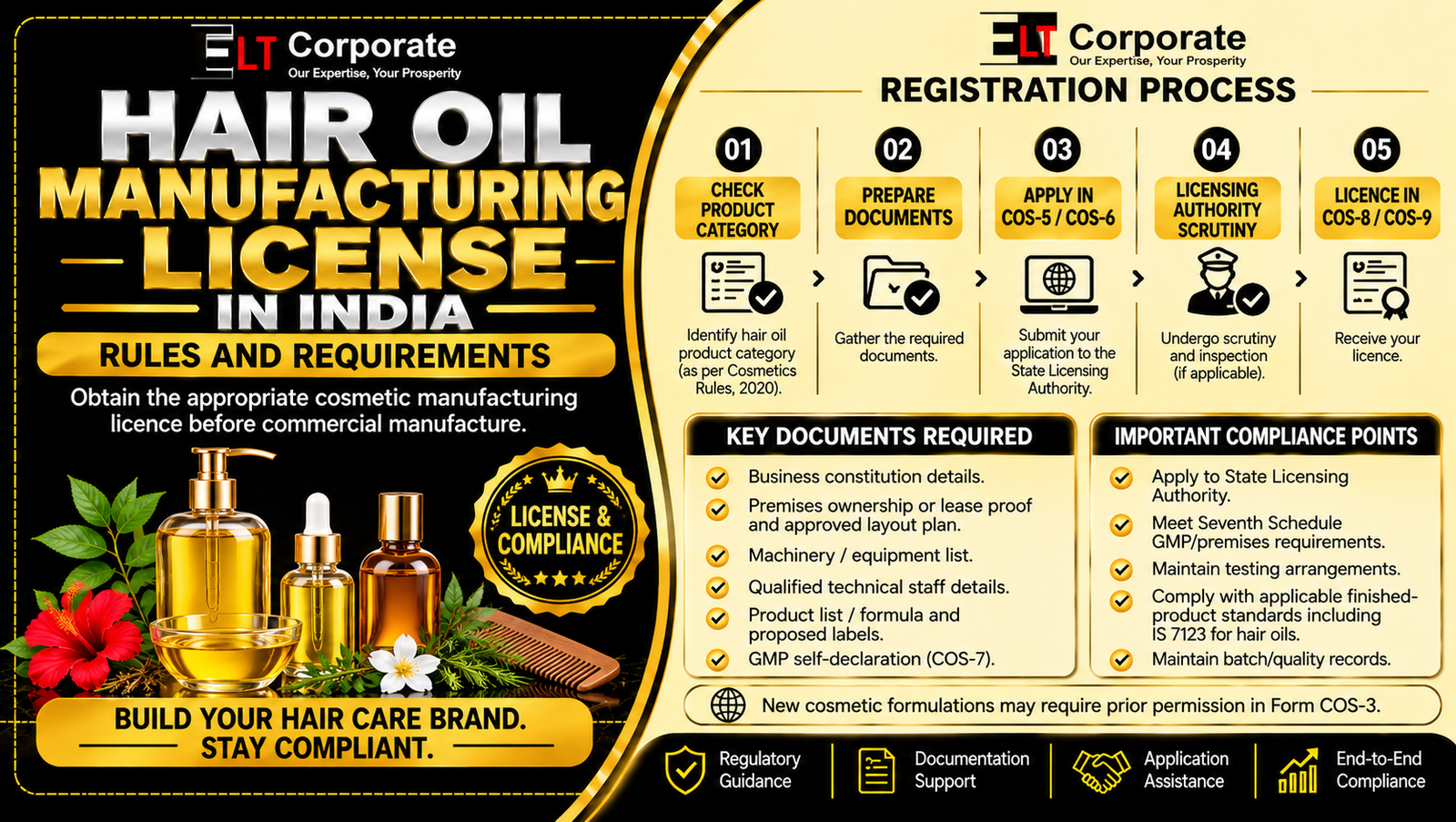
- Form COS-5: Application for a cosmetic manufacturing licence.
- Form COS-8: Cosmetic manufacturing licence.
B. Loan Licence for Hair Oil Manufacturing
Businesses without their own manufacturing facilities can explore manufacturing through an existing licensed manufacturing unit.
The applicable forms include:
- Form COS-6: Application for a loan licence.
- Form COS-9: Loan licence for manufacturing cosmetics.
C. Ayurvedic Hair Oil
If a product qualifies as an Ayurvedic medicine based on its formulation, ingredients, intended use, and therapeutic claims, it may require an applicable AYUSH manufacturing licence rather than an ordinary cosmetic manufacturing licence.
Therefore, product classification should be completed before selecting the application route.
Documents Required for Hair Oil Manufacturing License
Preparing the correct documentation is an important part of obtaining a hair oil manufacturing license in India. Applicants should arrange the necessary documents before submitting their applications.
Commonly required documents include:
- Identity proof and address proof of the applicant.
- PAN card of the business or proprietor.
- Certificate of Incorporation or business registration.
- Partnership deed, where applicable.
- Ownership proof or rent agreement of the premises.
- Manufacturing unit layout and site plan.
- List of manufacturing machinery and equipment.
- Details of proposed hair oil products.
- Product formulations and ingredient details.
- Qualifications and appointment details of technical staff.
- Details of testing facilities or an eligible testing laboratory.
- GMP self-certification in Form COS-7.
- Prescribed application fee and supporting declarations.
The documentation requirements may vary depending on the state authority and manufacturing arrangement.
Cosmetics Regulatory helps businesses organize their documents and identify missing information before application submission.
Need Help Getting Your Hair Oil Manufacturing License?
Planning to start a hair oil manufacturing business in India? Get expert assistance with licensing requirements, documentation, GMP compliance, and the application process.
Documents Required for Hair Oil Manufacturing License Contact UsManufacturing Premises Requirements
A suitable manufacturing facility is essential for obtaining a hair oil manufacturing license in India.
The manufacturing premises must comply with the applicable requirements of the Seventh Schedule of the Cosmetics Rules, 2020.
Important requirements include:
- Adequate manufacturing and storage space.
- Proper ventilation and lighting.
- Clean and hygienic production areas.
- Suitable mixing and blending equipment.
- Appropriate filling and packaging machinery.
- Separate arrangements for raw materials and finished products.
- Proper water supply and sanitation.
- Suitable storage conditions.
- Quality control and testing arrangements.
Manufacturers must maintain hygiene throughout production and ensure that raw materials and finished products are protected against contamination.
Confused about GMP and manufacturing premises requirements?
Talk to a Regulatory ExpertStep-by-Step Application Process
The application process for a Hair Oil Manufacturing License in India involves several stages.
Step 1: Product Classification
Identify whether the proposed product is a regular cosmetic hair oil or an Ayurvedic medicinal product. Review its ingredients, intended purpose, and marketing claims.
Step 2: Arrange Manufacturing Premises
Set up the manufacturing unit according to applicable infrastructure and GMP requirements.
Step 3: Prepare Documents
Collect business registration documents, premises details, product formulations, machinery information, and technical staff documents.
Step 4: Submit the Application
For regular cosmetic manufacturing, submit Form COS-5 to the concerned State Licensing Authority with the prescribed fee and supporting documents. For loan licence applications, use Form COS-6.
Step 5: Inspection and Verification
The licensing authority examines the application and may inspect the manufacturing premises to verify compliance with applicable requirements.
Step 6: Grant of Licence
After satisfactory verification, the authority may grant the manufacturing licence in Form COS-8 or the loan licence in Form COS-9.
Under Rule 23, the prescribed timeline for granting a licence is generally 45 days after receipt of a complete application, subject to fulfillment of applicable requirements.
Cosmetics Regulatory provides assistance throughout the application process, including documentation and regulatory follow-up.
Ready to apply for your Hair Oil Manufacturing License in India?
Contact Our TeamHair Oil Labelling and Packaging Requirements
Obtaining a Hair Oil Manufacturing License in India is not the only compliance requirement. Manufacturers must also ensure that their packaging and labels follow applicable cosmetic regulations.
Important label declarations include:
- Name of the cosmetic product.
- Manufacturer’s name and complete address.
- Manufacturing licence number.
- Batch number.
- Net contents.
- Manufacturing date and expiry or use-before details, as applicable.
- Ingredient declaration.
- Directions for use.
- Necessary warnings and precautions.
Manufacturers must also ensure that their advertising and product claims are accurate and not misleading.
Claims such as hair regrowth, treatment of hair loss, and curing scalp diseases should receive appropriate regulatory assessment before being printed on product labels or used in advertisements.
Cosmetics Regulatory assists brands with product label reviews and regulatory compliance guidance.
Quality Control and Testing Requirements
Quality control plays an important role in maintaining the safety, consistency, and quality of hair oil products.
Manufacturers should establish suitable quality control procedures covering:
- Raw material inspection.
- Finished product testing.
- Batch manufacturing records.
- Product specifications.
- Packaging material verification.
- Quality testing reports.
- Storage and handling procedures.
Manufacturers must maintain suitable testing arrangements through their own facilities or an eligible approved laboratory, as applicable under the Cosmetics Rules, 2020.
Proper quality documentation also helps businesses maintain consistent product standards.
Common Mistakes to Avoid During Licensing
Applicants may face regulatory objections because of incomplete documentation or incorrect product classification.
Some common mistakes include:
- Selecting the wrong licence category.
- Submitting incomplete application documents.
- Ignoring GMP requirements.
- Not arranging qualified technical personnel.
- Using unsuitable manufacturing premises.
- Preparing incorrect product formulations.
- Making misleading product claims.
- Ignoring packaging and labeling requirements.
Avoiding these mistakes can make the Hair Oil Manufacturing License in India application process smoother and reduce unnecessary delays.
Cosmetics Regulatory helps applicants identify potential compliance gaps before submitting their applications.
Why Choose Cosmetics Regulation?
Starting a hair oil manufacturing business requires proper regulatory planning and documentation. Businesses must understand the applicable licence category, manufacturing requirements, quality standards, and product compliance obligations.
Cosmetics Regulatory provides professional regulatory consultancy and assistance to manufacturers, entrepreneurs, startups, and private-label brands.
Our services include:
- Product category assessment.
- Manufacturing licence documentation.
- COS-5 and COS-6 application assistance.
- GMP compliance guidance.
- Manufacturing premises documentation.
- Product labelling review.
- Regulatory application support.
With professional guidance from Cosmetics Regulatory, businesses can prepare their applications more effectively and understand the applicable regulatory requirements.
Conclusion
Obtaining a Hair Oil Manufacturing License in India is an essential step for businesses planning to manufacture and sell cosmetic hair oils. From product classification and manufacturing premises to documentation, quality control, and labelling, every stage requires proper attention.
Entrepreneurs should identify the applicable regulatory framework before investing in manufacturing infrastructure or launching their products.
Cosmetics Regulatory can help you understand the licensing requirements and navigate the application process with professional assistance.
Frequently Asked Questions
Q1. Is a licence required to manufacture hair oil in India?
Yes. A cosmetic manufacturing licence from the concerned state licensing authority is generally required for commercial manufacturing.
Q2. Which form is required for a hair oil manufacturing license?
Form COS-5 is used to apply for a regular cosmetic manufacturing licence, while Form COS-8 is the licence issued.
Q3. Can I manufacture hair oil through a third-party manufacturer?
Yes. Eligible businesses can explore the loan licence route using Form COS-6, subject to applicable requirements.
Q4. Does CDSCO issue hair oil manufacturing licenses?
Domestic cosmetic manufacturing licenses are generally issued by state licensing authorities under the Cosmetics Rules, 2020.
Q5. Does Ayurvedic hair oil require a cosmetic licence?
Not necessarily. Products qualifying as Ayurvedic medicines may require an AYUSH manufacturing licence depending on their formulation, intended use, and claims.
Start Your Hair Oil Manufacturing Business!
Need assistance with a Hair Oil Manufacturing License in India? Get expert support for documentation, licensing, and regulatory compliance.
Get Free Consultation WhatsApp an Expert Call Now Contact Us