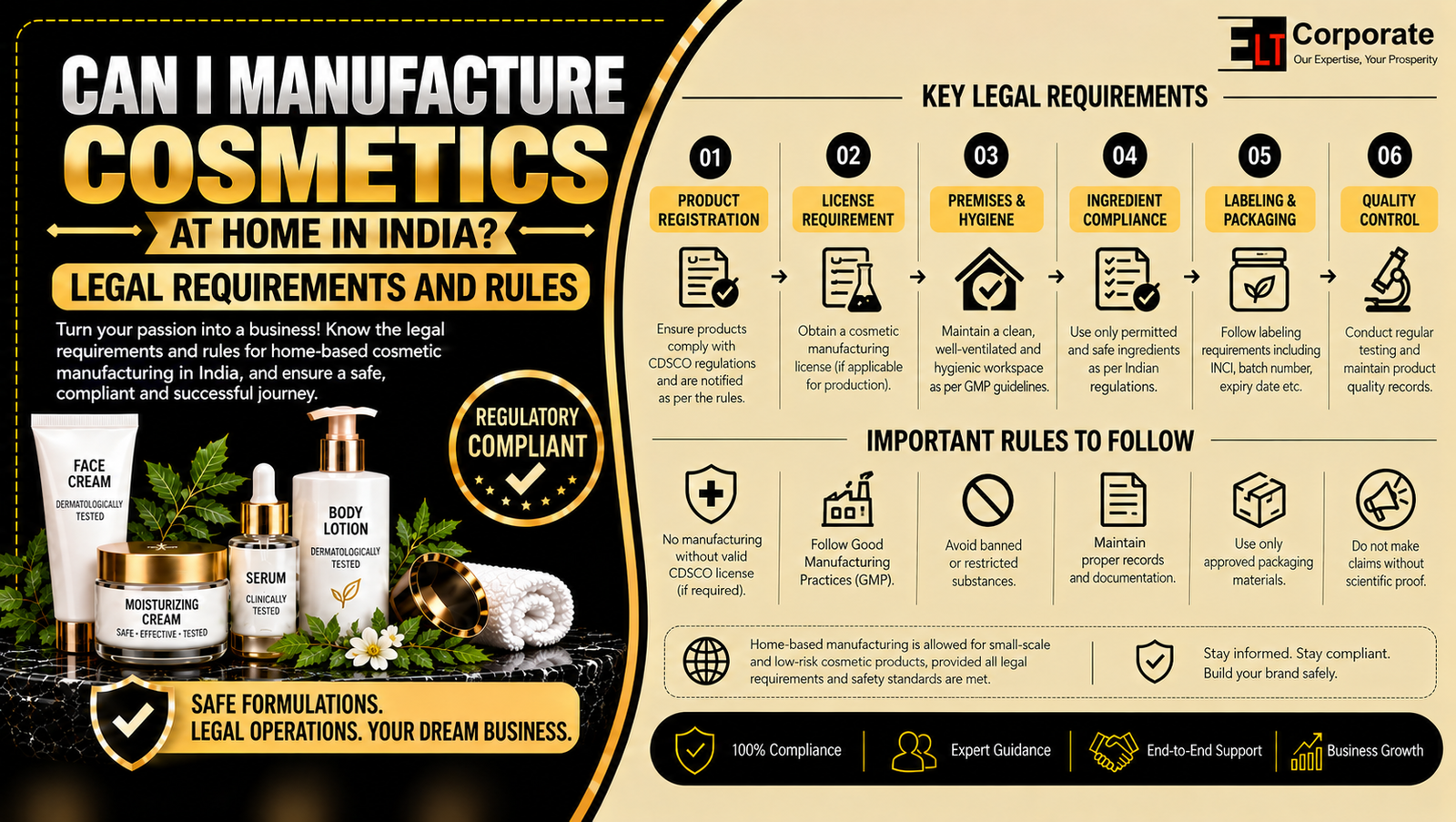

There is a growing number of brands, manufacturers, and private-label businesses in the Indian cosmetics industry. Manufacturing cosmetics requires regulatory approvals and maintaining a license and adhering to the regulations.
According to the Cosmetics Rules, 2020, manufacturing licenses are issued by state licensing authorities. These licenses are valid perpetually, subject to retention fees. Therefore, understanding the manufacturing license renewal process is important for every cosmetic manufacturer.
Cosmetics Regulatory provides manufacturers with information on various aspects of licensing, documentation, and compliance and regulatory processes. The Guide provides information on processes, important documents, government fees, and crucial compliance requirements.
Need Assistance With Cosmetic Manufacturing License Renewal?
Make your licence retention process easier with professional guidance on documentation, retention fees and regulatory compliance. Connect with our team for expert assistance.
What Is Cosmetic Manufacturing License Renewal?
Cosmetic Manufacturing License Renewal refers to maintaining the validity of an existing cosmetic manufacturing licence through the prescribed retention fee process.
Earlier, cosmetic manufacturing licenses followed a periodic renewal system. However, the Cosmetics Rules, 2020, introduced perpetual validity for licenses issued in Form COS-8 and Form COS-9.
Under Rule 30, manufacturers must pay the applicable retention fee before completing five years from the licence issue date. This means manufacturers generally do not need conventional renewal applications every five years. Instead, they must complete the prescribed retention fee requirements.
Cosmetics Regulation helps businesses understand these regulatory changes and their practical implications.
Who Needs to Maintain a Cosmetic Manufacturing License?
Any business manufacturing cosmetics for sale or distribution must obtain the appropriate licence.
This requirement applies to several types of businesses:
- Cosmetic manufacturers producing skincare products.
- Companies manufacturing haircare and personal care products.
- Businesses producing shampoos, conditioners, and soaps.
- Private-label cosmetic manufacturing companies.
- Contract manufacturers producing products for other brands.
- Businesses manufacturing makeup and beauty products.
Depending on the manufacturing arrangement, businesses generally require one of these licenses:
Form COS-8: For manufacturers operating their own manufacturing facilities.
Form COS-9: For businesses manufacturing cosmetics using another licensed manufacturer’s facilities.
Both licenses require compliance with applicable manufacturing standards.
Cosmetic Manufacturing License Renewal Process in India
Understanding the applicable procedure helps manufacturers avoid unnecessary delays.
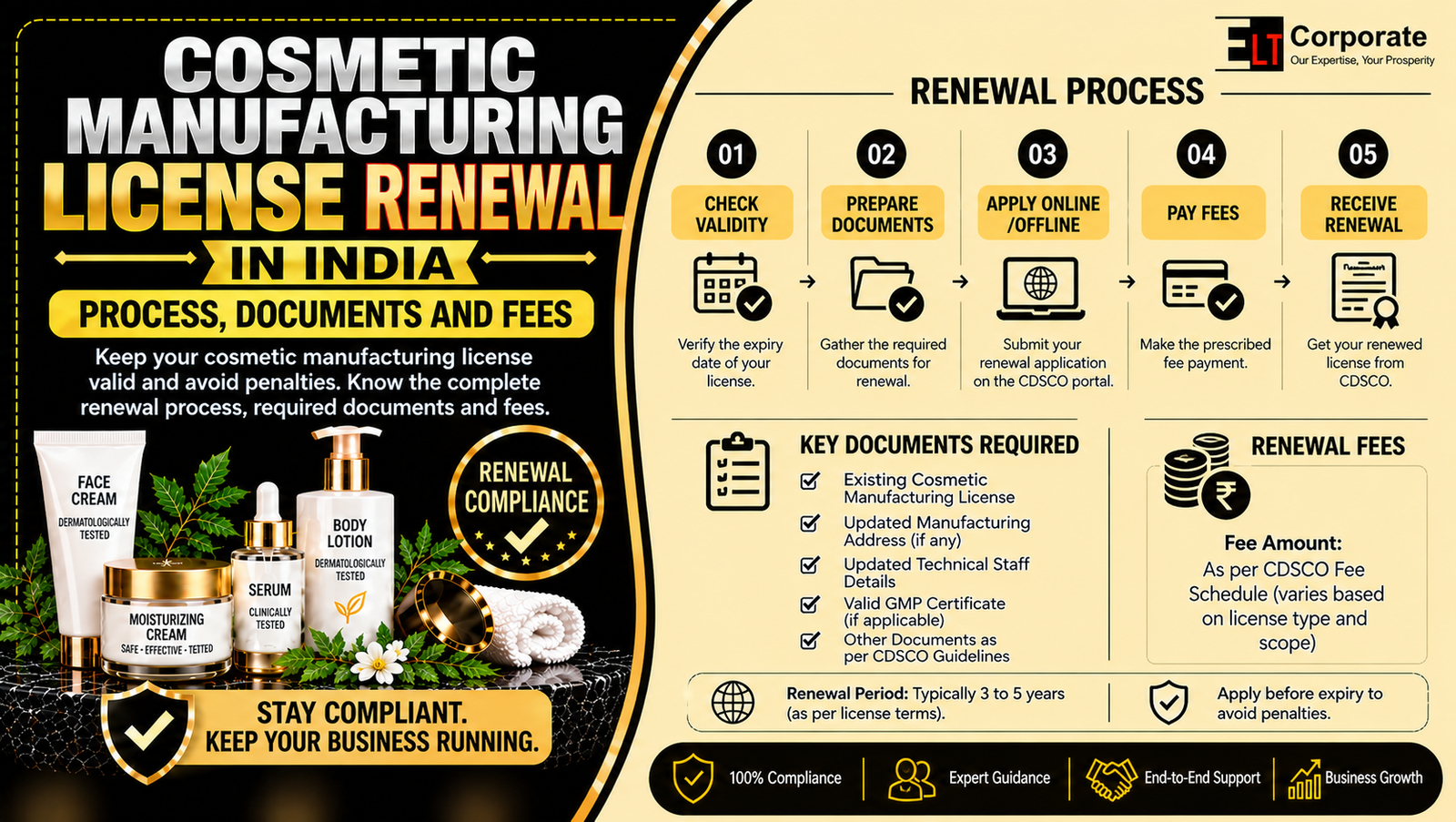
The Cosmetic Manufacturing License Renewal process mainly involves checking licence details, calculating the retention fee, and completing the prescribed payment.
Here are the important steps.
Step 1: Check Your Existing Manufacturing Licence
First, review your existing COS-8 or COS-9 licence.
Check the following information:
- Manufacturing licence number.
- Licence issue date.
- Manufacturing company name.
- Registered manufacturing address.
- Approved cosmetic categories.
- Approved product details.
Need Assistance With Cosmetic Manufacturing License Renewal?
Make your licence retention process easier with professional guidance on documentation, retention fees and regulatory compliance. Connect with our team for expert assistance.
These details help determine the applicable retention fee deadline.
Step 2: Verify Regulatory Compliance
Before proceeding with cosmetic manufacturing license renewal, review your manufacturing facility’s compliance status. Ensure that your premises follow applicable Good Manufacturing Practices (GMP).
Check manufacturing equipment, hygiene arrangements, storage facilities, and quality-control procedures. Also verify whether your product labels follow applicable regulatory requirements.
Step 3: Calculate the Applicable Retention Fee
Manufacturers must identify the applicable government fee. The amount depends on the licence category and approved cosmetic items. Check the Third Schedule of the Cosmetics Rules, 2020. Confirm the applicable amount with your State Licensing Authority.
Step 4: Complete the Retention Fee Payment
Submit the prescribed retention fee within the required timeframe. Keep the payment receipt and acknowledgement safely. These records help demonstrate compliance during future inspections.
Step 5: Maintain Updated Licence Records
After payment, maintain the acknowledgement and updated regulatory records. Cosmetics Regulatory recommends keeping licence documents, payment receipts, and compliance records organized.
Documents Required for Cosmetic Manufacturing License Renewal
Proper documentation is important for smooth regulatory processing. Manufacturers should keep the following documents ready:
- Copy of the existing COS-8 or COS-9 licence.
- Company incorporation certificate or business registration proof.
- PAN card of the company or proprietor.
- Manufacturing premises address proof.
- Details of approved cosmetic products.
- Updated manufacturing facility information.
- GMP compliance documents and declarations.
- Previous retention fee payment receipts, where applicable.
- Details of any changes in company constitution.
- Authorization letter for the appointed representative.
Additional documents may be requested by the concerned State Licensing Authority. For accurate documentation, Cosmetics Regulatory recommends reviewing the applicable state-specific requirements before submitting an application.
Cosmetic Manufacturing License Renewal Fees in India
Government fees depend on the applicable licence category and approved products.
Under the Third Schedule of the Cosmetics Rules, 2020, the prescribed manufacturing licence fee structure includes the following:
| Particulars | Government fee |
| COS-8 license, up to 10 items per category | ₹10,000 |
| Each additional item | ₹500 |
| Each additional category, up to 10 items | ₹10,000 |
| COS-9 loan license, up to 10 items per category | ₹10,000 |
| Each additional item under COS-9 | ₹500 |
These figures relate to the prescribed licence fee structure. The applicable retention fee should be verified against the current rules and State Licensing Authority requirements.
Cosmetic Manufacturing License Renewal fees should be paid within the prescribed deadline.
What Happens If You Miss the Payment Deadline?
Rule 30 also specifies consequences for delayed retention fee payments.
- A late fee of 2% of the retention fee applies monthly.
- The calculation covers every month or part thereof.
- The permitted late payment period is 180 days.
- Non-payment within this period results in deemed cancellation.
Therefore, timely cosmetic manufacturing license renewal compliance is extremely important. Manufacturers should not assume that an existing licence remains valid indefinitely without payment.
Important Compliance Requirements After Licence Renewal
Paying the retention fee is not the only regulatory responsibility. Manufacturers must continue following the applicable provisions of the Cosmetics Rules, 2020.
Important responsibilities include:
- Good Manufacturing Practices (GMP): Manufacturing premises must maintain prescribed hygiene, infrastructure, and quality standards.
- Product Quality Testing: Manufacturers must test raw materials and finished cosmetic products as required.
- Batch Manufacturing Records: Maintain complete production and raw material records.
- Product Labeling Compliance: Ensure labels follow applicable cosmetic labeling requirements.
- Inspection Readiness: Keep manufacturing records, inspection books, and relevant documents accessible.
- Reporting Changes: Inform the Licensing Authority about relevant changes in manufacturing details, composition, testing, or company constitution.
Under Rule 31, manufacturing premises are subject to inspections at least once every three years or as required under a risk-based approach.
Common Mistakes to Avoid During Licence Retention
Many manufacturers overlook important regulatory responsibilities.
Avoid these common mistakes:
- Assuming licenses require no further payments.
- Missing the five-year retention fee deadline.
- Ignoring changes in manufacturing addresses.
- Maintaining incomplete manufacturing records.
- Using outdated product labels.
- Ignoring GMP compliance requirements.
- Delaying communication with licensing authorities.
Avoiding these mistakes makes cosmetic manufacturing license renewal compliance easier.
Cosmetics Regulatory encourages manufacturers to review their regulatory obligations regularly rather than waiting for inspection notices.
Why Choose Cosmetics Regulatory for Licensing Assistance?
It is typical for cosmetic manufacturers to have problems with understanding cosmetic regulations. Consequently, it leads to some extra difficulties (such as mistakes in documents, etc.).
The company Cosmetics Regulatory provides professional support in the field of cosmetic licensing and regulation.
Businesses can seek guidance regarding:
- COS-8 Manufacturing License applications.
- COS-9 Loan Manufacturing License requirements.
- Cosmetic Manufacturing License Renewal and Retention Requirements.
- GMP Compliance and Documentation.
- Cosmetic product approval requirements.
- Regulatory documentation and application preparation.
The team helps businesses understand applicable requirements and prepare their documentation.
With professional guidance, manufacturers can approach cosmetic manufacturing license renewal more confidently.
Conclusion
Constraints on cosmetic manufacturing licenses pose problems in running businesses. It is important that the requirements of the Cosmetics Rules 2020 be known by the manufacturers. Renewing the license once every five years is not mandatory, but the paying of retention fees is. Compliance with the requirements for renewal of a cosmetic manufacturing license can help to avoid business problems.
The documentations of all kinds of cosmetics manufacturers, as well as those of skincare and hair care manufacturers, must be in order. Cosmetics Regulatory knows the requirements of different kinds of licenses and assists in compliance.
Cosmetics Regulatory provides professional services in cosmetic manufacturing licenses, retention fees, etc.
Need Help With Your Cosmetic Manufacturing License Renewal?
Don’t let missed deadlines or incomplete documentation affect your manufacturing operations. Get professional guidance on licence retention fees, required documents and regulatory compliance. Connect with our team to discuss your requirements.
Get assistance with cosmetic licensing, documentation and compliance requirements.
Frequently Asked Questions
Q1. Is cosmetic manufacturing licence renewal mandatory in India?
Under the Cosmetics Rules, 2020, licenses have perpetual validity. However, manufacturers must pay the prescribed retention fee every five years.
Q2. Which authority handles manufacturing licence retention?
The concerned State Licensing Authority handles cosmetic manufacturing licences and related regulatory matters.
Q3. What is the validity of a COS-8 licence?
A COS-8 licence remains valid perpetually, subject to prescribed retention fee payments and regulatory compliance.
Q4. What happens if the retention fee remains unpaid?
A late fee applies for up to 180 days. Continued non-payment results in deemed cancellation.
Q5. Can a cosmetic manufacturer change its manufacturing address?
Yes, but the manufacturer must follow the prescribed amendment procedure and obtain necessary regulatory approval.