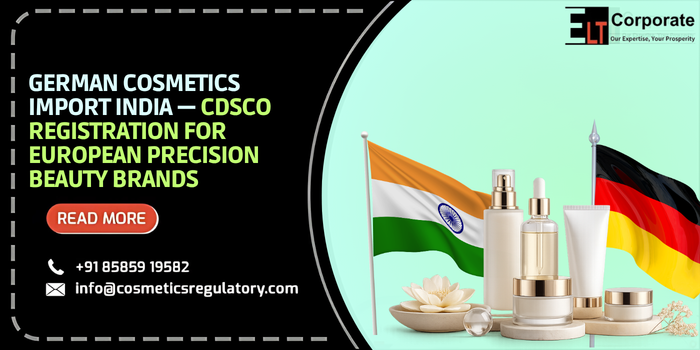

Germany is the world’s fourth-largest cosmetics market and home to some of the most respected precision beauty brands in the world — from pharmaceutical-grade skincare by brands like Eucerin, Nivea, Weleda, and Dr. Hauschka, to luxury cosmetics by Wella, BABOR, and Gehwol, to precision engineering in cosmetic formulation that defines the ‘European quality’ badge in Indian consumer minds.
India’s premium beauty consumer is increasingly drawn to German and European precision beauty — the clinical credibility, the dermatologist-recommended positioning, the natural and organic certifications, and the reputation for efficacy built on decades of European pharmaceutical tradition. The Indian skincare market is growing at 18% annually, and the premium international segment within it is growing even faster.
But importing German cosmetics into India involves a regulatory pathway that many European brands and their Indian partners navigate inefficiently — often discovering the nuances of CDSCO’s requirements only after delays, customs holds, or rejected applications. This guide covers everything a German cosmetics brand, European manufacturer, or Indian distributor needs to know about CDSCO registration, Form COS-1 compliance, documentation translation from EU standards to Indian requirements, and the specific challenges and opportunities that European precision beauty brands face in the Indian market.
Critical fact: A cosmetic product approved under the EU Cosmetics Regulation (EC No 1223/2009) and listed in the EU CPNP (Cosmetic Products Notification Portal) is NOT automatically registered in India. CDSCO maintains an independent registration system. Every German or European cosmetic product must be individually registered with CDSCO before it can legally be imported, sold, or distributed in India — regardless of its European regulatory status.
Why India Is the Right Market for German Precision Beauty
India’s attraction for German and European cosmetics brands is structural, not cyclical:
• The Indian skincare market crossed USD 2.5 billion in 2025 and is projected to reach USD 4+ billion by 2030 — making it one of the fastest-growing premium beauty markets globally
• Indian consumers associate ‘Made in Germany’ with pharmaceutical quality, clinical efficacy, and rigorous safety standards — a powerful positioning advantage over Asian beauty competitors
• The dermocosmetic and cosmeceutical segment is growing fastest in India — exactly where German brands like Eucerin, La Roche-Posay (French), and BABOR are strongest
• India’s growing premium retail infrastructure — Nykaa, Myntra, Sephora India, health-and-beauty chains — creates distribution channels that did not exist five years ago
• Wellness-conscious urban consumers in Mumbai, Delhi, Bengaluru, and Hyderabad actively seek European brand provenance as a trust signal
• E-commerce enables direct-to-consumer reach across Tier 2 and Tier 3 Indian cities for premium European products at scale
These factors make India a compelling market — but the entry requires proper regulatory preparation. German brands that invest in CDSCO compliance early capture the market window. Those that delay hand it to competitors.
The Regulatory Landscape — EU vs India
One of the most common misconceptions among German and European cosmetics companies entering India is that their EU compliance provides a shortcut to Indian registration. Understanding the actual relationship between EU and Indian cosmetics regulation is essential for setting realistic expectations:
| Aspect | EU (EC 1223/2009) | India (Cosmetics Rules 2020) |
| Registration system | Notification in CPNP — self-declaration based | Registration by CDSCO — regulatory review and approval required |
| Approval body | No single approval body — responsible person ensures compliance | Central Licensing Authority (CDSCO), Ministry of Health |
| Approval type | Notification — products can be marketed after notification | Registration Certificate (COS-2) required before any import |
| Timeline | CPNP notification — immediate | 45 to 60 days with complete documentation (longer if queries) |
| Ingredient list | INCI list on label — safety assessment required internally | Full INCI list submitted in application — CDSCO reviews against Ninth Schedule |
| Safety assessment | CPSR (Cosmetic Product Safety Report) by qualified assessor | Safety data submitted as part of COS-1 dossier — no separate CPSR format mandated |
| Prohibited ingredients | EU prohibited list (Annex II) | India’s Ninth Schedule prohibited list — overlaps but not identical |
| Animal testing | Banned in EU since 2013 | Banned for cosmetics tested after November 2014 — documentation required |
| Cruelty-free claim | EU ban-based — not a separate certification requirement | Must be substantiated — products tested anywhere after 2014 must provide evidence |
| Label language | Official EU language of sale | English mandatory; regional language may be added |
| Certificate for import | Free Sale Certificate required by importing countries | FSC from a German competent authority or recognised competent association/organisation, such as IKW/IHK/DIHK as applicable, may be submitted for CDSCO review. |
EU cosmetics regulation operates on a notification + responsible person model. India operates on a registration + approval model. The key difference: in the EU, your product can be marketed as soon as it is notified in CPNP. In India, you must wait for CDSCO to review and approve your COS-1 application and issue your COS-2 certificate before a single unit can enter the country. Plan for this timeline.
Step-by-Step: How to Register German Cosmetics with CDSCO
Step 1: Appoint an Authorised Indian Agent or Indian Importer
A German cosmetics company cannot file directly with CDSCO. The Form COS-1 application must be submitted by one of the following: the manufacturer (German company) themselves if they have an Indian legal entity; an Authorised Indian Agent appointed by the manufacturer through a notarized and apostilled Power of Attorney; or an Indian importer or distributor authorised by the manufacturer.
For most German brands entering India for the first time, the most practical route is to appoint an experienced Indian regulatory consultancy as the Authorised Agent — who handles the complete registration process, maintains the license, files annual COS-4A returns, and manages ongoing compliance. The agent takes legal regulatory responsibility for the product in India under the Cosmetics Rules, 2020.
The Power of Attorney from the German manufacturer must be notarized in Germany AND apostilled under the Hague Apostille Convention — India and Germany are both Hague Convention members. The apostille must be obtained from the correct German authority (typically the Oberlandesgericht or a notary whose signature is apostilled). This step takes 2 to 4 weeks in Germany and cannot be rushed.
Step 2: Obtain a Free Sale Certificate from Germany
The Free Sale Certificate (FSC) — called Freier Verkauf-Zertifikat in German — is a document from a German regulatory authority confirming that the cosmetic product is legally manufactured and marketed in Germany (and by extension, the EU). CDSCO requires this as mandatory documentation for all COS-1 applications.
For German cosmetics, the FSC is typically obtained from:
• The Bundesamt für Verbraucherschutz und Lebensmittelsicherheit (BVL) — Federal Office of Consumer Protection and Food Safety — the primary authority for cosmetics certificates in Germany
• The German Chamber of Commerce (DIHK) — can issue export certificates that are accepted in some contexts
• Local Industrie- und Handelskammer (IHK) — regional chambers that issue certificates of origin and free sale certificates for German products
The FSC must confirm that the product is legally manufactured and sold in Germany/EU, specify the manufacturer’s name and address, and cover the specific product names and models being registered in India. A generic FSC without product-specific details may be queried by CDSCO.
Important: German FSCs typically have a validity period of 1 to 2 years. Submit a freshly obtained FSC with your COS-1 application — do not submit an FSC that is close to expiry or already expired. CDSCO routinely queries expired or near-expiry FSCs.
Step 3: Prepare the Complete INCI Ingredient List
Your German manufacturer’s complete formulation must be provided in INCI (International Nomenclature of Cosmetic Ingredients) format — the same nomenclature used in the EU. Germany’s cosmetics industry is largely standardised on INCI names through the European Cosmetics Association (Cosmetics Europe), so German manufacturers typically have their INCI lists readily available.
CDSCO requires the full INCI list submitted as part of the COS-1 application. This list is reviewed by CDSCO assessors against India’s Ninth Schedule of the Cosmetics Rules, 2020 — which contains the list of prohibited and restricted ingredients.
Critical point: The EU’s Annex II prohibited ingredients list and India’s Ninth Schedule do not match exactly. Several ingredients that are permitted in the EU are restricted in India — and vice versa. A thorough ingredient compliance review against India’s Ninth Schedule must be conducted for every German product before filing the COS-1 application.
Step 4: Verify Ingredient Compliance Against India’s Ninth Schedule
This is the most technically demanding step and the one most commonly missed by German brands and their Indian partners who assume EU compliance implies Indian compliance. Specific areas of concern for German cosmetics:
• UV Filters: Germany/EU has an extensive approved UV filter list. India’s permitted UV filter list is more limited. Several EU-approved UV filters — particularly newer ones like Tinosorb S, Tinosorb M, and Mexoryl — may not appear on India’s approved list. Sunscreens are a particular risk area.
• Colorants: EU’s Annex IV permitted colorants and India’s permitted colorant lists overlap but are not identical. Particularly relevant for colour cosmetics, decorative products, and tinted skincare.
• Preservatives: EU Annex V preservatives and India’s permitted preservative list have differences in maximum concentrations and approval status for certain compounds.
• Plant extracts and natural ingredients: Several plant-derived compounds restricted in the EU (as potential sensitisers or phototoxic compounds) have different restriction levels in India.
• Fragrances: IFRA-compliant German fragrances are generally accepted in India, but specific fragrance allergen declaration requirements may differ.
ELT Corporate conducts a full formulation compliance review against India’s Ninth Schedule for every German product before the COS-1 application is prepared. This step prevents the most costly type of application failure — a rejection due to a prohibited ingredient discovered after filing.
Step 5: Prepare the Indian-Compliant Draft Label
Your German product’s EU-compliant label cannot be used as-is in India. An Indian label must be prepared — either as a separate Indian-market label or as a sticker applied to the product over the EU label — that meets all requirements of Chapter VI of the Cosmetics Rules, 2020.
Key differences between German/EU labels and Indian-compliant labels:
• Language: English is mandatory on Indian labels. German-language labels must have all mandatory information translated. French, Italian, or other EU-language labels similarly require full English translation.
• Manufacturer details: The German manufacturer’s name and full address must appear. Indian importer’s name and address must also appear.
• MRP: Maximum Retail Price in Indian Rupees must be declared — as per the Legal Metrology (Packaged Commodities) Rules. This is not a requirement in the EU.
• COS-2 registration number: Once granted, the registration certificate number must appear on the Indian label. EU labels do not carry CPNP notification numbers.
• Net content: Must be in metric units (grams or millilitres) — typically aligned with EU labels already.
• INCI list: Must appear in full in English on the outer label — descending order of concentration. German labels use the same INCI naming convention.
• Batch number and manufacturing date: Required format may differ slightly from EU label requirements.
• Drug claims prohibited: German cosmeceutical products often carry clinical efficacy language that may be acceptable under EU cosmetics regulation but constitutes a ‘drug claim’ under Indian cosmetics rules. Review all label claims carefully.
Step 6: Compile the Complete COS-1 Application Package
| Document | German-Specific Guidance |
| Form COS-1 (SUGAM portal) | Completed online. Product category must be correctly selected from CDSCO’s 80-category system. All details must match supporting documents exactly. |
| Power of Attorney | Must be notarized by German notary AND apostilled (Haager Apostille) from the competent German authority. Contact your agent or German legal counsel for the correct authentication process. |
| Free Sale Certificate | From BVL (Germany), DIHK, or IHK as appropriate. Must be current, product-specific, and cover the specific manufacturing site. |
| INCI Ingredient List with Percentages | Full formulation with INCI names — German manufacturers typically have this readily available from their EU CPNP notification data. |
| Cosmetic Product Safety Report (CPSR) | Germany’s EU-standard CPSR (Part A — Product Safety Information, Part B — Safety Assessment) is valuable supporting evidence for CDSCO, particularly for products making specific efficacy or safety claims. |
| Product Specifications | Physical and chemical specifications — appearance, pH, viscosity, colour — consistent with what is filed in the CPNP notification. |
| Stability Data | Shelf-life testing data — accelerated stability studies per ISO 29621 or equivalent. German manufacturers typically have this from EU compliance. |
| Draft Indian Label | Prepared specifically for India — English language, full INCI list, MRP field (to be filled post-launch), importer details, COS-2 number field. |
| Manufacturer’s Authorisation Letter | Formal letter from the German manufacturer authorising the Indian agent/importer to hold the COS-2 in India. On company letterhead, signed by authorised signatory. |
| Cruelty-Free Declaration | Declaration from manufacturer that the product (or its ingredients) has not been tested on animals after November 12, 2014 — the Indian compliance date. German manufacturers under EU regulation should be able to provide this readily. |
| Indian Agent/Importer Documents | PAN, GST, IEC of the Indian entity filing the application. |
Step 7: File on SUGAM Portal and Manage the Application
The complete COS-1 application is filed online through the CDSCO SUGAM portal at sugamcdsco.gov.in by the Authorised Indian Agent. After submission and fee payment, an Application Reference Number (ARN) is issued. The application is then reviewed by CDSCO’s cosmetics licensing team.
CDSCO may raise queries (deficiency notices) requesting clarification, additional documents, or corrections. These must be responded to through the portal within the stipulated deadline. In well-prepared cases, approval may be faster; however, applicants should plan for a practical timeline of 3–5 months, and longer where CDSCO raises queries or additional clarification is required.
German-Specific Registration Challenges — What to Prepare For
1. The Cosmeceutical Positioning Problem
Germany has a strong tradition of dermopharmacy and cosmeceuticals — products positioned at the intersection of cosmetics and pharmaceuticals. Brands like Eucerin, Bepanthen, and BABOR use clinical language, dermatologist recommendation claims, and efficacy data in their marketing and labeling that is standard in Europe but triggers ‘drug claim’ concerns under CDSCO’s cosmetics rules.
In India, the distinction between a cosmetic (regulated under the Drugs and Cosmetics Act as a cosmetic) and a drug is determined by the claims made. A German moisturiser claiming ‘clinically proven to treat dry skin condition’ may be reclassified as a drug by CDSCO — requiring a completely different regulatory pathway.
Solution: Before preparing Indian labels, conduct a systematic review of all label claims and marketing language against CDSCO’s guidance. Replace therapeutic claims with cosmetic claims. ‘Treating eczema ‘soothes and moisturises sensitive skin.’ ‘Clinically proven to cure’ becomes ‘dermatologically tested.’ This requires careful drafting — and sometimes consultation with CDSCO on borderline claims.
2. UV Filter Compliance for German Sunscreens
Germany is one of Europe’s leading manufacturers of advanced UV filter technology — companies like BASF develop UV filters (Tinosorb S, Tinosorb M, Uvinul series) that are approved in the EU and widely used by German sunscreen formulators. However, India’s approved UV filter list has not been updated to include several of these newer EU-approved filters.
A German sunscreen containing Tinosorb S or Tinosorb M may fail India’s ingredient compliance check because these filters are not on CDSCO’s approved list — even though they are standard in EU formulations. This affects both finished sunscreen products and skincare with SPF protection.
Solution: Before registering any German sunscreen or SPF product, submit the full UV filter composition for review against India’s permitted UV filter list. If non-approved filters are present, the German manufacturer must either provide an India-specific reformulation or the product cannot be registered as a cosmetic in India.
3. Translating EU CPSR into CDSCO’s Dossier Format
Germany’s EU-compliant Cosmetic Product Safety Report (CPSR) is a comprehensive, structured document covering product composition, physical and chemical properties, microbiological quality, impurities, packaging, normal and reasonably foreseeable use, exposure calculations, and the qualified Safety Assessor’s conclusion. This is valuable documentation for CDSCO — far more comprehensive than what most non-EU markets provide.
However, the CPSR format does not directly match CDSCO’s COS-1 dossier structure. Your Indian agent must translate the relevant CPSR data into the format and sequence required by CDSCO’s application guidance. This is a technical documentation task, not just a translation task.
4. Multiple EU Manufacturing Sites
Many German cosmetics companies manufacture at multiple sites across Germany and Europe — different product lines manufactured at different facilities, or manufacturing outsourced to contract manufacturers in Poland, Czech Republic, or other EU countries. CDSCO’s registration is site-specific — each manufacturing site requires its own COS-1 application with a site-specific FSC. German brands with complex multi-site manufacturing structures need to map their Indian product portfolio to specific manufacturing sites before preparing applications.
5. Organic and Natural Certifications — CDSCO’s View
Germany is a leader in certified organic cosmetics — NATRUE, BDIH, COSMOS NATURAL, and ECOCERT certified German brands have strong market appeal in India. However, CDSCO does not formally recognise these European organic certifications as part of the COS-2 registration process. They are valuable marketing credentials — but they do not expedite or replace the standard COS-1 application.
German brands should include their organic certifications in the application dossier as supporting documentation and use them prominently in Indian market positioning — but understand that they do not create a regulatory shortcut.
EU Cosmetics Compliance as a Competitive Advantage in India
While EU compliance does not replace CDSCO registration, it does create a significant advantage during the CDSCO review process:
• EU CPSR provides CDSCO with safety documentation that is orders of magnitude more comprehensive than what most non-EU applicants provide. This can reduce the likelihood of technical queries.
• EU prohibited ingredient compliance gives CDSCO confidence that the German manufacturer has rigorous safety standards — even if the specific EU and Indian lists differ slightly.
• EU cosmetic GMP standards / ISO 22716 GMP standards for cosmetics manufacturing are recognised globally as high-quality production standards. German manufacturers meeting EU GMP standards are well-positioned for CDSCO’s confidence in product quality.
• German dermatological testing data — patch testing, clinical efficacy data, ophthalmological testing for eye products — provides additional credibility that Indian applicants rarely have.
CDSCO assessors review hundreds of applications from Asian markets where documentation is often minimal. A well-prepared German cosmetic application with a full CPSR, EU-compliant stability data, extensive safety testing, and clear clinical documentation stands out positively. The quality of European documentation is a genuine asset — when properly translated into CDSCO’s required format.
Label Adaptation Strategy for German Brands — Practical Approach
German cosmetic brands typically face two label adaptation scenarios when entering India:
Scenario A: Indian-Market Sticker Approach
The German manufacturer continues to produce their standard EU-compliant labels. An Indian-market sticker is designed and applied to the product (on the outer carton or directly on the product) containing all mandatory Indian label information: English product name, importer details, INCI list in English, MRP field, COS-2 registration number, batch number format, and manufacturing/expiry date in Indian format.
This approach minimises disruption to the German manufacturer’s production process and is commonly used for initial India market entry when volumes are modest. It is CDSCO-compliant provided the sticker contains all mandatory elements and does not obscure mandatory EU label information.
Scenario B: India-Specific Label
For brands with significant India volumes or those building long-term Indian market presence, a fully India-specific label is designed that meets all requirements of both the Cosmetics Rules, 2020 (CDSCO) and the Legal Metrology (Packaged Commodities) Rules. This approach is cleaner for the consumer, more professional in retail presentation, and required for high-volume or retail-chain partnerships.
The India-specific label typically requires coordination between the German manufacturer, the Indian distributor, a label design agency, a regulatory consultant, and the packaging printer. Allow 6 to 8 weeks for this process from brief to print-ready artwork.
Timeline and Cost Expectations for German Brand Registration in India
| Stage | Typical Timeline | Key Action |
| Appoint Indian Agent + PoA preparation | 3 to 5 weeks | German notarization + apostille of PoA. Simultaneous with other steps. |
| FSC from Germany | 2 to 4 weeks | Apply to BVL, DIHK, or IHK for Free Sale Certificates. |
| Ingredient compliance review | 1 to 2 weeks | ELT Corporate reviews formulations against India’s Ninth Schedule. |
| Draft Indian label preparation | 2 to 4 weeks | Label design, INCI translation, MRP and importer details. |
| COS-1 application filing on SUGAM | 1 week | All documents assembled and filed by Indian agent. |
| CDSCO review period | 45 to 60 days | Monitor portal; respond to queries within deadline. |
| COS-2 certificate issued | Total: 3 to 5 months | First shipment can be imported immediately after certificate receipt. |
| Annual COS-4A filing | Each January | Annual import return — mandatory every year. |
| COS-2 renewal | Every 5 years | Renewal before certificate expiry. |
Government registration fee for imported cosmetics is generally USD 1,000 per cosmetic category, USD 50 per variant, and USD 500 per manufacturing site, as prescribed under the Cosmetics Rules, 2020. The final fee depends on the number of product categories, variants, and manufacturing sites covered in the COS-1 application.
Popular German Cosmetic Categories in India — Market Perspective
Understanding which German product categories resonate most strongly with Indian consumers helps you prioritise your registration portfolio:
Pharmaceutical-Grade Skincare (Dermocosmetics)
German pharmaceutical brands have built significant trust with Indian dermatologists and consumers through products like barrier repair creams, eczema care ranges, and sensitive skin formulations. Indian dermatologists frequently recommend German brands by name — creating pull-through demand. This category benefits most from Germany’s pharmaceutical heritage positioning.
Natural and Organic Skincare
German biodynamic and organic brands (WELEDA, Dr. Hauschka, LAVERA) have strong appeal among India’s eco-conscious urban consumers. NATRUE and COSMOS certifications are recognised by Indian premium beauty consumers even without CDSCO formal recognition of these certifications. This segment is growing fastest in India’s metro markets.
Professional Hair Care
German professional hair care (Wella, Schwarzkopf Professional, Goldwell) has established distribution through Indian salons and has brand recognition that predates CDSCO enforcement. These brands typically have existing import registrations but may have portfolio gaps as the product lines have expanded.
Suncare and SPF Products
The UV filter compliance challenge (discussed above) makes this category technically complex for German brands. However, there is strong market demand for European clinical sunscreens among India’s growing sun-protection aware consumer base. Brands willing to invest in UV filter compliance work will find limited competition and premium positioning opportunities.
Foot Care and Body Care Specialists
German brands like Gehwol, Herbacin, and Florena have pharmacy-channel distribution relationships in Europe that translate well to India’s growing dermatologist-recommended product channel. These are category leaders in Germany with limited Indian competition.
Frequently Asked Questions
Does my EU CPNP notification mean I am registered in India?
No. The EU Cosmetic Products Notification Portal (CPNP) is a European regulatory system. India’s CDSCO maintains an entirely separate registration database under the Cosmetics Rules, 2020. CPNP notification has no legal standing in India. You must file a separate Form COS-1 application with CDSCO for each product you wish to import into India. However, your CPNP notification data — particularly the INCI list and safety documentation — is valuable input for preparing your Indian application dossier.
How do I get a Free Sale Certificate from Germany for CDSCO?
The primary source for German Free Sale Certificates for cosmetics is the BVL (Bundesamt fur Verbraucherschutz und Lebensmittelsicherheit — Federal Office of Consumer Protection and Food Safety). German Chambers of Commerce (IHK/DIHK) also issue export certificates that CDSCO accepts. The FSC must confirm the product is legally manufactured and marketed in Germany, specify the manufacturer and product details, and be issued by a recognised German authority. Your Indian regulatory consultant or agent can advise on the specific format and authority most appropriate for your products.
My German sunscreen contains Tinosorb S — can it be registered in India?
This depends on India’s current permitted UV filter list. Tinosorb S (bis-ethylhexyloxyphenol methoxyphenyl triazine) has been under review for India’s permitted list but may not yet be formally approved. If your formulation contains UV filters not on India’s approved list, you have two options: work with your German manufacturer to provide an India-specific reformulation using only India-approved UV filters, or explore whether CDSCO will accept the product with appropriate safety documentation demonstrating the UV filter’s safety. ELT Corporate can assess the current status of specific UV filters and advise on the most practical path forward.
How many products can be covered in one COS-1 application?
A single COS-1 application can cover multiple products from the same manufacturer and manufacturing site. Products are listed individually within the application, with each assigned to its correct CDSCO category. Different pack sizes of the same formulation can be treated as variants within a single registration. Different formulations — even under the same brand — require separate listings. Your agent will optimise the application structure to minimise fees and administrative complexity.
Can I use a German-language label in India with an English sticker?
Yes — provided the English sticker contains all mandatory information required under the Cosmetics Rules, 2020 and the sticker does not obscure mandatory German label elements. The sticker approach is commonly used for initial market entry. As volumes grow, a fully India-specific English label is typically more professional and retail-ready. CDSCO’s concern is that all mandatory Indian label elements are present and legible — the underlying German label does not create compliance issues as long as the Indian requirements are fully covered by the sticker.
ELT Corporate — Your India Market Entry Partner for German and European Cosmetics
ELT Corporate has guided European cosmetics brands — from Germany, France, Italy, Switzerland, the Netherlands, and the UK — through the complete CDSCO registration process. We understand the specific translation challenges between EU and Indian regulatory frameworks, the UV filter compliance nuances, the cosmeceutical claim adaptation requirements, and the documentation workflow that makes German brand registrations efficient.
Our service for German and European cosmetics brands includes:
• Free pre-registration assessment — ingredient compliance review against India’s Ninth Schedule before any commitment to the application process
• EU-to-India documentation translation — converting CPSR, CPNP data, and EU-format documents into CDSCO’s required application format
• Power of Attorney guidance — advising on German notarization and apostille process
• Free Sale Certificate coordination — advising on correct German authority and process
• Form COS-1 preparation and SUGAM portal filing
• Indian label compliance review and adaptation guidance
• CDSCO query response management
• Annual COS-4A compliance management
• COS-2 renewal management — proactive reminders and renewal preparation
| Register Your German Cosmetics Brand in India — Free ConsultationShare your product categories, manufacturing details in Germany, and target the Indian market timeline. Our cosmetics regulatory specialists will assess your portfolio, confirm ingredient compliance, and give you a clear registration roadmap. |