
The Indian organic cosmetics market is booming. Consumers are actively seeking clean, natural, and certified organic beauty products — and D2C (Direct-to-Consumer) brands are capitalizing on this shift through Instagram Shops, their own D2C websites, Amazon, Nykaa, and importer of record. .
But here is where most founders hit a wall: you cannot legally import or sell private label organic cosmetics in India without CDSCO registration.
Whether you are sourcing from a manufacturer in South Korea, France, or the UK and selling under your own brand — or importing finished products to resell online — the regulatory pathway is the same. And getting it wrong can mean customs holds, product seizures, or marketplace de-listings.
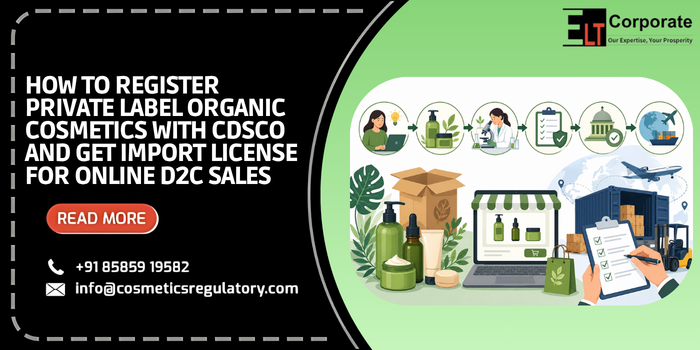
This guide walks you through the complete process — from understanding what CDSCO registration means for private label organic cosmetics, to getting your import license (COS-2), to launching legally on D2C channels in India.
First: Understand the Regulatory Framework
Cosmetics in India are regulated under the Drugs and Cosmetics Act, 1940 and the Cosmetics Rules, 2020. Two authorities are relevant depending on whether you manufacture or import:
| Activity | Regulating Authority | License/Form |
| Manufacturing cosmetics in India | State Licensing Authority (SLA) | COS-5 / COS-8 |
| Importing cosmetics into India | CDSCO (Central Licensing Authority) | COS-1 Application → COS-2 License |
For private label brands sourcing from overseas manufacturers — which is the most common D2C model for organic cosmetics — CDSCO import registration is mandatory.
Legal requirement: Commercial import of cosmetics into India generally requires registration under the Cosmetics Rules, 2020 through the Central Licensing Authority.
What Is “Private Label” in the Context of Cosmetics Regulation?
Private label cosmetics means products manufactured by a third-party overseas manufacturer, but sold under your brand name in India. For CDSCO purposes, this is treated as an import, and your Indian entity typically acts as the importer of record. .
Key distinctions CDSCO makes:
- Manufacturer: The overseas entity that physically manufactures the product (the factory in South Korea, Italy, etc.)
- Brand Owner / Importer: The Indian entity (your D2C brand) that imports and sells under its brand name
- Authorised Agent: An Indian entity authorised by the foreign manufacturer to apply for registration on their behalf
For most D2C founders, a commonly adopted structure is : you as the importer apply for the COS-2 license, with an authorization letter from your overseas manufacturer.
Do Organic Cosmetics Have Special Regulations?
This is a common question — and the answer is nuanced.
CDSCO does not have a separate registration category specifically for “organic” cosmetics. All cosmetics — organic, natural, herbal, or conventional — are regulated under the same Cosmetics Rules, 2020 framework and require the same Cosmetic Import Registration Certificate (COS-2).
However, organic cosmetics carry additional compliance considerations:
- Ingredient compliance: All ingredients must comply with BIS IS 4707 standards — including the updated IS 4707 (Part 2): 2025, which revised the list of prohibited and restricted ingredients (published September 2025)
- No animal testing: Any cosmetic whose manufacture involved animal testing after 12th November 2014 cannot be imported into India — a rule that aligns naturally with organic/cruelty-free brand positioning
- Claims compliance: Words like “organic,” “natural,” “herbal,” or “ECOCERT certified” on your label must be substantiated. CDSCO does not pre-approve labels, but false or misleading claims can result in post-market enforcement action
- Voluntary certifications: ECOCERT/COSMOS, PETA Cruelty-Free, Vegan Society, and Ecomark (BIS) are not mandatory but significantly strengthen your brand’s credibility with D2C consumers
Step-by-Step: CDSCO Registration and Import License for Private Label Organic Cosmetics
Step 1: Identify Your Product Category
Common organic cosmetic categories include:
- Face care (creams, serums, moisturizers, face oils)
- Hair care (shampoos, conditioners, hair masks, scalp serums)
- Body care (lotions, body butters, scrubs)
- Lip care (lip balms, lip oils)
- Sun care (sunscreens — note: SPF products may have additional requirements)
Choosing the wrong product family causes application rejection or delays. If your product spans categories (e.g., a tinted moisturizer with SPF), professional classification advice is strongly recommended.
Step 2: Prepare Your Document Dossier
This is the most time-intensive part of the process. A complete, accurate dossier is the single biggest factor in avoiding CDSCO queries that delay approval.
Core documents required for COS-1 application:
- Form COS-1 — duly filled, signed, and stamped application form (submitted online via SUGAM portal)
- Complete Ingredient List (INCI) — in descending order of concentration, as per international INCI nomenclature
- Free Sale Certificate (FSC) — confirming the product is freely sold in the country of manufacture, authenticated by the Indian Embassy of the country of origin or Apostilled (for Hague Convention member countries)
- Manufacturing License — license to manufacture cosmetics from the country of origin. If no such provision exists in the country of origin, a declaration from the importer is required
- Authorization Letter — from the overseas manufacturer authorizing the Indian entity to apply for import registration on its behalf. The document should be duly notarized, apostilled, or authenticated as applicable in the country of origin
- Label / Artwork — proposed label for Indian market, complying with Cosmetics Rules 2020 labeling requirements
- Certificate of Analysis (COA) — for each product, confirming it meets quality specifications
- Safety Data — ingredient safety information, especially for any ingredients that may be restricted under IS 4707
- Undertaking / Declaration — per Schedule D-III, committing to compliance with all conditions of the registration certificate
For organic certifications: Include your ECOCERT, COSMOS, or equivalent certification documents as supporting evidence for any organic claims on the label.
Step 3: Register on the SUGAM Portal
- Visit https://cdscoonline.gov.in
- Sign up as an Importer
- Complete account verification
- Access your dashboard once account is approved
All cosmetic import applications are submitted exclusively through this portal. No offline submission is accepted.
Step 4: File the COS-1 Application
On the SUGAM portal:
- Select Form COS-1 — Application for Import Registration Certificate
- Fill in manufacturing premises details, product description, brand name, pack sizes, and variants
- Upload all supporting documents
- Pay the application fee online
Fee structure: The fee is USD 250 (or equivalent in INR) per “Brand” — where “Brand” means each category of cosmetics as per CDSCO’s product family list. Multiple products from the same manufacturer in the same category can be covered under a single application.
Important: A single COS-1 application can cover multiple products from one manufacturer. Plan your product lineup before filing to consolidate applications and reduce costs.
Step 5: Respond to CDSCO Queries
After submission, CDSCO reviews the application. If deficiencies are found, discrepancies are communicated through your SUGAM dashboard. Common reasons for queries include:
- Ingredient not compliant with IS 4707 standards
- Free Sale Certificate not properly authenticated
- Label not meeting Cosmetics Rules 2020 requirements
- Missing or incomplete authorization letter
- Data mismatch between form and supporting documents
Respond completely and promptly. Partial responses lead to repeat queries, which is the primary cause of extended approval timelines.
Step 6: Receive COS-2 Registration Certificate
Once the application is found satisfactory, it is forwarded for approval of the Licensing Authority (Drugs Controller General of India). Upon approval:
- The COS-2 Import Registration Certificate is issued
- The approval letter becomes available in your SUGAM dashboard
- The certificate is generally valid for 3 years from date of issue
Typical timeline: 3 to 6 months from submission of a complete and accurate dossier. Incomplete applications or query delays can extend this significantly.
Once you have your COS-2 license, you are legally authorized to import those specific products from that specific manufacturing site into India for sale.
Labeling Requirements for Private Label Organic Cosmetics in India
For D2C brands, label compliance is non-negotiable — not just for CDSCO, but because platforms like Amazon, Nykaa, and Myntra verify label compliance before approving listings.
As per Cosmetics Rules 2020 and Legal Metrology (Packaged Commodities) Rules 2011, every cosmetic label must display:
- Product name and category (e.g., “Organic Rose Face Serum”)
- Brand name (your D2C brand)
- Name and address of manufacturer — “Manufactured by [overseas manufacturer name and address]”
- Name and address of importer — “Imported by [your Indian brand/entity name and address]”
- Import Registration Certificate number (your COS-2 number)
- Complete ingredient list in INCI nomenclature, in descending order of concentration
- Net weight/volume
- Manufacturing date and expiry date / best before date
- Batch number
- MRP (inclusive of all taxes)
- Country of origin
- Directions for use and precautions (where applicable)
For private labels specifically: Your brand name can appear prominently, but the manufacturer’s details and your importer details must both be on the label. You can use language like “Marketed by [Your Brand]” alongside “Manufactured by [Overseas Factory]” and “Imported by [Your Indian Entity].”
Online listings: All physical label details — MRP, expiry, net quantity, ingredients, and manufacturer info — must also be reflected accurately in your product listings on e-commerce platforms.
Additional Compliance for D2C Online Sales
Beyond CDSCO registration and labeling, launching a private label organic cosmetics brand on D2C channels in India requires:
GST Registration
Mandatory for all businesses selling goods in India, whether online or offline. Obtain your GSTIN before launching.
IEC (Import Export Code)
Required for importing goods into India. Applied through DGFT (Director General of Foreign Trade) online portal. Without an IEC, your shipments cannot clear customs.
Trademark Registration
Strongly recommended before launching D2C. Your brand name and logo should be registered under Class 3 (cosmetics and cleaning preparations) to prevent copycats and protect your brand identity — especially on marketplaces.
Legal Metrology Registration
Required for packaged commodities. Ensures your products display accurate weight, volume, and MRP declarations as required by the Legal Metrology Act.
Marketplace-Specific Requirements
Each platform has its own seller onboarding requirements:
- Amazon India: Requires CDSCO registration proof, GST, and compliant product listings
- Nykaa: Requires brand authorization, CDSCO registration, and label compliance verification
- Myntra: Similar to Nykaa — brand documentation and regulatory compliance required
- Your own D2C website: No marketplace gatekeeping, but all consumer protection laws still apply
Common Mistakes Private Label D2C Brands Make
| Mistake | Consequence |
| Importing before COS-2 is issued | Customs hold, possible seizure of goods |
| Wrong product category selected | Application rejection, restart from scratch |
| FSC not properly authenticated | CDSCO query, timeline extension |
| Label missing importer details | Marketplace de-listing, regulatory action |
| Organic claims not substantiated | Post-market enforcement, consumer complaints |
| Not obtaining IEC before import | Shipment stuck at customs |
| Filing separate applications per product unnecessarily | Higher fees, redundant work |
Timeline: What to Expect Realistically
| Stage | Estimated Time |
| Document preparation and dossier compilation | 4 – 8 weeks |
| SUGAM account approval | 3 – 5 working days |
| COS-1 application review by CDSCO | 3 – 6 months (complete dossier) |
| Query response and re-review | +4 – 8 weeks per query cycle |
| COS-2 license issuance | After satisfactory review |
Practical advice: Start your CDSCO registration process at least 6–9 months before your planned launch date. Do not build inventory or commit to marketplace launch dates until your COS-2 is in hand.
2026 Regulatory Updates You Should Know
- BIS IS 4707 (Part 2): 2025 — Updated list of prohibited, restricted, and GNRAS ingredients, effective September 2025. Verify all your organic formulations against this revised standard before applying.
- IS 4707 (Part 3): 2025 — New companion standard covering the list of permitted preservatives in cosmetics with restrictions, published September 2025.
- Mandatory BIS Certification (proposed): Industry stakeholders are closely monitoring potential Quality Control Orders (QCOs) that may impact certain cosmetic categories in future.
- New Drugs, Medical Devices and Cosmetics Act: India has been discussing modernization of the Drugs and Cosmetics legal framework, and businesses should monitor future CDSCO notifications and legislative developments.
The Bottom Line
Launching a private label organic cosmetics brand for D2C sales in India is a genuine opportunity — the market is growing, consumers are engaged, and digital channels make it possible to build a meaningful brand without massive retail infrastructure.
But regulatory compliance is not optional. The CDSCO import registration process is structured and manageable — if you approach it with accurate documentation, the right product classification, and enough lead time.
Get the paperwork right from the start, and you can build a brand that grows confidently — on your website, on Nykaa, on Amazon, and beyond.
Need Help Registering Your Private Label Organic Cosmetics with CDSCO?
We assist D2C brands with:
- Product category classification under CDSCO’s 80 product families
- Complete COS-1 dossier preparation
- Free Sale Certificate authentication guidance
- Label compliance review (Cosmetics Rules 2020 + Legal Metrology)
- SUGAM portal application filing and query handling
- End-to-end support from application to COS-2 license
Don’t let regulatory delays push back your launch. Talk to our cosmetics regulatory team today →