
The Indian market for cosmetics continues to grow significantly with international beauty and personal care companies expanding their presence in India through imports. However, before imports of cosmetics are legal in India, they must meet the different conditions under the Drugs and Cosmetics Act, 1940, and the Cosmetics Rules, 2020. One of the most important and essential requirements to adhere to is the declaration of the list of ingredients on the label of cosmetics.
A declaration of ingredients isn’t simply an additional labeling process. It’s a legally binding obligation that is designed to ensure consumers’ security in their purchases, transparency, and well-informed buying decisions. Incorrect, insufficient, or inaccurate declarations of ingredients could result in regulatory scrutiny as well as delays at importation or product detention and compliance notices, or even the cancellation of cosmetic import authorizations.
- Home: Ingredient Declaration Rules for Imported Cosmetics in India
This complete guide explains the declaration requirements of ingredients for cosmetics that are imported into India as well as specific regulations, labeling requirements as well as compliance processes, frequent mistakes, and the best guidelines for importers as well as brand owners.
Why Ingredient Declaration Matters
Ingredient declaration has many uses.
- Increases awareness among consumers
- Helps recognize allergens or sensitive ingredients
- Enables regulatory authorities to verify product safety
- Facilitates market surveillance and product recalls
- Ensures compliance with Indian cosmetic regulations
- Allows for better consumer choice
Accurate ingredient labeling is vital for importers to avoid customs problems, CDSCO objections, and other problems.
Regulatory Framework Governing Ingredient Declaration
Drugs and Cosmetics Act, 1940
The Drugs and Cosmetics Act is the primary law that governs the regulation of cosmetics in India. This act gives powers to regulate cosmetic products on issues related to safety, labeling, manufacture, and imports.
Cosmetics Rules, 2020
The Cosmetics Rules, 2020, lay down specific standards regarding the following:
- Cosmetic imports
- Product registration and compliance
- Labeling requirements
- Ingredient disclosure
- Safety standards
Importers must ensure that every cosmetic product imported into India complies with these provisions before market distribution.
Central Drugs Standard Control Organization (CDSCO)
CDSCO acts as India’s central regulatory authority responsible for:
- Cosmetic import registration
- Regulatory oversight
- Compliance monitoring
- Market surveillance
- Enforcement actions
During import review, CDSCO may verify ingredient declarations and supporting documentation.
Ingredient Declaration Requirements for Imported Cosmetics
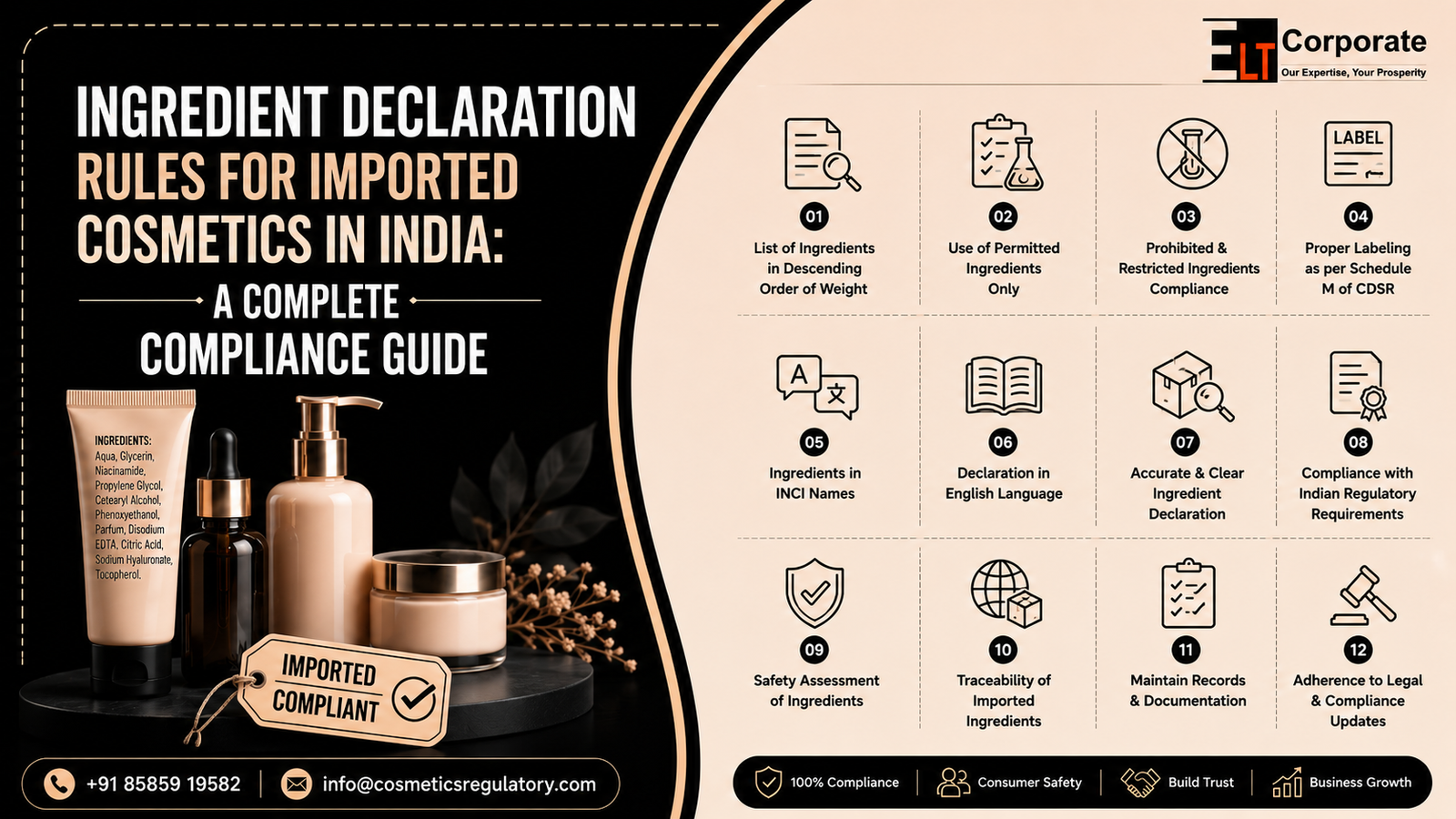
1. Listing of Ingredients
Imported cosmetics must display a complete list of ingredients used in the formulation.
The declaration should:
- Include all ingredients present in the product
- Reflect the actual product composition
- Match supporting technical documentation
- Be clearly legible and readable
Any discrepancy in the submitted documentation and the actual labeling could cause regulatory issues.
2. INCI Nomenclature Requirement
Ingredients should generally be declared using the International Nomenclature of Cosmetic Ingredients (INCI).
Benefits of INCI naming include:
- International consistency
- Regulatory transparency
- Consumer understanding
- Simplified compliance reviews
Examples:
| Common Name | INCI Name |
| Water | Aqua |
| Vitamin E | Tocopherol |
| Glycerin | Glycerin |
| Coconut Oil | Cocos Nucifera Oil |
Using standardized ingredient names reduces ambiguity during regulatory assessments.
3. Order of Ingredient Declaration
Ingredients should generally be listed in descending order of concentration.
This means:
- The highest concentration ingredient appears first
- The lowest-concentration ingredient appears later
- Trace ingredients may appear towards the end
The sequence must accurately reflect the formulation of the product.
4. Fragrance and Flavor Components
Flavor and fragrance ingredients can frequently be declared as a group as follows:
- Fragrance
- Perfume
- Aroma
But, in the event that certain scent allergies require disclosure in accordance with specific guidelines, disclosures may be mandatory.
Manufacturers should keep precise scent composition records for review by the regulatory authorities when required.
5. Color Additives and Pigments
Coloring agents used in cosmetic products should be properly identified.
Examples include:
- CI 77491
- CI 77891
- CI 19140
Importers should verify that color additives comply with Indian cosmetic regulations and approved usage conditions.
Labeling Requirements Related to Ingredient Declaration
Ingredient declarations should be included on the label of the product in a way that includes the following:
- Clear Text: Should be easy to read and comprehend.
- Legal: Font size should be visible enough to consumers.
- Indelible: Information should not fade or disappear during normal handling.
- Accessible: Consumers should be able to easily locate ingredient information without difficulty.
Documents Supporting Ingredient Compliance
Importers should maintain the following:
- Product Formula: Complete quantitative formulation details.
- Ingredient Specifications: The technical specifications for each ingredient.
- Certificate of Analysis: Qualitative Verification Document.
- Safety Assessment Reports: Evidence for product safety.
- Product Information File (PIF): A complete regulatory document for cosmetics imported.
The proper management of these records assists in addressing the regulatory questions efficiently.
Common Ingredient Declaration Errors
Many imported cosmetics face compliance issues because of avoidable mistakes.
- Missing Ingredients: Failure to disclose all ingredients used in the formulation.
- Incorrect INCI Names: Using trade names instead of recognized ingredient nomenclature.
- Mismatch Between Formula and Label: Label declaration does not correspond with actual product composition.
- Incomplete Color Additive Disclosure: Omitting color ingredients from labeling.
- Translation Errors: Incorrect ingredient translations leading to misleading information.
- Illegible Labeling: Font size or design makes ingredient information difficult to read.
Consequences of Non-Compliance
Inability to meet the ingredient declaration requirements could lead to:
- Import Delays: Products could be held pending further evaluation.
- The authorities can seek clarification or additional documents.
- Product Detention: Unconforming shipments might be seized at ports.
- Market Withdrawal: Items already being sold could require correction.
- Reputational damage: Issues related to regulation can have a negative impact on the credibility of brands.
Compliance Checklist for Importers
Before importing cosmetics into India, verify the following:
✓ Complete ingredient list available
✓ INCI nomenclature used correctly
✓ Ingredients listed in proper order
✓ Color additives declared
✓ Fragrance disclosures completed
✓ Label artwork reviewed
✓ Formula matches ingredient declaration
✓ Supporting technical documents maintained
✓ Regulatory review completed
✓ Import documentation aligned with labeling
Best Practices for Imported Cosmetic Label Compliance
To ensure smooth regulatory approval:
- Conduct pre-import label reviews
- Verify ingredient nomenclature accuracy
- Maintain updated formulation records
- Review supplier documentation regularly
- Implement quality control procedures
- Monitor regulatory updates
- Perform periodic compliance audits
These measures significantly reduce the risk of regulatory observations.
Frequently Asked Questions (FAQs)
Q1. Is it necessary to declare all the ingredients of the cosmetics that have been imported into India?
Yes. It is necessary that imported cosmetics conform to all the relevant ingredient labeling requirements prior to marketing within the country.
Q2. Can we use trade names in lieu of INCI names?
No. Ingredient nomenclature standards are to be followed in general.
Q3. Are the fragrances’ ingredients disclosed?
Yes. Fragrances are usually disclosed together, but this varies according to the standards relevant to the cosmetics under question.
Q4. What are the consequences of not mentioning an ingredient?
The cosmetic in question will not be compliant.
Q5. Can CDSCO verify ingredient declarations?
Yes. Authorities may review submitted documentation and product labels to verify compliance.