
Importing cosmetics into India requires strict compliance with the regulatory framework governed by the Central Drugs Standard Control Organisation (CDSCO). At the heart of this process is the COS-1 licence — the mandatory import licence for cosmetic products entering the Indian market. Without it, no cosmetic product may be legally imported, sold, or distributed in India.
At ELT Corporate, we provide comprehensive documentation support and end-to-end advisory services to help businesses navigate the CDSCO cosmetic import licensing process accurately, efficiently, and without unnecessary delays.
What is the COS-1 Cosmetic Import Licence?
The COS-1 is the official import licence issued by CDSCO under the Drugs and Cosmetics Act, 1940 and the Cosmetics Rules, 2020. It is mandatory for any entity wishing to import cosmetic products into India for the purpose of sale, distribution, or commercial use.
The licence is granted to the Indian importer or authorised agent and specifies the approved products, their country of origin, and the manufacturer details. Each product or product range must be individually covered under a valid COS-1 licence before it can clear Indian customs.
Failure to obtain this licence — or submitting an incomplete application — results in consignment detention, rejection at the port of entry, or regulatory penalties.
Who Needs a COS-1 Licence?
The COS-1 licence is required by any individual or business entity that:
- Imports cosmetic products from any country into India for commercial purposes
- Acts as an authorised Indian agent or representative of a foreign cosmetic manufacturer
- Distributes or sells imported cosmetics within the Indian domestic market
- Sources cosmetic products for repackaging, relabelling, or redistribution in India
- Imports cosmetics for professional use, salon supply, or institutional sale
Whether you are a large multinational brand, a trading company, or a first-time importer, a valid and correctly documented COS-1 licence is a non-negotiable regulatory requirement.
Regulatory Framework
The COS-1 import licence is governed by the following legislation and rules:
Drugs and Cosmetics Act, 1940 The primary legislation governing the import, manufacture, distribution, and sale of cosmetics in India. Schedule S of the Act defines the standards for cosmetics.
Cosmetics Rules, 2020 Replaced the earlier Cosmetics Rules of 1945. These rules define the detailed procedures for import licensing, labelling requirements, prohibited substances, and product standards applicable to imported cosmetics.
CDSCO Guidelines for Cosmetic Import Supplementary guidance issued by CDSCO specifying the documentation requirements, application procedures, fees, and conditions attached to COS-1 licences.
Bureau of Indian Standards (BIS) Certain cosmetic categories may additionally require BIS certification or compliance with IS standards before import clearance is granted.
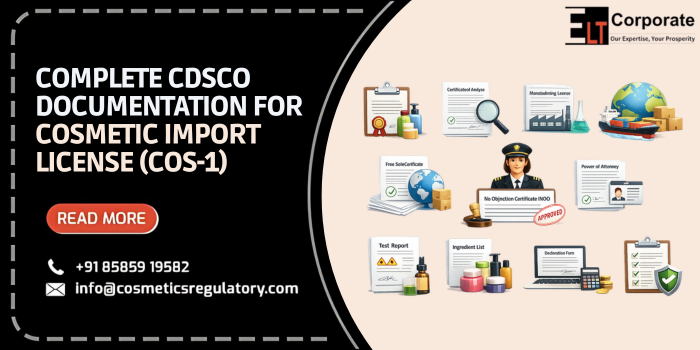
Complete Documentation Required for COS-1 Application
The following documents must be prepared, compiled, and submitted as part of a complete COS-1 application. Incomplete or incorrectly prepared documentation is the most common cause of application rejection or delay.
1. Application Form — Form COS-1
The prescribed application form available on the CDSCO online portal (Sugam Portal). The form must be completed in full with accurate product and applicant details. A separate application is required for each product or product group where applicable.
Key details required:
- Name and address of the Indian importer or authorised agent
- Name and address of the foreign manufacturer
- Country of origin and country of export
- Product name and complete product description
- Intended use and category of the cosmetic product
- Quantity proposed to be imported
2. Manufacturer’s Licence or Certificate of Manufacture
A valid manufacturing licence or equivalent certificate issued by the competent authority of the country of manufacture. This document confirms that the foreign manufacturer is legally authorised to produce cosmetic products in their country of origin.
Requirements:
- Must be current and valid at the time of application
- Must bear the official seal or stamp of the issuing authority
- Must be apostilled or notarised as per applicable treaty arrangements
- If not in English, a certified English translation must accompany the original
3. Certificate of Free Sale (CFS)
One of the most critical documents in the COS-1 application. The Certificate of Free Sale confirms that the cosmetic product is freely sold and marketed in its country of origin or country of export without any restriction.
Requirements:
- Issued by the competent government authority of the country of origin (health ministry, customs authority, or trade body as applicable)
- Must specifically name the product(s) covered
- Must be apostilled and, where required, notarised
- Must be current — CDSCO typically requires the CFS to be issued within one to three years of the application date
- Certified English translation required if issued in a foreign language
4. Product Composition and Formula Details
A complete declaration of the product’s ingredients and formulation. This is required to verify compliance with the Cosmetics Rules, 2020 and to confirm that no prohibited or restricted substances are present.
Requirements:
- Full list of ingredients with their INCI (International Nomenclature of Cosmetic Ingredients) names
- Percentage composition of each ingredient
- Declaration that the formula does not contain any substance prohibited under Schedule Q of the Cosmetics Rules, 2020
- Declaration signed and stamped by the foreign manufacturer or their authorised representative
5. Product Labels and Labelling Declaration
Copies of all labels intended for use on the product when sold in India, along with a declaration of labelling compliance.
Labelling must include:
- Product name
- Name and address of the manufacturer
- Name and address of the Indian importer
- Country of origin
- Net quantity (in metric units)
- Batch number and date of manufacture
- Best before / expiry date
- List of ingredients in descending order of concentration
- Any applicable directions for use or warnings
- MRP (Maximum Retail Price) if applicable
- Any required regulatory statements as per Cosmetics Rules, 2020
Labels must comply in full with the labelling requirements under Rule 134 of the Cosmetics Rules, 2020 before submission.
6. Safety Data Sheet (SDS) or Product Safety Report
A technical document confirming that the product has been assessed for safety and is suitable for its intended cosmetic use. While a full EU-style cosmetic product safety report is not always mandated, CDSCO may require a safety assessment or SDS for products containing active ingredients or those intended for sensitive applications.
Typically includes:
- Toxicological data on key ingredients
- Dermatological safety assessment or patch test data
- Stability study results confirming shelf life
- Microbiological test results where applicable
7. Certificate of Analysis (COA)
A laboratory-issued certificate confirming that the imported product has been tested and meets its stated specifications. The COA must cover physical, chemical, and microbiological parameters appropriate to the product category.
Requirements:
- Issued by an accredited laboratory
- Must reference the specific batch or product being imported
- Must be signed by the responsible analyst or quality assurance representative
- Should cover all relevant parameters including preservative efficacy where applicable
8. Authorisation Letter from the Foreign Manufacturer
A formal letter from the foreign manufacturer authorising the Indian importer or agent to apply for the COS-1 licence and import their products into India.
The letter must state:
- Full name and address of the manufacturer
- Full name and address of the authorised Indian importer or agent
- Specific products covered by the authorisation
- Validity period of the authorisation
- Signature and official stamp of the manufacturer’s authorised signatory
- This letter must typically be notarised and apostilled
9. Undertaking or Declaration by the Indian Importer
A signed undertaking by the Indian importer confirming compliance with the Drugs and Cosmetics Act, 1940 and the Cosmetics Rules, 2020 and accepting responsibility for the quality, safety, and labelling of the imported products.
Contents typically include:
- Declaration that the product does not contain prohibited substances
- Confirmation that the product meets Indian labelling requirements
- Undertaking to maintain import records and make them available for inspection
- Declaration of accuracy of all submitted documents
10. Proof of Business Registration of the Indian Importer
Documentary evidence confirming the legal existence and registration of the Indian importing entity.
Acceptable documents include:
- Certificate of Incorporation (for companies registered under the Companies Act, 2013)
- Partnership Deed (for partnership firms)
- GST Registration Certificate
- Import Export Code (IEC) certificate issued by DGFT
- PAN card of the business entity
11. Import Export Code (IEC)
A mandatory registration certificate issued by the Directorate General of Foreign Trade (DGFT), Ministry of Commerce and Industry. No entity may legally import goods into India without a valid IEC. The IEC number must be quoted in the COS-1 application and on all import documentation.
12. Power of Attorney (if applicable)
Where the COS-1 application is being filed by a consultant, regulatory affairs professional, or third-party representative on behalf of the Indian importer, a notarised Power of Attorney authorising that representative to act on the importer’s behalf must be submitted.
13. Fee Payment Receipt
CDSCO charges a prescribed application fee for each COS-1 licence. Proof of payment must be submitted along with the application. Fees are payable through the Sugam online portal and vary depending on the number of products and the type of applicant.
Application Process — Step by Step
Step 1 — Registration on the CDSCO Sugam Portal
The Indian importer must first register as a user on the CDSCO Sugam online portal (sugam.cdsco.gov.in). All COS-1 applications are submitted digitally through this platform.
Step 2 — Document Compilation and Verification
All required documents are gathered, verified for accuracy and completeness, and prepared in the prescribed format. Foreign documents are apostilled and translated where necessary.
Step 3 — Online Application Filing
The Form COS-1 is completed on the Sugam portal and all supporting documents are uploaded in the specified file formats. The prescribed application fee is paid online.
Step 4 — Scrutiny by CDSCO
CDSCO’s technical officers review the submitted application and documents. Queries or deficiency notices may be raised if any document is incomplete, inconsistent, or missing.
Step 5 — Response to Queries
Any deficiency raised by CDSCO must be addressed promptly and accurately. Delayed or inadequate responses extend processing timelines significantly.
Step 6 — Inspection (if required)
For certain product categories, CDSCO may require an inspection of the importer’s premises or additional laboratory testing of product samples before the licence is granted.
Step 7 — Grant of COS-1 Licence
Upon satisfactory review, CDSCO issues the COS-1 import licence. The licence specifies the approved products, the importer’s details, the manufacturer’s details, and the validity period.
Common Reasons for COS-1 Application Rejection or Delay
- Certificate of Free Sale is expired, incorrectly issued, or not apostilled
- Ingredient list contains substances prohibited under Schedule Q
- Labelling does not comply with Cosmetics Rules, 2020 requirements
- Manufacturer’s authorisation letter is missing, expired, or lacks notarisation
- Mismatch between product name on documents and on the label
- Certificate of Analysis does not cover required parameters
- IEC certificate is absent or not current
- Incomplete or inaccurate Form COS-1 submission
- Fee payment not completed or payment receipt not uploaded
Validity and Renewal of the COS-1 Licence
A COS-1 import licence is typically granted for a validity period of three years from the date of issue. Prior to expiry, the licence must be renewed by submitting an updated application with current documentation. Importing under an expired licence constitutes a regulatory violation and may result in consignment seizure and legal action.
ELT Corporate provides timely renewal reminders and manages the complete renewal process on behalf of clients.
How ELT Corporate Can Help
Document Preparation and Review
We prepare, review, and verify every document required for your COS-1 application — ensuring accuracy, consistency, and compliance with CDSCO’s current requirements before anything is submitted.
Apostille and Legalisation Coordination
We coordinate the apostille and notarisation of all foreign documents through the appropriate channels, ensuring they meet CDSCO’s authentication standards.
Sugam Portal Application Filing
Our regulatory team handles the complete online application process on the CDSCO Sugam portal — from registration and form completion to document upload and fee payment.
Deficiency Response Management
If CDSCO raises queries or deficiency notices, we prepare precise, well-supported responses to resolve them quickly and keep your application moving forward.
Labelling Compliance Review
We review your proposed product labels against the full requirements of the Cosmetics Rules, 2020 and advise on any changes needed before submission.
Licence Renewal and Ongoing Compliance
We monitor the validity of your COS-1 licences and manage the renewal process proactively, ensuring your import authorisation remains uninterrupted.
Frequently Asked Questions
How long does the COS-1 application process take?
Processing timelines vary depending on the completeness of documentation and CDSCO’s current workload. A well-prepared application typically takes between four to twelve weeks from submission. Deficiency notices can extend this timeline considerably, which is why thorough preparation is essential.
Is a separate COS-1 licence required for each product?
Generally, a separate application must be filed for each distinct product. However, products within the same range from the same manufacturer may in some cases be covered under a single application — this is subject to CDSCO’s discretion and the product category.
Can a foreign company apply directly for a COS-1 licence?
No. The COS-1 licence must be applied for by an entity registered in India — either the Indian importer or an authorised Indian agent of the foreign manufacturer.
What happens if I import cosmetics without a valid COS-1 licence?
Importing cosmetics without a valid COS-1 licence is a violation of the Drugs and Cosmetics Act, 1940. Consequences include detention and seizure of the consignment at the port of entry, cancellation of the shipment, financial penalties, and potential legal proceedings against the importer.
Does the COS-1 cover all cosmetic products?
The COS-1 licence covers cosmetic products as defined under the Drugs and Cosmetics Act, 1940. Certain products that are classified as drugs — such as medicated skincare products or sunscreens with therapeutic claims — may require a separate drug import licence rather than a COS-1.