
Starting a cosmetic business from home can be an attractive opportunity for entrepreneurs, beauty professionals, and small brands. However, before launching products, it is important to understand the legal requirements for commercial cosmetic manufacturing in India.
If you want to manufacture cosmetics at home in India, you should first assess your premises, manufacturing arrangements, product categories, and applicable licensing requirements. Cosmetics Regulatory helps aspiring cosmetic entrepreneurs understand regulatory procedures and prepare for a compliant business launch.
EXPERT COSMETIC REGULATORY ASSISTANCE
Need Help Starting Your Cosmetic Business?
Get professional guidance on cosmetic manufacturing licences, documentation, premises requirements, and regulatory compliance before starting your business.
Cosmetics Regulatory | Your Partner for Cosmetic Regulatory Compliance
Can I Manufacture Cosmetics at Home in India Legally?
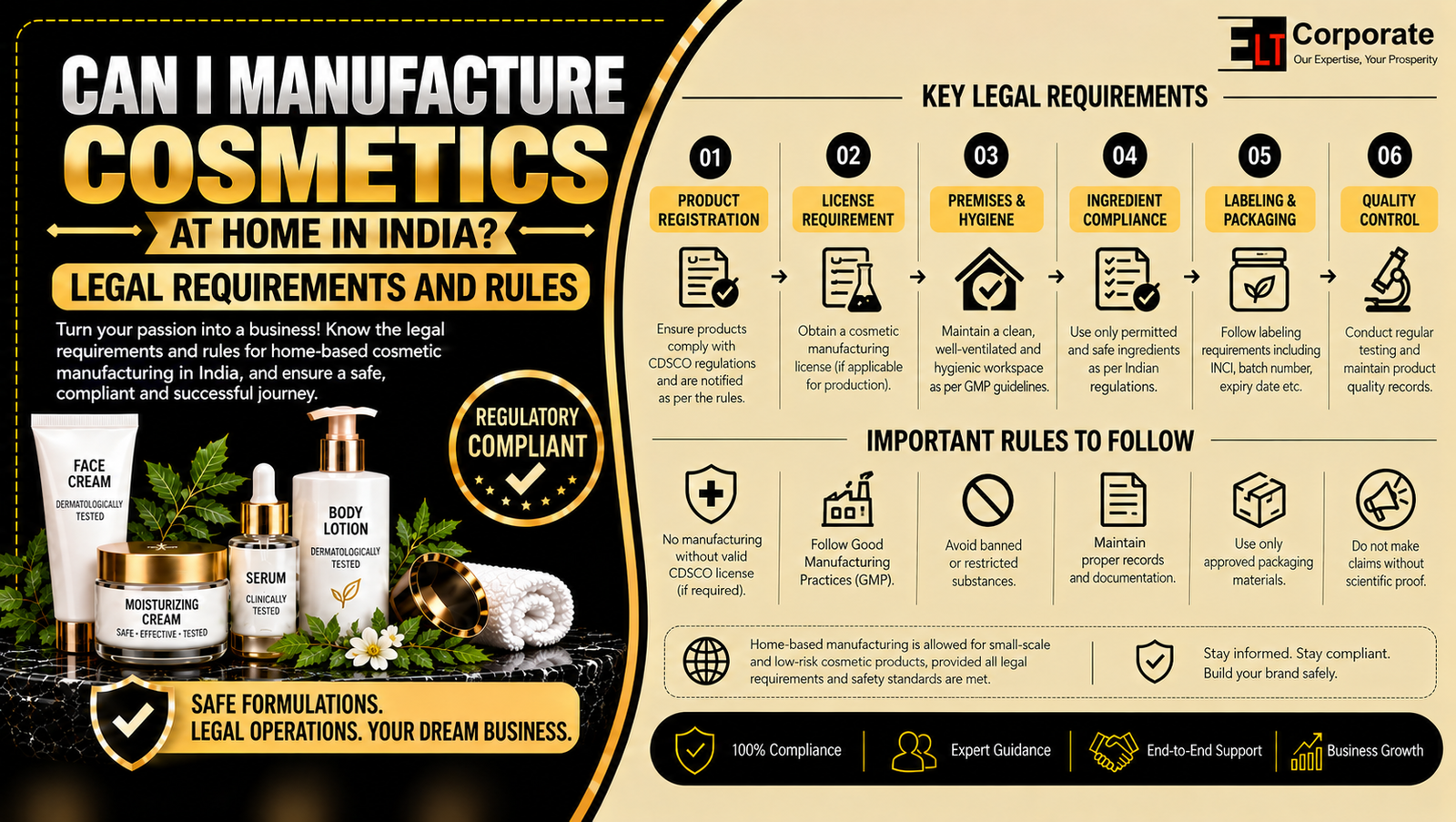
The answer depends on your proposed setup and whether the premises can meet the applicable regulatory requirements. Commercial cosmetic manufacturing is regulated under the Drugs and Cosmetics Act, 1940, and the Cosmetics Rules, 2020.
The manufacturing licence is issued by the relevant State Licensing Authority, not CDSCO. The authority assesses applications under the applicable rules.
If you plan to manufacture cosmetics at home in India, do not assume that an ordinary residential kitchen or bedroom automatically qualifies as an approved manufacturing facility. You must verify the premises requirements and applicable local permissions before starting commercial production.
Cosmetics Regulatory recommends reviewing your business model before investing in equipment, packaging, or raw materials.
Which Home-Based Cosmetic Businesses Need Regulatory Review?
Different business models can involve different responsibilities.
| Business model | What to check |
| Handmade soaps and skincare | Applicable cosmetic classification and manufacturing licence |
| Face creams and body lotions | Manufacturing premises, quality requirements, and documentation |
| Private-label products | Licensed third-party manufacturing arrangements |
| Small beauty startups | Applicable licensing, labeling, and product compliance |
| Personal-use preparations | Commercial sale and manufacturing requirements if the activity expands |
People who want to manufacture cosmetics at home in India for commercial sale should assess the relevant requirements before accepting orders.
Cosmetics Regulatory can help businesses understand which regulatory questions need to be resolved before launch.
EXPERT COSMETIC REGULATORY ASSISTANCE
Need Help Starting Your Cosmetic Business?
Get professional guidance on cosmetic manufacturing licences, documentation, premises requirements, and regulatory compliance before starting your business.
Cosmetics Regulatory | Your Partner for Cosmetic Regulatory Compliance
What Licence Is Required for Home-Based Cosmetic Manufacturing?
Under the Cosmetics Rules, 2020, applicants generally use Form COS-5 for a cosmetic manufacturing licence and Form COS-6 for a loan license, as applicable.
A license may be relevant when a business intends to use another licensed manufacturer’s premises under the applicable regulatory arrangement.
Entrepreneurs planning to manufacture cosmetics at home in India should identify the correct route instead of assuming that registering a business or obtaining a GST number replaces a cosmetic manufacturing licence.
The applicable licence depends on the manufacturing arrangement, premises, products, and regulatory requirements.
For official guidance, consult the CDSCO Cosmetics Rules, 2020.
Important Requirements Before Starting
Before you manufacture cosmetics at home in India, review the following areas.
1. Manufacturing Premises
The facility must satisfy applicable requirements relating to premises, hygiene, equipment, storage, and manufacturing operations. Residential use alone does not establish compliance.
2. Product Formulation
Prepare accurate formulation details, ingredient information, manufacturing procedures, and relevant product specifications.
3. Quality and Safety
Review applicable quality standards and testing arrangements. Products must comply with relevant requirements under the Cosmetics Rules, 2020.
4. Labelling and Packaging
Check the applicable labelling requirements, ingredient declarations, manufacturer information, batch details, and other required particulars before selling products.
5. Business and Local Permissions
Depending on the premises and business structure, additional local permissions or other registrations may need to be assessed separately.
Cosmetics Regulatory recommends checking these requirements before committing to a home-based production model.
Planning to Start a Cosmetic Brand?
Understand your cosmetic manufacturing licence requirements, suitable manufacturing options, and essential documents before investing in production.
Get Free Expert ConsultationWhat If Your Home Cannot Meet Manufacturing Requirements?
You may consider working with an appropriately licensed third-party cosmetic manufacturer instead of setting up your own facility.
Under this arrangement, a manufacturer produces products for your brand under agreed commercial and regulatory arrangements. You should verify the manufacturer’s license, product scope, documentation, quality procedures, and responsibilities before signing an agreement.
For entrepreneurs who cannot manufacture cosmetics at home in India in a compliant facility, this option may provide a practical alternative.
Cosmetics Regulatory can guide businesses in understanding the compliance considerations involved in selecting a manufacturing arrangement.
Documents to Prepare Before Applying
The exact checklist depends on the application and authority. Documents that may be relevant include:
- Applicant identity and business constitution documents.
- Proof of lawful possession of the proposed premises.
- Details of technical personnel.
- Product lists and formulation information.
- Manufacturing methods and product specifications.
- Equipment and facility details.
- Required declarations and supporting records.
If you intend to manufacture cosmetics at home in India, confirm the current requirements with your State Licensing Authority before submitting an application.
Cosmetics Regulatory can assist with understanding the documentation process and identifying potential gaps.
Common Mistakes to Avoid
Entrepreneurs should avoid beginning commercial production before checking licensing requirements. Other common mistakes include assuming that handmade products are automatically exempt, using unsuitable premises, making unsupported product claims, and overlooking labeling requirements.
Anyone planning to manufacture cosmetics at home in India should also avoid assuming that a third-party manufacturer’s licence automatically covers every independent business arrangement.
COSMOS Regulatory encourages businesses to assess these matters before launching products or accepting commercial orders.
Frequently Asked Questions
Q1. Can I sell homemade cosmetics online?
Commercial sale requires assessment of applicable manufacturing, product, and labeling requirements. Selling through a website or marketplace does not remove regulatory obligations.
Q2. Is a cosmetic manufacturing licence required for a home business?
If you commercially manufacture cosmetics, applicable licensing requirements must be assessed. Whether your proposed premises qualify depends on the relevant rules and the authority’s assessment.
Q3. Can I use a third-party manufacturer?
Yes, this may be an option if the manufacturing arrangement and products comply with applicable requirements.
Q4. Who issues cosmetic manufacturing licenses in India?
The relevant State Licensing Authority issues cosmetic manufacturing licenses under the applicable regulatory framework.
Q5. Can Cosmetics Regulatory help me get started?
Cosmetics Regulatory can provide guidance on licensing requirements, documents, and compliance considerations. Approval remains subject to the competent authority.
COSMETICS REGULATORY SUPPORT
Ready to Start Your Cosmetic Business?
Get expert guidance on cosmetic manufacturing licences, home-based production feasibility, documentation, and third-party manufacturing options before launching your brand.
Get clarity on the applicable requirements before investing in your manufacturing setup.