
You have the brand vision. You have identified your target audience. You know the products you want to launch. Now comes the question that every cosmetic startup founder must answer before anything else — will you import your products or manufacture them?
This is not merely an operational decision. It shapes your regulatory journey, your capital requirements, your speed to market, your quality control capabilities, your margins, and your long-term brand positioning. Getting this decision wrong can mean burning capital on inventory you cannot sell, regulatory delays that push back your launch by months, or quality inconsistencies that damage your brand before it even gets started.
This guide provides a comprehensive, honest comparison of the import route versus the domestic manufacturing route for cosmetic startups in India — covering regulatory requirements, costs, timelines, quality control, scalability, and the practical realities of each path — so you can make an informed decision that is right for your specific business.
Understanding the Two Routes
The Import Route
You source finished cosmetic products — or formulations — from overseas manufacturers (typically in countries like South Korea, France, Italy, China, the USA, or the UK) and import them into India for sale under your brand. The products are already manufactured abroad; your role is that of an importer and brand owner.
Regulatory path: Cosmetic Import Licence under Form COS-1 (Cosmetics Rules, 2020), issued by CDSCO (Central Drugs Standard Control Organisation).
The Domestic Manufacturing Route
You either set up your own manufacturing facility in India or partner with a domestic contract manufacturer (also called a third-party manufacturer or loan licensee) to produce cosmetics in India under your brand. The products are made within India.
Regulatory path: Cosmetic Manufacturing Licence under Form COS-2 / Form 31 / Form 32 (depending on whether you are the primary licensee or a loan licensee), issued by the State Drug Control Authority (e.g., Karnataka Drug Control Authority for Bengaluru-based startups).
At a Glance — Quick Comparison Table
| Parameter | Import Route | Domestic Manufacturing |
| Regulatory Body | CDSCO (Central) | State Drug Control Authority |
| Licence Form | Form COS-1 | Form COS-2 / Form 31 / 32 |
| Licence Timeline | 3 – 6 months | 2 – 6 months (contract mfg) |
| Minimum Capital Required | Moderate – High | Low (contract) / Very High (own factory) |
| Speed to Market | Moderate | Faster (via contract manufacturer) |
| MOQ (Minimum Order Quantity) | Higher (international shipping) | Lower (domestic contract manufacturers) |
| Product Customisation | Limited | High |
| Quality Control | Relies on foreign manufacturer | Greater control (especially own factory) |
| Regulatory Complexity | Higher (foreign documents, apostille) | Moderate |
| Scalability | Easy (increase import volumes) | Depends on manufacturing capacity |
| Brand Perception | “Imported” premium positioning | “Made in India” / Vocal for Local positioning |
| Ongoing Compliance | Moderate | Moderate – High |
| Ingredient Restrictions | Must comply with Indian prohibited list | Formulate within Indian norms |
| Best For | Niche / premium / K-beauty / global brands | Mass market, Ayurvedic, custom formulations |
The Import Route — A Deep Dive
How It Works
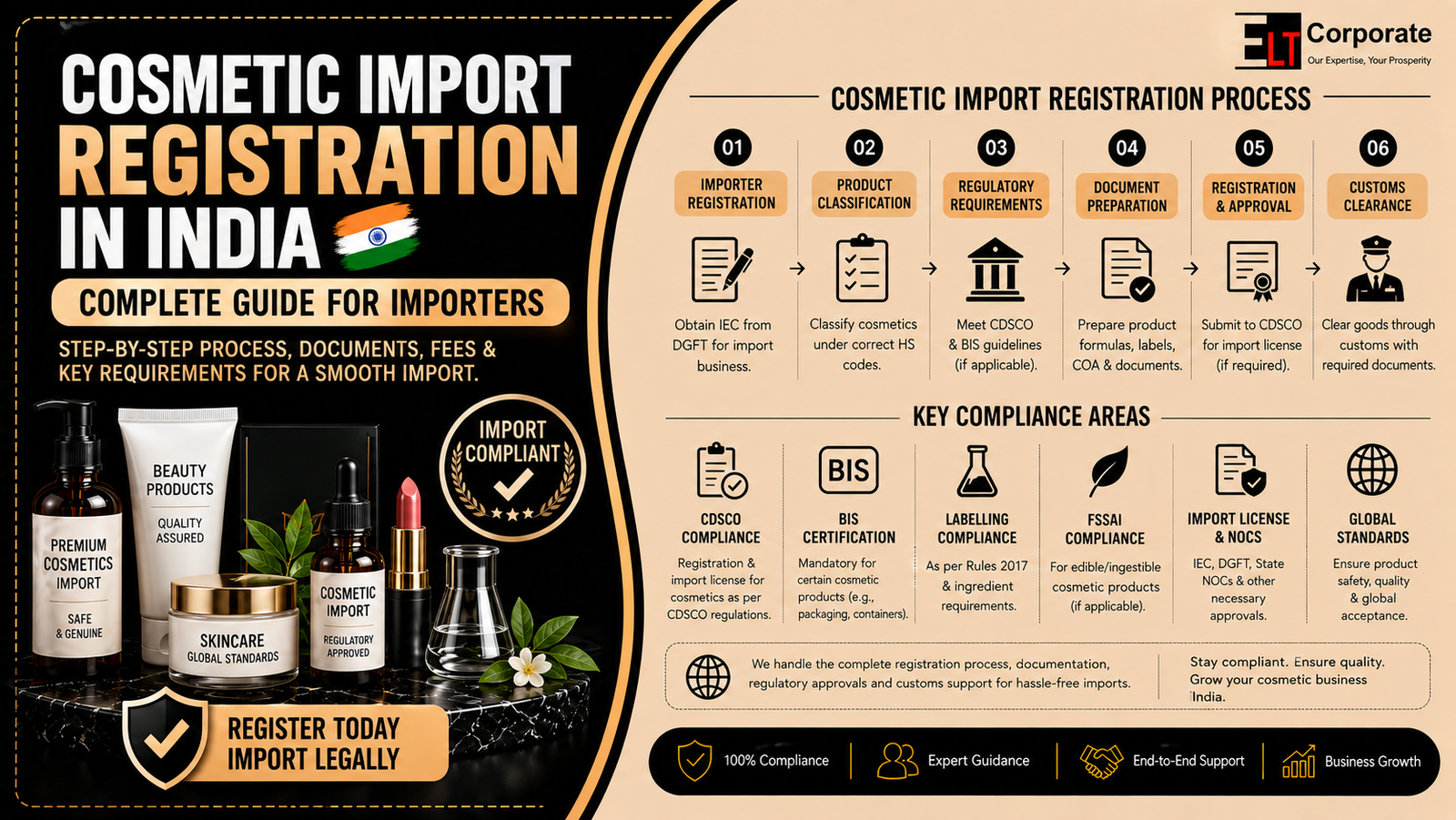
Under the import route, you identify an overseas cosmetic manufacturer whose finished products align with your brand vision. You negotiate a supply agreement, obtain the required documentation from the manufacturer, apply for a Cosmetic Import Licence via Form COS-1 on the CDSCO SUGAM portal, and — once licensed — begin importing.
Your business model is essentially that of a brand owner and importer. The manufacturing expertise stays with the overseas factory. Your value addition lies in brand building, marketing, distribution, and customer experience.
Regulatory Requirements — Import Route
Primary Licence: Cosmetic Import Licence — Form COS-1 filed with CDSCO through the SUGAM portal (sugam.gov.in).
Supporting Licences and Registrations:
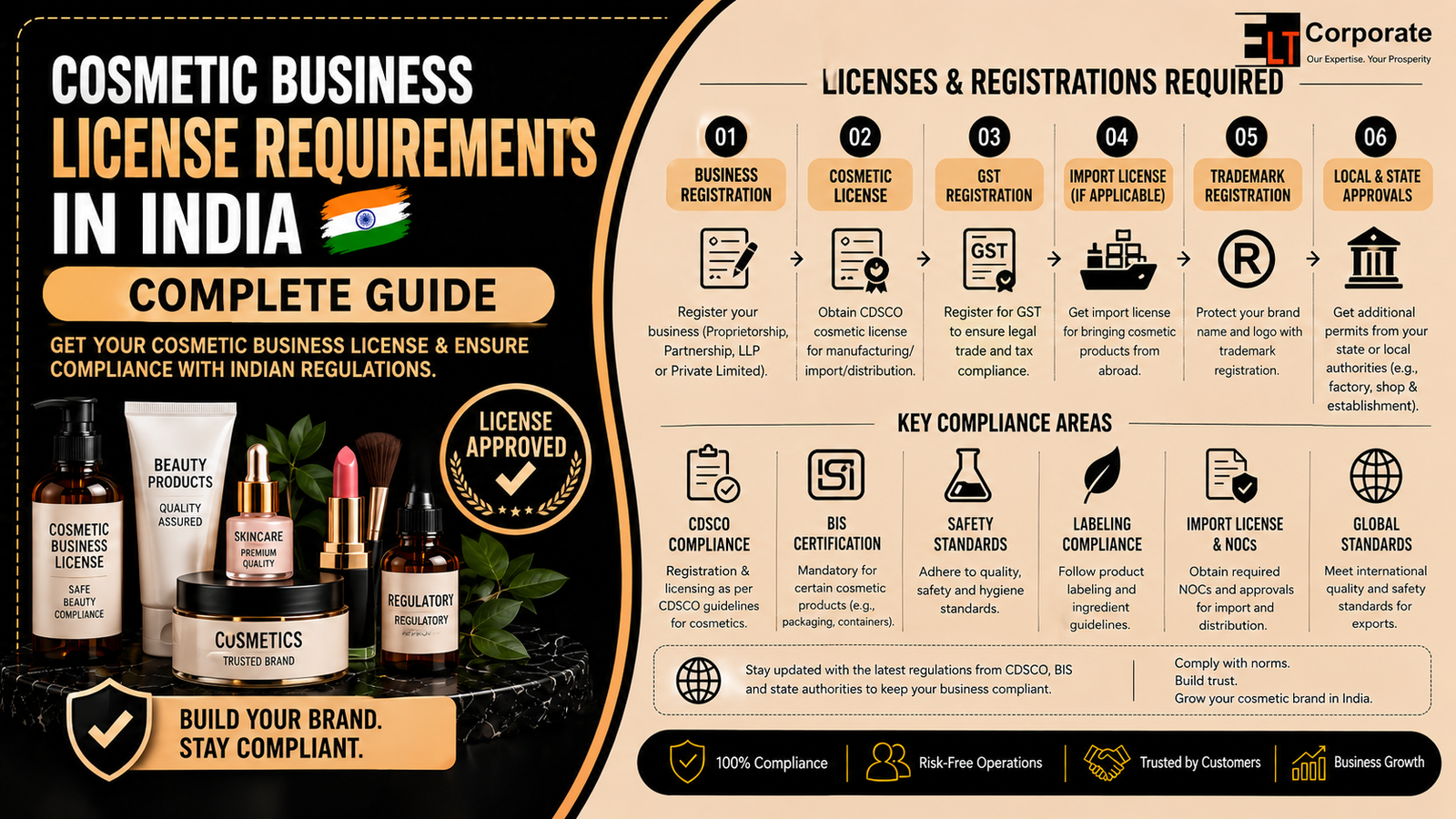
- Import Export Code (IEC) from DGFT — mandatory before applying
- GST Registration
- Business Registration (Pvt Ltd, LLP, Proprietorship, etc.)
Documents Required from Overseas Manufacturer:
- Certificate of Free Sale (CFS) — apostilled / legalised by Indian Embassy
- Certificate of Analysis (CoA) for each product
- Complete INCI ingredient list for each product
- GMP Certificate / ISO 22716 Certificate of the overseas facility
- Site Master File (SMF) of the manufacturing facility
- Manufacturer’s Declaration / Authorisation appointing you as Indian importer
- Product labels compliant with Indian cosmetic labelling rules
Timeline for Import Licence: 3 to 6 months (from date of complete document submission)
Government Fee: ₹3,000 per manufacturer (as prescribed under Cosmetics Rules, 2020; subject to revision)
Advantages of the Import Route for Cosmetic Startups
1. Access to World-Class Formulations Importing allows you to offer products formulated and manufactured to international standards — Korean skincare technology, French luxury formulations, or Italian professional hair care — without investing in formulation R&D yourself. This is a significant advantage when entering premium or niche segments.
2. Faster Initial Product Development Since the product is already formulated and manufactured overseas, your time from concept to import-ready product can be faster than developing a custom formulation from scratch in India. Many overseas manufacturers have ready catalogues of finished products available for white-label or OEM supply.
3. “Imported” Brand Positioning In many segments of the Indian cosmetics market — premium skincare, K-beauty, professional salon products — “imported” carries a perception of quality, sophistication, and efficacy. The import route allows startups to leverage this positioning authentically.
4. Lower Initial Operational Complexity You do not need to manage a manufacturing facility, production staff, raw material procurement, or batch manufacturing logistics. Your operational focus stays on brand building and sales.
5. Regulatory Pathway is Centrally Managed Unlike manufacturing licences (which vary by state), import licences are managed centrally through CDSCO — providing a more uniform regulatory experience regardless of your location in India.
Disadvantages of the Import Route for Cosmetic Startups
1. Complex and Document-Heavy Licensing Process Obtaining a Cosmetic Import Licence requires extensive documentation from the overseas manufacturer — CFS, SMF, GMP certificates, apostille of foreign documents. Coordinating with overseas factories to obtain these documents can be time-consuming and frustrating, especially with manufacturers who are unfamiliar with Indian regulatory requirements.
2. Manufacturer-Specific and Product-Specific Licence A separate Form COS-1 application is required for each overseas manufacturer. If you wish to source from three different countries and five different manufacturers, you need five separate licences — each with its own document set, fee, and processing time.
3. Higher Minimum Order Quantities (MOQs) International shipping economics typically demand higher MOQs. A startup wanting to test market reception with small quantities faces significant challenges — minimum orders of 500 to 5,000 units per SKU are common with overseas factories, and international freight costs make smaller orders disproportionately expensive.
4. Longer and Less Predictable Supply Chain International supply chains are subject to shipping delays, port congestion, customs clearance timelines, and geopolitical disruptions. A startup relying entirely on imported inventory has limited ability to respond quickly to demand spikes or supply disruptions.
5. Limited Product Customisation Most overseas manufacturers offering white-label or OEM products have limited flexibility to customise formulations for small-volume Indian importers. You largely sell what they make — with limited ability to adjust formulations, fragrance, texture, or activities to differentiate your brand.
6. Foreign Exchange Risk Procurement in USD, EUR, KRW, or other foreign currencies exposes the startup to currency fluctuation risk. A significant depreciation of the INR between ordering and payment can materially impact margins.
7. Ingredient Compliance Risk CDSCO maintains a list of prohibited and restricted ingredients for cosmetics in India. Products freely sold in South Korea, Europe, or the USA may contain ingredients that are prohibited or restricted in India. Every product’s full formulation must be carefully screened against Indian regulations before import — and if a prohibited ingredient is found after the licence is granted, the consequences can be severe.
8. No “Made in India” Positioning With rising nationalist sentiment and the government’s push for Vocal for Local and Made in India, some market segments — particularly mass market, Ayurvedic, and government-linked channels — are moving away from imported products or face additional barriers.
The Domestic Manufacturing Route — A Deep Dive
How It Works
Under the domestic manufacturing route, your cosmetic products are manufactured within India — either in your own factory or through a contract / third-party manufacturer (also called a loan licensee arrangement).
Option A — Own Manufacturing Facility: You set up and operate your own cosmetic manufacturing unit, obtain a manufacturing licence, hire production and QC staff, procure raw materials, and manage batch production in-house.
Option B — Contract / Third-Party Manufacturing (Most Common for Startups): You partner with an existing licensed cosmetic manufacturer who produces products to your specifications under a Loan Licence arrangement. The contractor manufactures, you brand and sell. This is the dominant model for Indian cosmetic startups.
Regulatory Requirements — Domestic Manufacturing Route
For Own Manufacturing Facility: Manufacturing Licence in Form COS-2 (or Form 31 under the transitional framework) from the State Drug Control Authority. Requires dedicated premises meeting GMP standards, qualified technical staff, and adequate equipment.
For Contract / Loan Manufacturing: The contract manufacturer holds the manufacturing licence. You, as the brand owner / loan licensee, may need to be named on the Loan Licence (Form 32). Requirements vary by state and specific arrangement.
Supporting Licences:
- GST Registration
- Business Registration
- FSSAI Registration (if manufacturing products that have a dual cosmetic/food classification — unlikely but possible)
- BIS Registration (if applicable for specific product categories under Quality Control Orders)
Timeline for Manufacturing Licence:
- Contract manufacturing arrangement: 1 – 3 months (primarily involves vetting and contracting the manufacturer)
- Own manufacturing facility licence: 3 – 8 months (includes premises inspection by Drug Control Authority)
Government Fee: Varies by state and scale of operations; typically ₹2,000 – ₹10,000 for manufacturing licences under the Cosmetics Rules, 2020.
Advantages of the Domestic Manufacturing Route for Cosmetic Startups
1. Faster Market Entry via Contract Manufacturing Working with an established domestic contract manufacturer can get you to market faster than the import route. You leverage the manufacturer’s existing licence, facility, and production capability — eliminating the time needed to obtain an import licence and source foreign documents.
2. Lower MOQs Indian contract manufacturers — particularly those specialising in startups and indie brands — typically offer significantly lower MOQs than overseas factories. Starting with 200 to 500 units per SKU is often feasible, allowing startups to test product-market fit with lower inventory risk.
3. High Product Customisation Domestic contract manufacturers can formulate entirely custom products to your specifications — specific actives, fragrance profiles, textures, concentrations, and claims. This level of product customisation is a powerful competitive differentiator and is far more accessible domestically than through overseas OEM suppliers.
4. Formulation Compliance Built In Reputable Indian contract manufacturers are already familiar with Indian cosmetic ingredient regulations. Prohibited and restricted ingredient compliance is managed as part of formulation development — significantly reducing the risk of regulatory issues post-production.
5. “Made in India” and Ayurvedic Positioning The Made in India positioning resonates strongly in many market segments — particularly mass market, rural and semi-urban, Ayurvedic / natural / herbal cosmetics, and government and institutional procurement channels. This positioning is authentically available only through domestic manufacturing.
6. Faster Response to Market Demand With a domestic supply chain, restocking and production turnarounds are significantly faster. You can respond to unexpected demand spikes or launch new SKUs without the 8–12 week lead time typical of international supply chains.
7. No Foreign Exchange Risk Procurement, production, and invoicing all in INR — eliminating currency risk from your cost structure.
8. Easier Regulatory Inspections and Compliance State Drug Control inspectors are accessible and familiar with the local regulatory landscape. Communication is easier, inspections are more predictable, and issue resolution is faster than dealing with CDSCO on import-related matters involving overseas manufacturers.
Disadvantages of the Domestic Manufacturing Route for Cosmetic Startups
1. Own Factory Requires Very High Capital Investment Setting up a GMP-compliant cosmetic manufacturing facility from scratch requires significant capital — in the range of ₹50 lakhs to several crores depending on the product category, batch size, and location. This is not viable for most early-stage startups.
2. Quality Control Dependency on Contract Manufacturer When using a third-party contract manufacturer, you are dependent on their quality systems, raw material suppliers, production discipline, and batch consistency. Poor choice of contract manufacturer is one of the most common causes of quality disasters for Indian cosmetic startups.
3. Intellectual Property Risk Sharing proprietary formulations with a contract manufacturer carries IP risk, particularly if the manufacturer produces similar products for competing brands. Robust non-disclosure agreements and formulation ownership clauses in the manufacturing contract are essential but do not eliminate all risk.
4. Limited Access to Cutting-Edge International Formulations Indian contract manufacturers may not have access to the latest international cosmetic actives, delivery systems, or formulation technologies that are available from leading overseas manufacturers. For startups positioning on advanced ingredient technology, this can be a limitation.
5. State-Level Regulatory Variability Manufacturing licences are issued by state drug control authorities, and regulatory standards, inspection frequency, and compliance requirements vary significantly across states. What is acceptable in one state may not be in another, creating complexity for startups with multi-state manufacturing arrangements.
6. Scaling May Require Changing Manufacturers A contract manufacturer capable of handling initial low-volume production may not have the capacity to support scale-up. Switching manufacturers’ mid-growth can disrupt formulation consistency, packaging, and regulatory documentation.
Key Factors to Consider When Choosing Your Route
Factor 1 — Product Category and Positioning
Choose Import if: Your brand is positioned in the premium or luxury segment, you are building around K-beauty, J-beauty, or European formulation expertise, or you are targeting a niche that genuinely values international provenance.
Choose Domestic Manufacturing if: You are building a mass-market brand, an Ayurvedic / herbal brand, a naturals brand, or targeting government / institutional channels where Made in India is a preference or requirement.
Factor 2 — Available Capital
Choose Import if: You have moderate capital and want to avoid the very high capex of setting up a factory, but have enough for international MOQs and the import licence process.
Choose Contract Manufacturing if: You have limited initial capital — domestic contract manufacturing allows you to start with low MOQs and minimal upfront investment beyond product development costs.
Avoid Own Factory if: You are at the idea or early startup stage — the capital, time, and operational complexity of setting up your own manufacturing facility is rarely justified before significant revenue traction is established.
Factor 3 — Speed to Market
Contract manufacturing wins on speed for most startup scenarios. Finding a good contract manufacturer, finalising the formulation, and going to production can happen within 3 to 6 months. Import licensing, particularly when overseas documents need apostille and CDSCO review, consistently takes longer.
Factor 4 — Formulation Differentiation
Import wins if you are reselling or white-labelling an overseas manufacturer’s existing formulation. But domestic contract manufacturing wins if you want to develop a truly custom, proprietary formulation that belongs to your brand — because Indian contract manufacturers offer far greater flexibility for Indian-market-focused formulation development.
Factor 5 — Regulatory Risk Appetite
The import route carries a specific risk — if a prohibited ingredient is discovered in an imported product after the licence is granted and stock has been imported, the consequences (seizure, recall, licence cancellation) can be financially devastating. Domestic contract manufacturing, particularly with established manufacturers familiar with Indian regulations, carries lower ingredient compliance risk.
Factor 6 — Long-Term Brand Vision
Are you building a brand around global sourcing and international formulation heritage? Import is your natural route. Are you building a brand around Indian ingredients, Ayurvedic heritage, sustainable domestic supply chains, or “clean beauty made in India”? Domestic manufacturing is your natural route.
The Hybrid Approach — The Best of Both Worlds?
Many successful Indian cosmetic brands do not choose one route exclusively — they use both strategically.
A common hybrid approach:
- Launch core hero products through domestic contract manufacturing — faster, cheaper, customisable
- Import specific hero SKUs that require international formulation technology or a credible “imported” positioning for premium pricing
- Transition to own manufacturing once revenue justifies the capital investment
This approach allows startups to enter the market quickly and cost-effectively while building toward a diversified, resilient supply chain.
Regulatory reality of the hybrid approach: You must maintain both an Import Licence (Form COS-1 with CDSCO) and a manufacturing/loan licence arrangement (with the State Authority) simultaneously. This requires managing two parallel compliance frameworks, which adds administrative complexity but is entirely manageable with the right regulatory support.
Common Mistakes Cosmetic Startups Make When Choosing Their Route
Choosing import because it “sounds simpler” — then discovering the documentation complexity Many founders assume importing is straightforward — order from overseas, sell in India. The Cosmetic Import Licence process, with its foreign manufacturer documentation requirements, apostille obligations, and CDSCO processing timelines, frequently surprises unprepared startups.
Choosing contract manufacturing without vetting the manufacturer’s regulatory standing Not all cosmetic contract manufacturers in India operate to the same standards. Engaging a manufacturer without a valid, current manufacturing licence, or one with a poor GMP track record, exposes your brand to serious regulatory and quality risk.
Underestimating the import MOQ commitment A startup that commits to large import MOQs before validating product-market fit can find itself with unsellable inventory. Always negotiate the smallest viable initial MOQ for test batches.
Not checking ingredients against Indian prohibited lists before importing This mistake, made after the licence is already granted and goods are already imported, can be catastrophic. Always conduct ingredient compliance screening before even beginning the import licence application.
Treating the manufacturing licence as the end of compliance Both routes carry ongoing obligations — labelling compliance, record-keeping, adverse event reporting, licence renewal. Many startups discover these obligations only after receiving their licence.
Regulatory Support — How We Help Cosmetic Startups Navigate Both Routes
Whether you choose the import route, domestic manufacturing, or a hybrid strategy, our regulatory team provides:
For the Import Route:
- Form COS-1 application preparation and filing
- Foreign manufacturer document coordination and checklist
- Ingredient compliance screening against Indian prohibited lists
- Label compliance review for Indian market
- CDSCO query response and follow-up
- Post-licence compliance support
For the Domestic Manufacturing Route:
- Contract manufacturer vetting and regulatory due diligence
- Manufacturing licence (Form 31 / 32 / COS-2) application support
- GMP compliance gap assessment
- Label design review and compliance advisory
- State Drug Control inspection preparation
For the Hybrid Approach:
- Parallel import and manufacturing licence management
- Unified compliance calendar
- Regulatory strategy advisory for portfolio expansion
Frequently Asked Questions
Q1. Can a cosmetic startup in India sell both imported and domestically manufactured products under the same brand?
Yes, absolutely. Many Indian cosmetic brands operate with a mixed portfolio — some SKUs imported, others domestically manufactured. You need the appropriate licence for each — a Cosmetic Import Licence for the imported products and a manufacturing/loan licence for the domestically produced ones.
Q2. Is it cheaper to import cosmetics or manufacture them in India?
It depends heavily on the product category, volume, and quality tier. For premium or specialised formulations, importing can offer better cost-to-quality ratios at scale. For mass-market products, domestic manufacturing — particularly through contract manufacturers — typically offers lower per-unit costs once MOQs are managed efficiently.
Q3. Can I import cosmetics and then repackage or relabel them in India?
Yes, but this constitutes a manufacturing activity and requires a separate manufacturing licence (for repackaging / relabelling) in addition to the import licence. Simply importing and repackaging without the appropriate licence is a regulatory violation.
Q4. How do I find a good cosmetic contract manufacturer in India?
Look for manufacturers with a valid, current manufacturing licence from their State Drug Control Authority, a track record of producing product categories similar to yours, ISO 22716 (Cosmetics GMP) certification, experience with indie / startup brands, and willingness to do small initial batches. References from other brands they manufacture are valuable. Our team can assist with manufacturer vetting and regulatory due diligence.
Q5. Does the import licence cover all products from one manufacturer, or do I need separate licences for each product?
The Cosmetic Import Licence under Form COS-1 is manufacturer-specific. It covers the specific products listed in the application for that manufacturer. Adding new products from the same manufacturer may require an amendment application. Products from a different manufacturer require a separate licence application.
Q6. What is the difference between white-label and OEM manufacturing for cosmetics?
White-label means you purchase a manufacturer’s standard, pre-developed formulation and apply your own brand label. OEM (Original Equipment Manufacturer) or custom manufacturing means you provide the formulation specifications and the manufacturer produces it to your requirements. OEM offers more differentiation; white-label offers faster launch at lower cost.
Q7. If I start with contract manufacturing, can I switch to my own factory later?
Yes. This is a common growth path for Indian cosmetic brands. You start with contract manufacturing to validate the market and generate revenue, then invest in your own facility once the business justifies it. The regulatory transition involves applying for your own manufacturing licence while managing the continuity of supply during the transition.