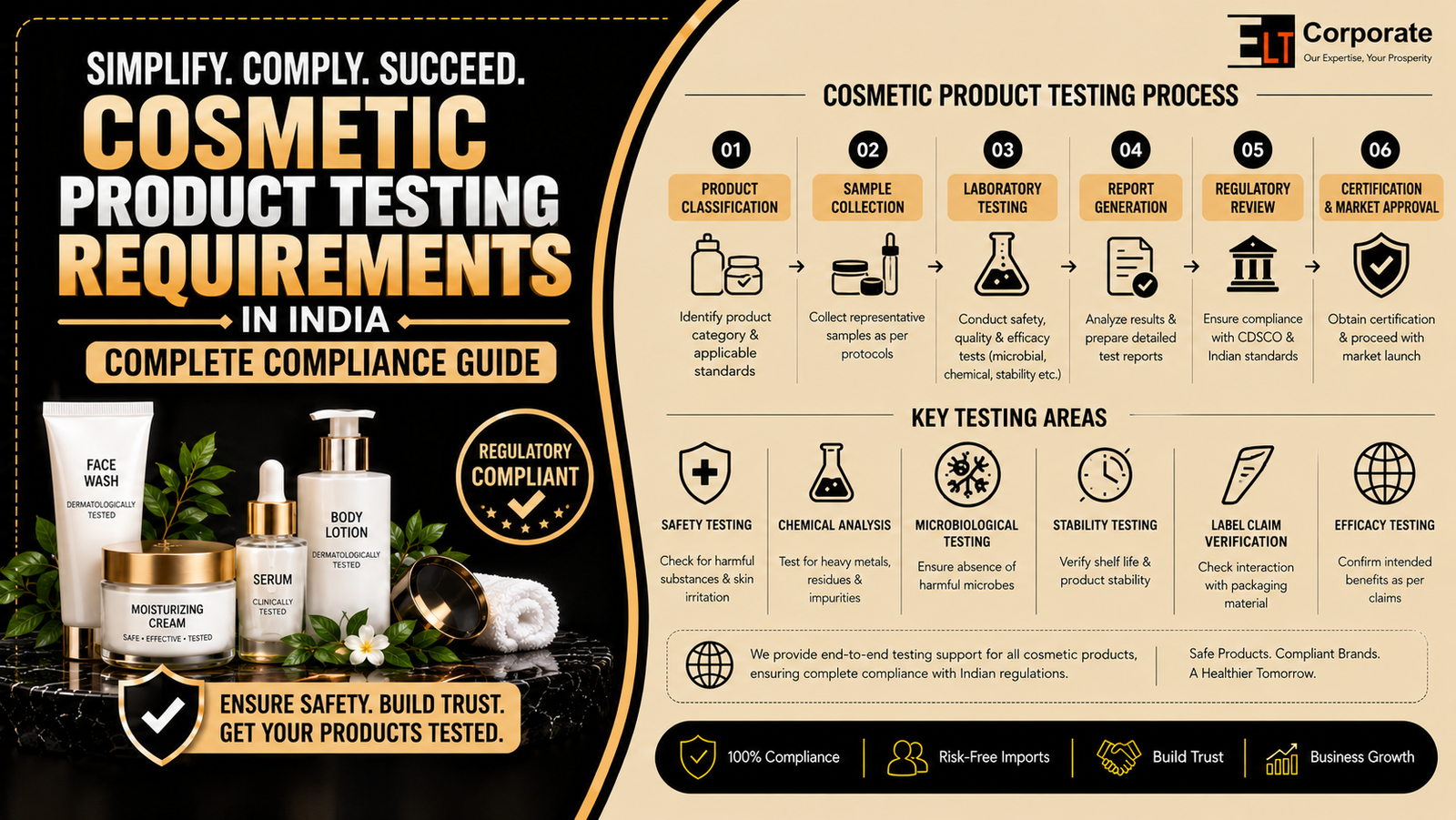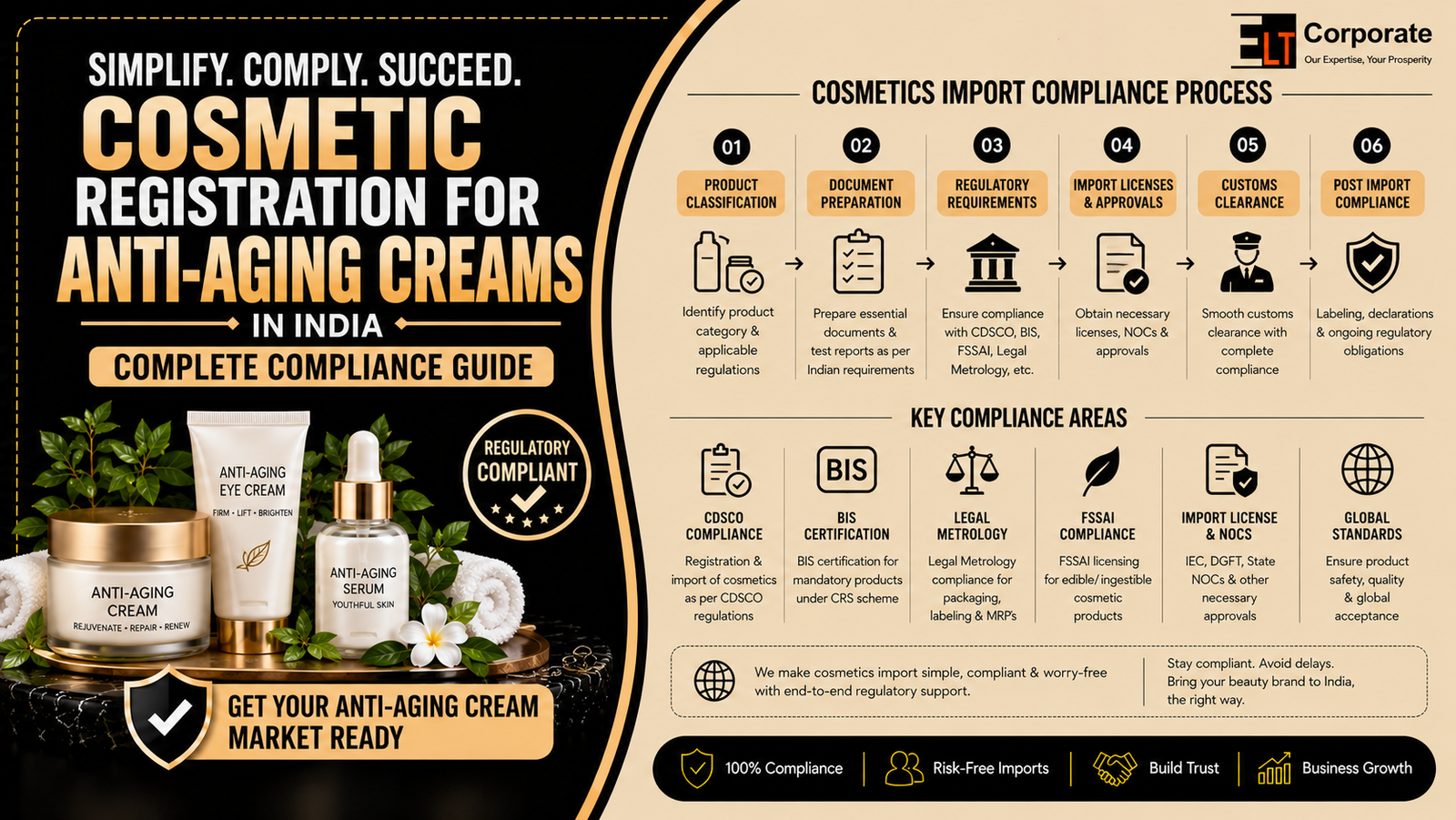


Bengaluru has emerged as one of India’s most vibrant hubs for beauty and personal care startups. From cruelty-free skincare brands to professional salon product lines, entrepreneurs across the city are building businesses around internationally sourced cosmetic products. But before a single unit of an imported cosmetic can legally enter the Indian market, one critical regulatory step must be completed — obtaining a Cosmetic Import License.
Under the Drugs and Cosmetics Act, 1940 and the Cosmetics Rules, 2020, importing cosmetics into India without a valid licence is a punishable offence. The licensing process is administered at the central level by the Central Drugs Standard Control Organisation (CDSCO), and applications are submitted through Form COS-1 — the prescribed application form for a cosmetic import licence.
For beauty startups in Bengaluru, navigating this process can feel overwhelming. This guide breaks it all down — the documents you need, the fees involved, the process to follow, and the key things to get right the first time.
What is a Cosmetic Import License (Form COS-1)?
Form COS-1 is the official application form prescribed under the Cosmetics Rules, 2020 for obtaining a licence to import cosmetics into India. It replaces the earlier Form 43 that was used under the old Cosmetics Rules framework.
A Cosmetic Import Licence grants the holder the legal right to import specified cosmetic products from specified foreign manufacturers for sale and distribution in India. The licence is product-specific and manufacturer-specific — meaning a separate application is required for each foreign manufacturer whose products you wish to import.
The licence is issued by the CDSCO (Central Drugs Standard Control Organisation) under the Ministry of Health and Family Welfare, Government of India. For startups operating from Bengaluru, the relevant CDSCO zonal office is the CDSCO South Zone, headquartered in Chennai — though applications are now primarily filed through the SUGAM online portal
Who Needs to Apply for a Cosmetic Import License in Bengaluru?
Any individual or business entity based in Bengaluru that intends to commercially import cosmetic products from outside India must apply for a Cosmetic Import Licence via Form COS-1. This includes:
- Beauty startups importing branded foreign cosmetics for resale in India
- E-commerce sellers sourcing cosmetics from overseas suppliers
- Salon and spa chains importing professional-grade foreign cosmetic products
- Distributors and wholesale traders importing cosmetics for supply to retailers
- Private label brands sourcing finished cosmetic products from foreign contract manufacturers
- Subscription box businesses curating imported beauty products for Indian consumers
- Health and wellness brands importing personal care products classified as cosmetics
If you are importing products that are classified as drugs (medicated creams, therapeutic shampoos, certain sunscreens above prescribed SPF thresholds, etc.) rather than cosmetics, a different licence — a Drug Import Licence — is required. Correctly identifying your product’s regulatory classification is the essential first step.
What Products are Covered Under Cosmetic Import Licence?
The Cosmetics Rules, 2020 define cosmetics broadly. Products requiring a Cosmetic Import Licence include:
Skin Care Face creams, moisturisers, serums, face masks, toners, eye creams, body lotions, lip balms, sunscreens (non-therapeutic), and exfoliators
Hair Care Shampoos, conditioners, hair masks, hair oils, hair serums, hair growth tonics (non-drug), and hair styling products
Colour Cosmetics Foundations, concealers, lipsticks, lip glosses, eyeshadows, mascaras, eyeliners, blushes, highlighters, and setting sprays
Nail Care Nail polishes, base coats, top coats, nail treatments, and cuticle oils
Fragrances Perfumes, eau de toilette, body mists, and deodorants
Oral Care Toothpastes, mouthwashes, and teeth-whitening products (cosmetic grade)
Baby Cosmetics Baby lotions, powders, shampoos, and wipes
Men’s Grooming Shaving creams, aftershaves, beard oils, and men’s skincare products
Herbal and Natural Cosmetics Plant-based skincare and haircare products not classified as Ayurvedic drugs
Essential Documents Required for Form COS-1 Application
This is the most critical part of the licensing process. Incomplete or incorrect documentation is the most common reason for application delays and rejections. Below is a comprehensive checklist of all documents required for a Cosmetic Import Licence application via Form COS-1.
A. Documents from the Applicant (Indian Importer — Bengaluru Entity)
1. Completed Form COS-1 The duly filled application in the prescribed format under the Cosmetics Rules, 2020. The form must be filled accurately with details of the applicant, the foreign manufacturer, and the products to be imported.
2. Business Registration Certificate Proof that the applicant is a legally registered business entity in India. Acceptable documents include:
- Certificate of Incorporation (for Private Limited / Public Limited Companies)
- Partnership Deed (for Partnership firms)
- LLP Agreement and Certificate of Incorporation (for LLPs)
- Udyam Registration Certificate (for proprietorships and MSMEs)
- Shop and Establishment Registration Certificate
3. GST Registration Certificate A valid GST registration certificate showing the applicant’s GSTIN. This establishes the business’s tax compliance status and commercial legitimacy.
4. PAN Card of the Business Entity Permanent Account Number (PAN) of the company, firm, or proprietorship applying for the licence.
5. Aadhaar Card / ID Proof of the Authorised Signatory Government-issued identity proof of the person signing the application (proprietor, partner, director, or authorised representative).
6. Address Proof of Business Premises in Bengaluru Documentary evidence of the registered business address, such as:
- Rent agreement / lease deed for the office or warehouse
- Utility bill (electricity/water) not older than 3 months
- Property tax receipt (if owned premises)
7. Import Export Code (IEC) The Import Export Code issued by the Directorate General of Foreign Trade (DGFT) is mandatory for any entity importing goods into India. A valid IEC certificate must accompany the application.
8. Authorisation Letter (if applicable) If the application is being filed or signed by a person other than the proprietor, partner, or director, a duly signed authorisation letter / board resolution authorising that person to apply must be provided.
9. Affidavit / Undertaking A duly sworn affidavit on non-judicial stamp paper from the proprietor / partners / directors, declaring:
- That the applicant has not been convicted of any offence under the Drugs and Cosmetics Act
- That all particulars furnished are true and correct
- Undertaking to comply with the conditions of the licence
10. Power of Attorney (if applicable) If a regulatory consultant or legal agent is filing the application on behalf of the company, a duly executed Power of Attorney authorising them to act must be provided.
B. Documents from the Foreign Manufacturer
These documents must be obtained from the overseas cosmetic manufacturer whose products you wish to import. They are critical to the application and often take the longest to compile.
11. Certificate of Free Sale (CFS) Issued by the competent authority in the manufacturer’s country (typically the national drug or health regulatory authority), the CFS confirms that:
- The cosmetic product is freely manufactured and sold in the country of origin
- It is not subject to any restriction or recall
- The manufacturer is in good standing with local regulatory authorities
The CFS must be:
- Current and valid (not older than 3 years, typically)
- Apostilled or legalised by the Indian Embassy / High Commission in the manufacturer’s country
- Product-specific or category-specific
12. Certificate of Analysis (CoA) A detailed laboratory analysis report for each product, confirming its composition, quality parameters, and compliance with specifications. It must be issued by the manufacturer’s quality control laboratory or an accredited third-party laboratory.
13. Product Formulation / Composition Details A complete list of all ingredients in each product, declared in INCI (International Nomenclature of Cosmetic Ingredients) format. This is used to verify that no prohibited substances are included and that permissible concentrations are adhered to.
14. Manufacturing Licence / GMP Certificate of the Foreign Manufacturer Documentary proof that the foreign manufacturing facility is licensed and complies with Good Manufacturing Practices (GMP) in its country. This may be:
- A GMP certificate issued by the national regulatory authority
- An ISO 22716 (Cosmetics GMP) certificate from an accredited certification body
15. Site Master File (SMF) of the Foreign Manufacturer A comprehensive document describing the manufacturing site, its quality management systems, manufacturing processes, and controls. The SMF provides CDSCO with assurance about the manufacturer’s standards.
16. Product Labels and Artwork Proposed label designs for each product, showing all label elements required under Indian regulations, including:
- Product name and generic name
- Complete ingredient list (INCI order, descending concentration)
- Net content / net weight
- Manufacturer’s name and address
- Country of origin
- Importer’s name and address (the Bengaluru entity)
- Batch number and date of manufacture
- Best before / expiry date
- Directions for use and precautions
- Any applicable warnings
17. Declaration / Undertaking from the Foreign Manufacturer A formal declaration from the overseas manufacturer:
- Authorising the Indian applicant to import and sell their products in India
- Confirming the accuracy of all submitted technical data
- Agreeing to cooperate with CDSCO inspections if required
18. Product Safety Data / Safety Assessment Report (if applicable) For certain product categories, a safety assessment report prepared by a qualified cosmetic safety assessor may be required, demonstrating that the product is safe for use as directed.
19. Clinical/Efficacy Data (for Specific Claims) If the product makes specific performance claims (anti-ageing, hair regrowth, teeth whitening beyond cosmetic thresholds), supporting clinical or efficacy data may be requested by CDSCO.
C. Additional Documents (Situation-Specific)
20. No Objection Certificate (NOC) from State Drug Controller For certain product categories or in specific regulatory situations, an NOC from the Karnataka State Drug Controller may be required before or alongside the CDSCO application.
21. Prior CDSCO Approval for Restricted Ingredients If any product contains ingredients that require prior approval or are subject to specific concentration limits under Indian cosmetic regulations, prior approval documentation must be included.
22. Test Reports from Indian Laboratory (if required) CDSCO may, at its discretion, request that samples of the imported cosmetic be tested at an approved Indian laboratory before or after licence issuance.
Government Fees for Cosmetic Import License (Form COS-1)
The fee structure for Cosmetic Import Licences under the Cosmetics Rules, 2020 is prescribed by the central government. Fees are paid online through the SUGAM portal at the time of application.
Fee Structure
| Application Type | Government Fee |
| New Cosmetic Import Licence (per manufacturer) | ₹3,000 |
| Addition of new product(s) to existing licence | ₹1,000 per product (subject to prescribed limits) |
| Renewal of Cosmetic Import Licence | ₹2,000 |
| Duplicate Licence (loss or damage) | ₹500 |
| Amendment to existing licence (change of address, name, etc.) | ₹500 |
Note: The above fees are government fees prescribed under the Cosmetics Rules, 2020. These are subject to revision by the Government of India. Always verify the current fee schedule on the SUGAM portal or with CDSCO before submitting your application.
Additional Cost Considerations for Beauty Startups
Beyond government fees, beauty startups in Bengaluru should budget for the following associated costs:
| Cost Item | Estimated Range |
| Apostille / Legalisation of CFS from foreign country | ₹5,000 – ₹20,000 per document (varies by country) |
| Translation of foreign-language documents (if required) | ₹2,000 – ₹8,000 per document |
| Affidavit notarisation charges | ₹500 – ₹2,000 |
| Regulatory consultant / professional fees | ₹15,000 – ₹60,000 (varies by scope) |
| SUGAM portal account setup and digital signature | ₹1,500 – ₹3,000 |
| Product testing at approved Indian lab (if required) | ₹5,000 – ₹25,000 per product |
| Label printing and design revision | ₹3,000 – ₹15,000 per product |
Total estimated startup cost for first import licence application (single manufacturer, 3–5 products): ₹40,000 – ₹1,20,000 depending on complexity, country of origin, and professional support engaged.
Step-by-Step Process for Obtaining Cosmetic Import Licence via Form COS-1 in Bengaluru
Step 1 — Product Classification and Regulatory Assessment
Before beginning the application, confirm that your products are correctly classified as cosmetics (not drugs or nutraceuticals) under Indian law. Identify the applicable regulatory requirements for each product category.
Step 2 — Obtain Import Export Code (IEC)
If you do not already have an IEC, apply to the DGFT online. IEC is mandatory before applying for any import licence.
Step 3 — Register on the SUGAM Portal
Create an account on the CDSCO SUGAM portal (sugam.gov.in). Digital Signature Certificate (DSC) may be required for application submission.
Step 4 — Collect Documents from Foreign Manufacturer
Initiate communication with your overseas supplier early. Obtaining the CFS, Site Master File, GMP certificate, and manufacturer declaration can take several weeks depending on the country and manufacturer.
Step 5 — Apostille / Legalise Foreign Documents
Documents issued in foreign countries must be apostilled or legalised for use in India. This is done through the competent authority in the manufacturer’s country and then verified by the Indian Embassy / High Commission.
Step 6 — Prepare Indian Applicant Documents
Compile all documents from the Indian applicant side — business registration, IEC, GST, affidavit, label artworks, and authorisation letters.
Step 7 — Fill Form COS-1 on SUGAM Portal
Complete the Form COS-1 online through the SUGAM portal. Enter accurate details of the applicant, the manufacturer, and each product to be imported.
Step 8 — Pay Government Fee Online
Pay the prescribed government fee online through the SUGAM portal payment gateway. Retain the payment receipt for your records.
Step 9 — Upload Documents and Submit Application
Upload all required documents in the prescribed format (PDF, size limits as per SUGAM portal requirements) and submit the application online.
Step 10 — CDSCO Review and Queries
CDSCO reviews the application and may raise queries or request additional information. Respond promptly and accurately to all queries to avoid delays.
Step 11 — Licence Issuance
Upon successful review, CDSCO issues the Cosmetic Import Licence digitally through the SUGAM portal. The licence specifies the approved products, manufacturer details, and conditions of import.
Step 12 — Comply with Licence Conditions
After receiving the licence, ensure ongoing compliance with all conditions — including correct labelling of every imported consignment, maintaining import records, and reporting any adverse events to CDSCO.
Validity and Renewal of Cosmetic Import License
- A Cosmetic Import Licence issued under Form COS-1 is valid for 5 years from the date of issue
- Renewal must be applied for before the expiry date — late renewal may require a fresh application
- Renewal application is submitted through the SUGAM portal with updated documents and the prescribed renewal fee
- Significant changes (new products, new manufacturer, change of importer address) require amendment applications
Key Compliance Obligations After Getting the Licence
Obtaining the licence is not the end of the journey. Bengaluru beauty startups must remain compliant throughout their import operations:
Labelling Compliance Every imported cosmetic consignment must bear labels conforming to Indian regulations. Labels must display all mandatory information including the importer’s name and address in Bengaluru, INCI ingredient list, expiry date, and batch number.
Import Records Importers must maintain detailed records of all imports — including commercial invoices, bills of lading, customs clearance documents, and batch-wise stock records — for a minimum period of 5 years.
No Prohibited Ingredients CDSCO maintains a list of ingredients prohibited in cosmetics in India. It is the importer’s responsibility to ensure that no consignment contains prohibited substances, even if the product is freely sold in the country of origin.
Adverse Event Reporting If any consumer reports a serious adverse reaction to an imported cosmetic product, the importer must report this to CDSCO in a timely manner and cooperate with any regulatory investigation.
Market Surveillance CDSCO and state drug control authorities may conduct market surveillance and sample imported cosmetics for testing at any time. Products found to be non-compliant may be seized, recalled, or subject to licence cancellation.
Common Mistakes Beauty Startups Make — And How to Avoid Them
Importing Before Obtaining Licence Many startups place orders and receive goods before the licence is issued, assuming the process will be completed in time. Importing without a valid licence is an offence. Always obtain your licence before your first shipment arrives.
Incomplete Manufacturer Documents The Certificate of Free Sale and Site Master File are frequently submitted with missing information or without proper apostille. Verify document completeness before submission.
Incorrect Product Classification Importing a product classified as a drug (such as a high-SPF medicated sunscreen or an anti-dandruff shampoo with active drug ingredients) under a cosmetic licence is a serious violation. Always confirm regulatory classification with an expert.
Label Non-Compliance Labels that work in the product’s home country may not comply with Indian requirements. Have all labels reviewed against Indian cosmetic labelling rules before importing.
Not Accounting for Timeline The licensing process typically takes 3 to 6 months or more, depending on document completeness and CDSCO workload. Plan your import timeline accordingly and do not commit to launch dates before the licence is secured.
Ignoring Prohibited Ingredient Lists Some ingredients permitted in the EU, USA, or South Korea are prohibited in India. Check every product’s full formulation against CDSCO’s prohibited and restricted ingredient lists before applying.
Why Bengaluru Beauty Startups Should Work with a Regulatory Expert
The Cosmetic Import Licence process under Form COS-1 involves navigating:
- Central (CDSCO) and state-level (Karnataka Drug Control) regulations
- International document requirements (apostille, foreign government certifications)
- Online portal filing (SUGAM) with specific technical requirements
- Product-specific compliance assessment
- Ongoing post-licence obligations
For a beauty startup focused on product development, branding, and market building, managing this regulatory process internally can divert significant time and resources. Working with an experienced regulatory consultant or compliance service provider in Bengaluru allows startups to:
- Get the application right the first time, avoiding costly delays
- Receive expert guidance on product classification and ingredient compliance
- Have a specialist manage CDSCO query responses
- Stay updated on regulatory changes that affect their product portfolio
- Focus on growing their business while compliance is handled professionally
Frequently Asked Questions
Q1. How long does it take to get a Cosmetic Import Licence via Form COS-1 in Bengaluru? The process typically takes 3 to 6 months from the date of submission of a complete application. Delays are most commonly caused by incomplete documentation, CDSCO queries, or delays in obtaining foreign manufacturer documents such as the Certificate of Free Sale or Site Master File.
Q2. Can I import cosmetics from multiple foreign manufacturers on a single licence? No. A separate Form COS-1 application must be filed for each foreign manufacturer. Each licence is specific to one manufacturer and the products listed in that application.
Q3. Is there a limit on the number of products I can include in one application? CDSCO guidelines specify the number of products that can be covered under a single application. If you wish to import a large range of products from one manufacturer, confirm with a regulatory expert or on the SUGAM portal whether multiple applications are required.
Q4. Can a beauty startup apply for a Cosmetic Import Licence as a sole proprietorship?
Yes. Sole proprietorships, partnerships, LLPs, and private limited companies can all apply for a Cosmetic Import Licence. The business must have a valid IEC and GST registration.
Q5. Do imported cosmetics need to be re-tested in India after obtaining the licence? CDSCO may, at its discretion, require testing of imported samples at an approved Indian laboratory either during the application process or through market surveillance after the licence is issued. Building this into your quality assurance plan is advisable.
Q6. What happens if CDSCO finds a prohibited ingredient in my imported cosmetic after the licence is issued?
The licence may be suspended or cancelled, the product may be seized and destroyed, and the importer may face legal action under the Drugs and Cosmetics Act. Thorough ingredient review before applying is essential to prevent this.
Q7. Is the Cosmetic Import Licence the same as customs clearance?
No. The Cosmetic Import Licence is a regulatory licence from CDSCO that authorises you to import a specific cosmetic product. Customs clearance is a separate process handled by Indian Customs at the port of entry, where the importer presents the licence along with shipping documents to clear the goods through customs.
Q8. Do imported cosmetics need to comply with BIS (Bureau of Indian Standards) standards?
Some cosmetic products may be subject to mandatory BIS quality standards under the Quality Control Order applicable to cosmetics. Check whether your specific product categories are covered under any applicable BIS mandatory standards.