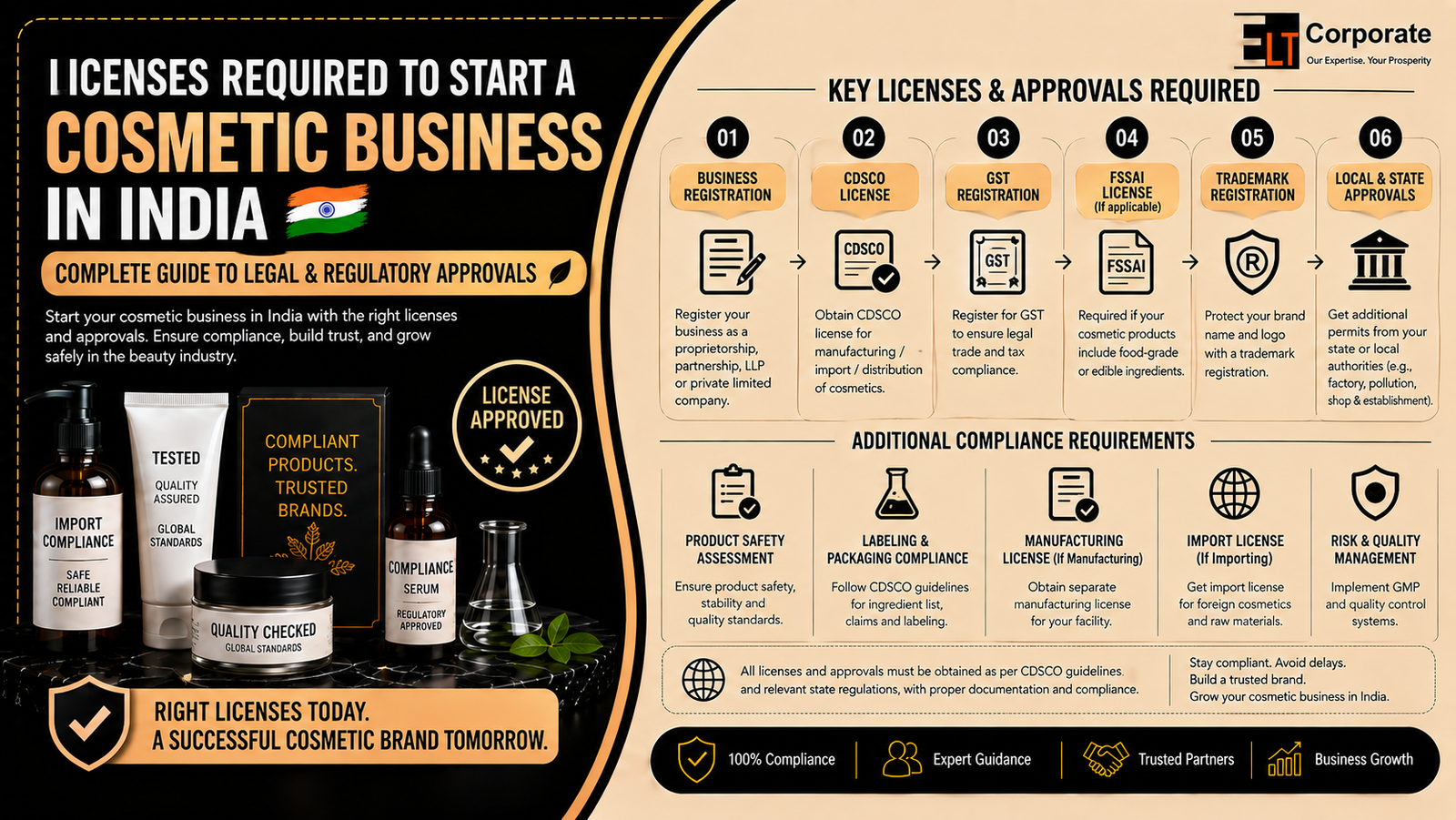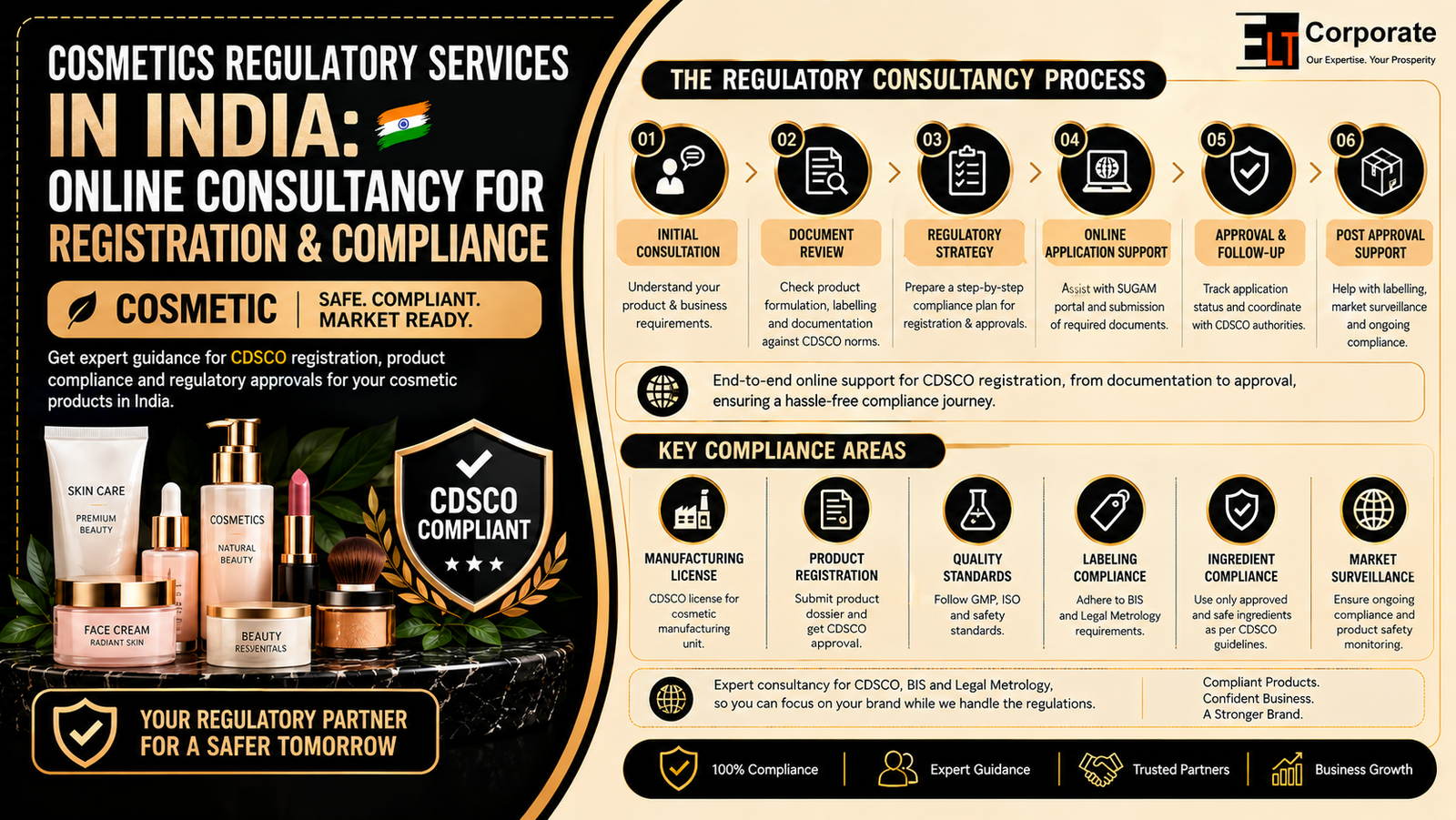
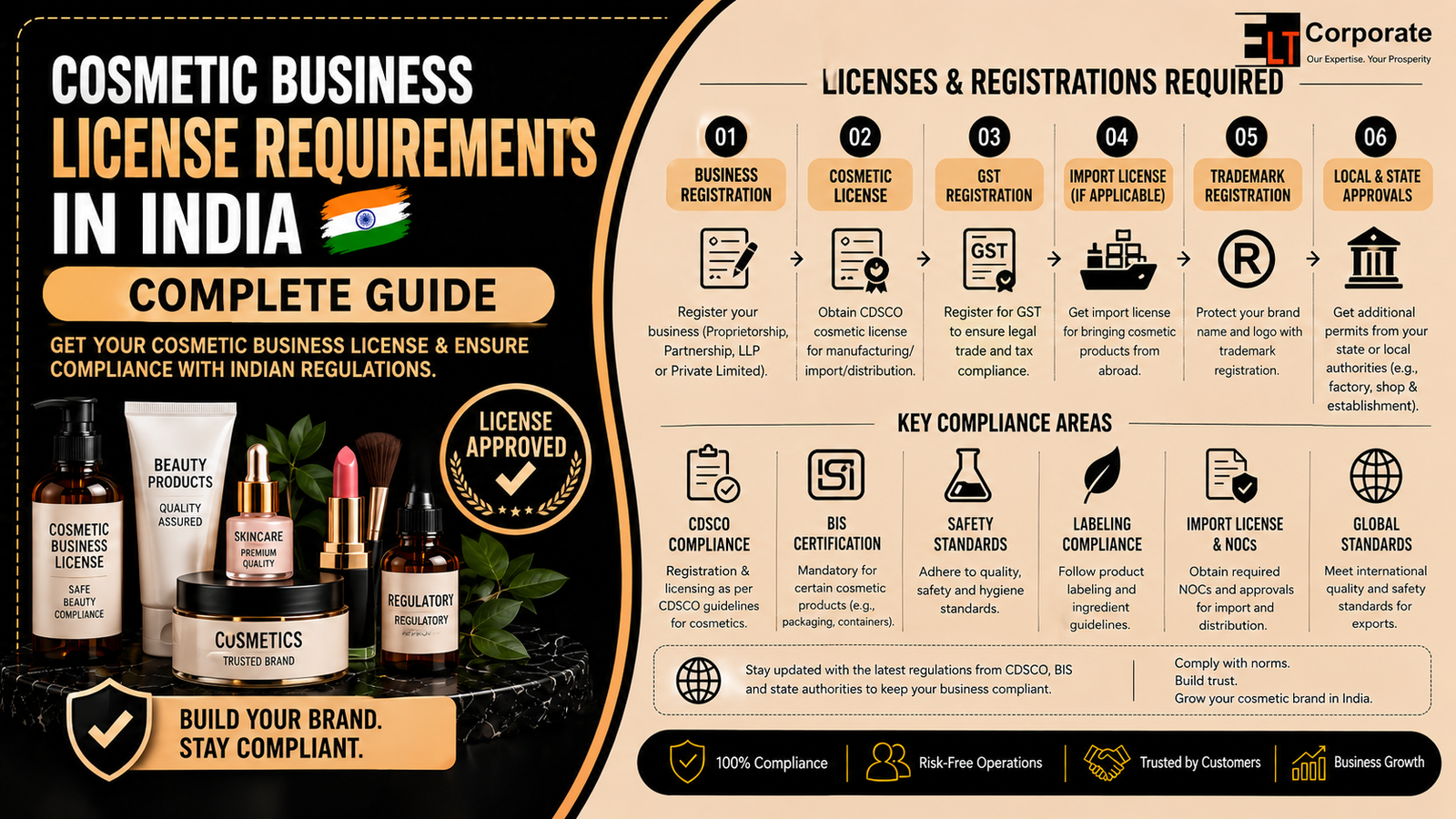

Starting a cosmetic business in India can be a profitable opportunity, but launching products legally requires more than creating a brand and selling products online. Businesses need to understand licensing, product compliance, manufacturing, import registration, labelling, testing, documentation, and claims requirements before entering the market.
The cosmetic business license requirements in India depend mainly on the type of business activity. A company manufacturing cosmetics in its own facility may follow a different regulatory route from an importer, private-label brand, or business using a third-party manufacturer.
India regulates cosmetics under the Drugs and Cosmetics Act, 1940, and the Cosmetics Rules, 2020. Domestic manufacturing is regulated through state licensing authorities, while imported cosmetics are subject to registration through the Central Licensing Authority/CDSCO.
🚀 Planning to Start a Cosmetic Business in India?
Get expert assistance with cosmetic licensing, registration, documentation, labelling and compliance before launching your product.
🎯 Get Free Expert Consultation 💬 WhatsApp an Expert 📞 Call NowWhat Are Cosmetic Business License Requirements in India?
There is no single license that applies to every cosmetic business.
The applicable approval depends on whether you plan to:
- Manufacture cosmetics in your own factory
- Manufacture products through a third-party manufacturer
- Use a loan-licence arrangement
- Import finished cosmetics
- Launch a private-label cosmetic brand
- Sell cosmetics under your own brand
- Import products from a foreign manufacturer
Therefore, identifying the correct cosmetic business license requirements in India should be the first regulatory step before investing in manufacturing, packaging, or marketing.
1. Cosmetic Manufacturing License in India
If you want to manufacture cosmetics in India for sale or distribution, you need to follow the applicable manufacturing licensing framework under the Cosmetics Rules, 2020.
The application for a manufacturing license is made to the State Licensing Authority. The rules provide the relevant application process and forms, including Form COS-5 for a manufacturing license application and Form COS-6 for a loan license application.
After the applicable requirements are fulfilled, the manufacturing license is granted in Form COS-8, while a loan license is granted in Form COS-9.
Who Needs a Manufacturing License?
A manufacturing license may be relevant if you:
- Own a cosmetic manufacturing facility
- Manufacture skincare products
- Manufacture haircare products
- Manufacture makeup products
- Manufacture personal-care cosmetics
- Manufacture products for another cosmetic brand
The manufacturing premises, equipment, technical staff, testing arrangements, and documentation must meet applicable regulatory requirements.
2. COS-8 Cosmetic Manufacturing License
COS-8 is an important approval for businesses manufacturing cosmetics for sale or distribution in India.
The applicable requirements can involve:
- Manufacturing premises
- Site and layout details
- Machinery and equipment
- Technical personnel
- Manufacturing process
- Testing arrangements
- Product information
- Raw-material information
- Quality-control documentation
- Applicable standards
The cosmetic business license requirements in India should therefore be assessed before setting up a manufacturing unit rather than after production begins.
The Cosmetics Rules also prescribe statutory fees for manufacturing licenses. The applicable fee depends on the number and categories of cosmetic items covered by the application.
For the latest fee structure, businesses should verify the applicable provisions of the Third Schedule before filing.
3. COS-9 Loan License for Cosmetic Manufacturing
Not every cosmetic brand wants to establish its own manufacturing factory.
A business may instead use another licensed manufacturer’s facilities under the applicable loan-licence framework.
This arrangement can be useful for entrepreneurs and brands that want to launch their own cosmetic products while working with an established manufacturing facility.
However, the business should verify:
- Manufacturer’s license
- Manufacturing facility
- Product category
- Manufacturing agreement
- Product formulation
- Testing requirements
- Packaging and labeling
- Claims
- Responsibilities of each party
Third-party manufacturing does not mean that compliance can simply be ignored by the brand owner.
4. Third-Party Cosmetic Manufacturing
Third-party manufacturing is one of the common business models used by new cosmetic brands in India.
Under this model, the brand owner generally works with an existing manufacturer that handles the manufacturing process.
Before signing an agreement, the brand should verify whether the manufacturer’s facility and license are appropriate for the products being manufactured.
The business should also clearly define responsibility for:
- Product formulation
- Raw materials
- Manufacturing
- Testing
- Batch documentation
- Packaging
- Labelling
- Product claims
- Regulatory records
Understanding the cosmetic business license requirements in India before selecting a third-party manufacturer can help prevent compliance problems later.
5. Cosmetic Import Registration in India
If you plan to import finished cosmetic products manufactured outside India, the regulatory route is different from domestic manufacturing.
CDSCO states that cosmetics intended for import into India must be registered under the applicable Cosmetics Rules, 2020 framework.
For import registration, an application is made in Form COS-1, and the Import Registration Certificate is issued in Form COS-2, subject to applicable requirements.
The registration process can involve the cosmetic product as well as the foreign manufacturing site.
Imported cosmetic businesses may include:
- Foreign cosmetic manufacturers
- Indian importers
- Authorized agents
- Indian subsidiaries
- International cosmetic brands
- Imported skincare brands
- Imported haircare brands
- Imported makeup brands
Therefore, importers need to understand the cosmetic business license requirements in India before arranging commercial imports.
📋 Not Sure Which Cosmetic Licence You Need?
Share your product and business details with our regulatory team and get guidance on the applicable licensing and compliance requirements.
✅ Get Free Consultation 💬 Talk to an Expert on WhatsApp6. Documents Required for Cosmetic Business
The exact documents depend on the type of business and application.
Common documents may include:
- Business details
- Applicant information
- Manufacturing-site details
- Product information
- Product formulation
- Ingredient list
- Product specifications
- Testing information
- Proposed labels
- Manufacturer authorization
- Free Sale Certificate, where applicable
- Manufacturing license or equivalent document
- Undertakings and declarations
- Power of Attorney or authorization documents
- Fee payment documents
For imported cosmetics, CDSCO provides specific checklists and guidance for documents required for registration.
Read more:
Documents Required for Cosmetic Registration in India
https://cosmeticsregulatory.com/blog/documents-required-cosmetic-registration-india/
7. Cosmetic Product Testing Requirements
Product quality and safety are important parts of cosmetic compliance.
The Cosmetics Rules require cosmetics to comply with applicable standards of quality and safety. Businesses should identify the applicable standards and testing requirements for each product before commercial launch.
Depending on the product, compliance review may involve:
- Physical parameters
- Chemical specifications
- Microbiological requirements
- Product stability
- Safety-related information
- Applicable BIS standards
- Ingredient restrictions
- Product-specific requirements
Testing requirements should be assessed according to the actual product rather than assuming that every cosmetic follows exactly the same testing process.
8. Cosmetic Labelling Requirements
Labelling is another major area that cosmetic businesses need to review before launch.
The Cosmetics Rules prescribe information that must appear on cosmetic labels, including relevant product identification, batch or lot information, expiry/use-before information where applicable, manufacturer details, and license information.
Depending on the product and packaging, additional requirements may apply under other applicable laws.
A label review should cover:
- Product name
- Brand name
- Net quantity
- Manufacturer information
- Manufacturing address
- License number
- Batch or lot number
- Use-before/expiry information where applicable
- Ingredient declaration
- Directions for use
- Warnings and precautions where applicable
- Other mandatory declarations
Before printing thousands of packages, businesses should get the final artwork reviewed.
You can also read our guide on cosmetic labeling requirements:
https://cosmeticsregulatory.com/blog/labeling-requirements-for-cosmetics/
9. Cosmetic Claims Compliance
Marketing claims can create regulatory problems if they are not properly reviewed.
Under Rule 36 of the Cosmetics Rules, 2020, a cosmetic must not claim or convey an idea that is false or misleading to the intended user.
Businesses should therefore carefully review claims such as
- Anti-aging
- Skin whitening
- Acne treatment
- Hair growth
- Hair fall reduction
- Wrinkle removal
- Permanent results
- Medical benefits
- Disease-related claims
- Therapeutic claims
Claims should be assessed according to the product, ingredients, supporting evidence, and applicable regulatory requirements.
This is an important part of the cosmetic business license requirements in India because regulatory compliance extends beyond obtaining a license and includes how the product is presented and marketed.
10. Private Label Cosmetic Business Requirements
Private-label cosmetics allow entrepreneurs to sell products under their own brand while using a third-party manufacturer.
A typical private-label process can include:
Brand Concept → Product Selection → Manufacturer → Formulation → Testing → Packaging → Labelling → Claims Review → Launch
Before launching a private-label product, the brand should determine:
- Who is manufacturing the product?
- Does the manufacturer hold the appropriate license?
- What is the product category?
- Is the formulation compliant?
- What testing is required?
- Is the packaging compliant?
- Are the marketing claims acceptable?
- Which party is responsible for each compliance activity?
The applicable cosmetic business license requirements in India depend on the actual manufacturing and business arrangement.
11. SUGAM Portal for Imported Cosmetics
Businesses importing cosmetics should also understand the CDSCO online application process.
CDSCO provides online services and guidance for cosmetic import registration. For applicable import registration applications, Form COS-1 is submitted through the prescribed online process.
Applicants should prepare their information before starting the application, including:
- Applicant details
- Manufacturer information
- Manufacturing site
- Product category
- Product variants
- Product composition
- Proposed labels
- Supporting documents
- Authorisation documents
- Applicable fee information
Read our detailed guide:
SUGAM Portal for CDSCO Cosmetic Registration
https://cosmeticsregulatory.com/blog/sugam-portal-for-cdsco-cosmetic-registration/
12. Licenses and Registrations You May Need
The exact approvals depend on your business model.
| Business Activity | Main Regulatory Route |
| Own cosmetic manufacturing | Manufacturing license framework |
| Third-party manufacturing | Applicable manufacturing/loan-licence arrangement |
| Imported cosmetics | CDSCO import registration |
| Private-label brand | Depends on manufacturing/import arrangement |
| New cosmetic | Additional requirements may apply. |
| Cosmetic packaging | Labelling and applicable packaging declarations |
| Cosmetic advertising | Claims and advertising compliance |
This is why businesses should not assume that one general business registration automatically covers all cosmetic business license requirements in India.
13. Common Mistakes Cosmetic Businesses Should Avoid
New cosmetic businesses often focus heavily on branding and marketing while leaving compliance until the final stage.
Common mistakes include:
Starting Manufacturing Before Checking Licensing
Businesses should identify the applicable manufacturing route before beginning commercial production.
Choosing a Manufacturer Without Verification
A third-party manufacturer should be checked for appropriate licensing, infrastructure, and product capability.
Printing Labels Too Early
Packaging should be reviewed before large-scale printing.
Making Aggressive Claims
Claims such as “cures,” “permanently removes,” or disease-treatment claims may create regulatory concerns depending on the product and wording.
Submitting Inconsistent Documents
Company names, addresses, product names, manufacturer details, and other information should remain consistent across the application and supporting documents.
Ignoring Imported Cosmetic Requirements
Foreign brands and Indian importers should not treat import registration as the same process as domestic manufacturing.
14. Step-by-Step Process to Start a Cosmetic Business
Here is a practical process for new entrepreneurs.
Step 1: Select Your Business Model
Decide whether you will manufacture, import, use third-party manufacturing, or launch a private-label brand.
Step 2: Identify Your Products
Prepare a list of products, categories, variants, and intended pack sizes.
Step 3: Determine the Applicable Regulatory Route
Identify whether manufacturing licensing, import registration, or another regulatory requirement applies.
Step 4: Review the Formulation
Check ingredients, product classification, applicable standards, and restrictions.
Step 5: Verify the Manufacturer
If using third-party manufacturing, verify the manufacturer’s license, facility, and product capability.
Step 6: Complete Product Testing
Identify the applicable quality and safety testing requirements.
Step 7: Review Labels
Check the final packaging artwork before printing.
Step 8: Review Claims
Review claims used on packaging, websites, marketplaces, social media, and advertisements.
Step 9: Prepare Documents
Compile all applicable business, product, manufacturer, and regulatory documents.
Step 10: Submit the Applicable Application
Complete the relevant regulatory application and submit the required documents and fees.
Step 11: Maintain Compliance
After launch, continue maintaining appropriate records and reviewing product, label, and claims compliance.
Cosmetic Business Compliance Checklist
Before launching your product, check the following:
- Business model identified
- Product category identified
- Manufacturer verified
- Applicable license/registration identified
- Formulation reviewed
- Testing requirements checked
- Product documentation prepared
- Labels reviewed
- Claims reviewed
- Manufacturer authorization prepared where applicable
- Import documents prepared where applicable
- Applicable application submitted
- Compliance records maintained
Following this checklist can help businesses organize their cosmetic business license requirements in India before entering the market.
Conclusion
Starting a cosmetic brand in India requires regulatory planning from the beginning. The applicable license or registration depends on whether you manufacture products yourself, use a third-party manufacturer, operate through a loan-licence arrangement, or import finished cosmetics.
Businesses should review licensing, formulation, testing, documentation, labelling, and claims before commercial launch. Proper planning can help reduce avoidable regulatory queries, packaging changes, and launch delays.
If you are unsure about the cosmetic business license requirements in India for your product or business model, getting an expert compliance review before launch can help you identify the applicable regulatory pathway.
✅ Ready to Launch Your Cosmetic Business?
Before manufacturing, importing or selling your cosmetic products, get your licensing, registration, documentation, labelling and claims reviewed by a regulatory expert.
🎯 Get Free Expert Consultation 💬 WhatsApp Our Regulatory Team 📞 Call Now 📩 Contact UsFree initial consultation • Cosmetic Regulatory Experts
Frequently Asked Questions
Q1. Do I need a license to start a cosmetic business in India?
It depends on the business activity. Manufacturing and importing cosmetics have specific regulatory requirements, while private-label and third-party manufacturing arrangements may follow different routes.
Q2. What is COS-8 in cosmetics?
COS-8 is the form in which a license to manufacture cosmetics for sale or distribution is granted under the applicable Cosmetics Rules framework.
Q3. What is COS-9?
COS-9 relates to a license for manufacturing cosmetics under the applicable regulatory framework.
Q4. Do imported cosmetics need registration in India?
Yes. Cosmetics imported into India are subject to the applicable CDSCO registration requirements before import.
Q5. Can I start a private-label cosmetic brand without owning a factory?
A private-label brand can work with a third-party manufacturer, but the applicable manufacturing, product, labelling, testing, and claims requirements still need to be addressed.
Q6. What documents are required for a cosmetic business?
Documents vary according to the business model. They can include manufacturer details, product information, formulations, labels, testing documents, authorizations, manufacturing documents, and other regulatory records.
✅ Ready to Start Your Cosmetic Business?
Get your cosmetic business model, licensing and compliance requirements reviewed by an expert before launch.
💬 Get Your Free Compliance Review