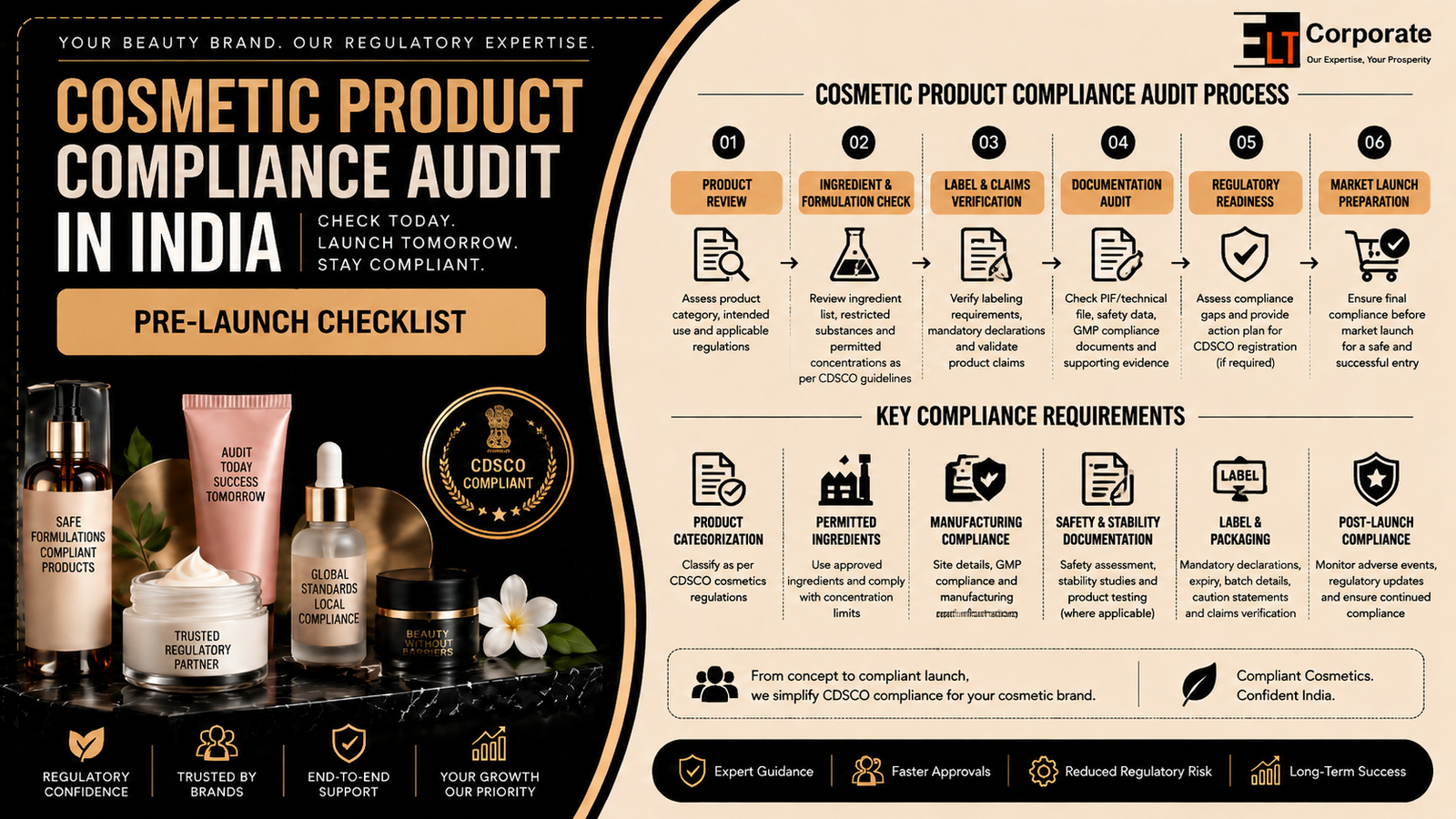

Launching a cosmetic product in India involves more than developing a formula and designing attractive packaging. Before a product is manufactured, imported, marketed, or sold, businesses should review its regulatory classification, formulation, documentation, labeling, testing, claims, and applicable registration or licensing requirements.
A cosmetic product compliance audit in India is a practical pre-launch review that helps brands identify potential regulatory gaps before they invest heavily in manufacturing, packaging, inventory, advertising, and distribution.
The regulatory framework for cosmetics in India is primarily governed by the Drugs and Cosmetics Act, 1940, and the Cosmetics Rules, 2020. CDSCO states that cosmetics imported into India must be registered under the applicable rules, while cosmetics imported or manufactured in India must comply with applicable quality and safety standards.
Whether you are a cosmetic startup, private-label brand, Indian manufacturer, importer, foreign manufacturer, skincare brand, haircare company, or makeup business, completing a regulatory review before launch can help identify issues at an earlier stage.
🚀 Need a Pre-Launch Cosmetic Compliance Audit?
Before you manufacture or import your cosmetic product, get your formula, documents, label, claims and regulatory requirements reviewed by cosmetic compliance experts.
🚀 Get Free Consultation 💬 Talk to an Expert on WhatsApp
Planning to launch a cosmetic product in India?
Get your compliance requirements reviewed before investing in production and packaging.
What Is a Cosmetic Product Compliance Audit in India?
A cosmetic product compliance audit is a structured review of a product and its regulatory documentation before commercial launch.
The purpose is to identify potential gaps relating to:
- Product classification
- Formula and ingredients
- Manufacturing or import route
- Registration or licensing
- Product documentation
- Packaging and labeling
- Testing and specifications
- Cosmetic claims
- Manufacturer information
- Importer information
- Supporting regulatory records
It is not simply a review of the product label. A proper pre-launch audit should consider the different compliance elements that work together.
For example, a brand may have a compliant-looking package but discover that its product claims require further review. Similarly, an imported cosmetic may have complete product information but still require the applicable Indian registration process before import.
Why Should You Conduct a Cosmetic Compliance Audit Before Launch?
Regulatory issues discovered after manufacturing can be expensive to correct.
A business may already have:
- Printed thousands of labels
- Purchased packaging
- Manufactured inventory
- Created e-commerce listings
- Started advertising
- Signed distributor agreements
- Planned an influencer campaign
If a compliance issue is identified at this stage, changes can affect the launch schedule and increase costs.
A pre-launch cosmetic compliance audit provides an opportunity to review the product before these expenses become difficult to reverse.
It can help businesses identify whether the proposed product, documentation, packaging, and marketing strategy are aligned with the applicable regulatory requirements.
1. Check the Regulatory Classification of Your Cosmetic Product
The first step in a compliance audit is understanding what the product is and how it is intended to be used.
Common cosmetic categories include:
- Face creams
- Moisturisers
- Serums
- Cleansers
- Sunscreens
- Shampoos
- Conditioners
- Hair masks
- Body lotions
- Lip-care products
- Makeup
- Bath products
- Personal-care products
However, the product name alone should not be used to determine its regulatory position.
The audit should consider:
- Intended use
- Product presentation
- Formulation
- Directions for use
- Consumer-facing claims
- Packaging
- Marketing language
This is particularly important when a product is marketed with claims that may go beyond ordinary cosmetic purposes.
2. Review the Product Formula and Ingredients
The next step is to review the formulation.
Under the Cosmetics Rules, 2020, cosmetics imported or manufactured in India must comply with applicable specifications and quality and safety standards. Rule 39 also refers to the Ninth Schedule and other applicable standards.
A formula review may consider:
- Full ingredient list
- Ingredient names
- Ingredient concentrations
- Restricted ingredients
- Prohibited ingredients
- Colorants
- Product category
- Intended use
- Applicable standards
- Product specifications
This step is particularly useful for private-label and imported cosmetic brands.
A formulation developed for the US, European, Korean, Japanese, or another market should not automatically be assumed to satisfy every Indian requirement.
The formula should be reviewed against the applicable Indian regulatory framework before commercial launch.
3. Review the Manufacturing or Import Route
The compliance requirements can differ depending on how the product will enter the Indian market.
If You Manufacture Cosmetics in India
Businesses manufacturing cosmetics in India should evaluate the applicable manufacturing license requirements, premises, technical personnel, equipment, testing arrangements, documentation, and other applicable requirements.
If your business is planning its own manufacturing facility, the applicable requirements under the Cosmetics Rules, 2020, should be assessed before production begins.
If You Import Cosmetics into India
Imported cosmetics follow a separate regulatory pathway.
CDSCO states that a cosmetic falling within the applicable definition must be registered along with its pack size, variants, and manufacturing premises before import into India.
Therefore, an importer should review:
- Foreign manufacturer details
- Product details
- Manufacturing premises
- Product variants
- Pack sizes
- Registration requirements
- Supporting documents
- Indian labeling requirements
A compliance audit can help identify these requirements before the product is shipped to India.
4. Audit Your Cosmetic Registration and Licensing Requirements
One of the most important parts of a pre-launch review is identifying the applicable regulatory route.
Depending on the business model, the audit may need to establish whether the product involves:
- Cosmetic manufacturing requirements
- Import registration requirements
- Product registration
- Manufacturing premises requirements
- Applicable permissions for new cosmetics
- Other regulatory documentation
For imported cosmetics, CDSCO provides guidance, application checklists, and SUGAM-related resources through its Cosmetics Division.
The application information should be consistent with the underlying product and manufacturer documentation.
Don’t Wait Until Shipment to Check Registration
For imported products, regulatory planning should ideally happen before commercial shipment.
A brand should know the applicable registration route and documentation requirements before committing to large inventory quantities.
5. Check Documents Before Application Submission
Documentation is another major part of a cosmetic compliance audit in India.
Depending on the regulatory route, documents may include:
- Product information
- Manufacturer details
- Manufacturing-site information
- Product formula
- Product specifications
- Label artwork
- Testing information
- Free Sale Certificate, where applicable
- Manufacturing license or equivalent documentation, where applicable
- Authorisation documents
- Claims information
- Product lists
- Government fee/payment records
- Other applicable supporting documents
For imported cosmetics, CDSCO guidance includes requirements relating to product information, specifications/testing, manufacturing licenses, and free sale certificates, subject to the applicable circumstances.
Document Consistency Check
The information should be cross-checked across:
- Registration application
- Product documents
- Manufacturer documents
- Free Sale Certificate
- Product label
- Product specifications
- Authorisation documents
Small inconsistencies in product names, manufacturer details, addresses, pack sizes, or variants can create unnecessary clarification work.
6. Conduct a Cosmetic Label Compliance Audit
Your packaging should be reviewed before it goes to mass printing.
The Cosmetics Rules contain requirements concerning information such as batch details, manufacturing license information, net contents, warnings where applicable, ingredients, and registration information for imported cosmetics.
A label audit may review:
- Product name
- Net quantity
- Manufacturer information
- Importer information
- Batch/lot information
- Manufacturing information
- Expiry/use-before information, where applicable
- Ingredient declaration
- Directions for use
- Warnings
- Precautions
- Registration information for applicable imported cosmetics
- Other mandatory declarations
For imported cosmetics, CDSCO guidance also states that India-specific labeling may be stickered on the unit pack at bonded warehouses in applicable cases.
Why Audit the Label Before Printing?
Imagine printing 10,000 boxes and then discovering that the artwork needs modification.
A pre-launch label audit can help reduce the risk of:
- Reprinting
- Packaging wastage
- Delayed launch
- Incorrect e-commerce information
- Product relabeling
For this reason, label compliance should be reviewed before final packaging approval.
7. Review Cosmetic Product Claims
Claims are one of the most important areas of a cosmetic compliance audit.
Claims can appear on:
- Product packaging
- Websites
- Amazon
- Flipkart
- Other e-commerce platforms
- Advertisements
- Influencer campaigns
- Brochures
- Product catalogs
CDSCO states under Rule 36 that a cosmetic must not purport or claim to convey an idea that is false or misleading to the intended user.
Therefore, claims should be reviewed before publication.
Examples that may require careful regulatory assessment include claims relating to:
- Acne treatment
- Hair growth
- Scar removal
- Disease treatment
- Pigmentation treatment
- Wrinkle removal
- Medical or therapeutic outcomes
The audit should consider not only the words on the product package but also the overall marketing message.
A product may have an acceptable formulation but create compliance concerns if its advertising presents it as treating or curing a condition.
🔍 Not Sure Whether Your Cosmetic Claims Are Compliant?
Get your product claims, packaging language and marketing content reviewed by cosmetic regulatory experts before launch.
🔍 Get Free Claims Review 💬 WhatsApp Regulatory Expert
Planning to launch soon?
Review your claims before printing packaging or starting marketing campaigns.
8. Review Product Testing and Specifications
Testing and technical documentation should also be considered during the audit.
Depending on the product, the review may include:
- Product specifications
- Applicable testing methods
- Microbiological requirements
- Safety information
- Stability information
- Quality standards
- Ingredient-related documentation
- Testing reports
The Cosmetics Rules require applicable cosmetics to comply with relevant quality and safety specifications and standards.
The exact testing requirements should therefore be determined based on the product rather than applying one generic testing checklist to every cosmetic.
9. Audit Your E-Commerce and Marketing Content
Modern cosmetic brands often sell through multiple channels. Your compliance audit should therefore extend beyond the physical product.
Review:
Website
Check:
- Product description
- Benefits
- Claims
- Ingredients
- Directions
- Warnings
- Product images
- Regulatory statements where applicable
E-Commerce Listings
Review:
- Product title
- Bullet points
- Product description
- Images
- Claims
- Search-friendly marketing language
Social Media
Check:
- Instagram captions
- Reels
- Influencer scripts
- Promotional banners
- Before/after claims
- Testimonials
The objective is to ensure that marketing content does not create claims that are inconsistent with the product’s intended cosmetic positioning.
10. Review Your Product Packaging and Digital Information Together
One common mistake is reviewing the physical label separately from the online listing.
Instead, compare the information across:
| Area | What to Check |
| Product Label | Product name, ingredients, declarations, and warnings |
| Website | Product description and claims |
| E-commerce | Product title, benefits, and descriptions |
| Social Media | Promotional claims and messaging |
| Product Documents | Formula, specifications, and manufacturer information |
| Registration Documents | Product, manufacturer, and pack-size information |
The product information should remain consistent wherever possible.
11. Conduct a Pre-Launch Compliance Gap Analysis
After reviewing the product, documents, packaging, and claims, prepare a gap list.
For example:
| Compliance Area | Status | Action |
| Product Classification | Review Required | Confirm regulatory position. |
| Formula | Review Required | Check applicable ingredients/standards. |
| Documents | Incomplete | Obtain missing documents. |
| Label | Changes Required | Update artwork |
| Claims | Review Required | Modify unsupported claims. |
| Testing | Pending | Confirm applicable testing. |
| Registration | Pending | Determine the applicable route. |
| Website | Review Required | Check marketing claims. |
| E-commerce | Review Required | Align product information. |
This approach gives the brand a practical pre-launch compliance roadmap instead of discovering issues after manufacturing or import.
Cosmetic Product Compliance Audit Checklist
Before launching a cosmetic product in India, review these key areas:
- Product classification reviewed
- Intended use confirmed
- Formula reviewed
- Ingredients checked
- Applicable standards identified
- Manufacturing/import route confirmed
- Registration or licensing requirements identified
- Manufacturer documents collected
- Product documents reviewed
- Testing requirements identified
- Product specifications reviewed
- Label artwork reviewed
- Ingredient declaration checked
- Warnings and directions checked
- Imported-product information checked where applicable
- Cosmetic claims reviewed
- Website claims reviewed
- E-commerce listing reviewed
- Social media claims reviewed
- Final compliance gaps addressed
Common Cosmetic Compliance Mistakes to Avoid
1. Finalizing Packaging Before Regulatory Review
Packaging should ideally be reviewed before large-scale printing.
2. Assuming an Overseas Formula Is Automatically Compliant
Products developed for another market should still be evaluated against the applicable Indian requirements.
3. Checking Only the Product Label
Online listings, advertisements, and social media can also contain product claims.
4. Submitting Inconsistent Documents
Product and manufacturer information should be cross-checked before submission.
5. Treating Compliance as a Post-Launch Activity
Compliance planning is more effective when started during product development.
6. Using Aggressive Marketing Claims
Claims should be reviewed before publication and should not be false or misleading.
How a Cosmetic Regulatory Consultant Can Help With a Compliance Audit
A cosmetic regulatory consultant can help businesses review their product before commercial launch.
Depending on the project, support may include:
- Product regulatory assessment
- Cosmetic classification review
- Formula and ingredient review
- Registration guidance
- Manufacturing license guidance
- Import registration support
- Documentation review
- Label compliance review
- Claims review
- Testing coordination
- SUGAM application support
- Pre-launch compliance checklist
- Regulatory gap analysis
This can be particularly useful for:
- Cosmetic startups
- Private-label brands
- Skincare companies
- Haircare brands
- Makeup brands
- Cosmetic importers
- Foreign manufacturers
- Indian manufacturers
- E-commerce cosmetic businesses
- International cosmetic brands
Who Should Get a Cosmetic Product Compliance Audit?
A pre-launch audit can be useful if you are:
Launching a new cosmetic product
If you are developing your first product, an audit can help you understand the applicable regulatory requirements before production.
Starting a private-label cosmetic brand
Private-label businesses should review the manufacturer’s documents, product formula, packaging, and claims before approving production.
Importing cosmetics into India
Imported cosmetics require attention to the applicable registration and import requirements before commercial import.
Launching multiple products
A product-by-product compliance review can help identify differences in formulas, claims, packaging, and regulatory documentation.
Rebranding an existing cosmetic
Changing the product name, packaging, claims, or other information can require a fresh compliance review.
When Should You Conduct the Compliance Audit?
The ideal time is before mass production, bulk packaging, import shipment, or major marketing activity.
A practical sequence is
Product Concept → Formula → Classification → Documents → Testing → Label Review → Claims Review → Registration/Licensing → Final Compliance Audit → Manufacturing/Import → Marketing → Launch
Starting the review early gives businesses more opportunity to make changes before costs increase.
Why Pre-Launch Compliance Can Save Time and Cost
A regulatory problem discovered before production can usually be addressed more easily than one discovered after thousands of units have been manufactured.
For example, early review may identify:
- A label declaration that needs correction
- A missing document
- A product claim that needs modification
- An ingredient requiring further assessment
- A registration requirement that needs to be completed
- An inconsistency between manufacturer documents and product information
The objective is not simply to complete paperwork. It is to make the product launch process more organized and reduce avoidable compliance gaps.
Final Pre-Launch Recommendation
Before commercially launching a cosmetic product in India, businesses should review the product, formula, ingredients, manufacturing/import route, documents, testing, packaging, claims, and marketing content together.
A cosmetic product compliance audit in India provides a structured way to identify potential gaps before they become expensive post-production or post-launch problems.
The exact regulatory requirements depend on the product and business model, so brands should assess their individual circumstances rather than relying on a generic checklist.
🚀 Need a Pre-Launch Cosmetic Compliance Audit?
Before you manufacture or import your cosmetic product, get your formula, documents, label, claims and regulatory requirements reviewed by cosmetic compliance experts.
🚀 Get Free Consultation 💬 Talk to an Expert on WhatsApp
Planning to launch a cosmetic product in India?
Get your compliance requirements reviewed before investing in production and packaging.
Conclusion
Launching a cosmetic product successfully requires regulatory planning alongside product development and marketing. From formula and ingredients to documentation, labelling, testing, registration, claims, and digital marketing, each area should be reviewed before commercial launch.
If you are preparing to launch a cosmetic product in India, a structured cosmetic product compliance audit can help you identify potential gaps early and prepare the product for the applicable regulatory process. Get your cosmetic product reviewed before production, import, or launch.
Frequently Asked Questions
Q1. Is a cosmetic compliance audit mandatory in India?
A “cosmetic compliance audit” is a practical pre-launch review rather than a separate regulatory approval category. However, businesses must comply with the applicable requirements under the Cosmetics Rules, 2020, and other applicable laws before manufacturing, importing, or marketing their products.
Q2. What does a cosmetic compliance audit cover?
It can cover product classification, formulation, ingredients, registration or licensing, documents, testing, specifications, packaging, labelling, claims, and marketing content.
Q3. When should I conduct a cosmetic compliance audit?
Ideally, conduct the review before final packaging, mass manufacturing, bulk import, or major advertising activity. Early review gives the business more opportunity to correct potential gaps.
Q4. Does an imported cosmetic need registration in India?
CDSCO states that cosmetics imported into India are subject to registration requirements under the applicable Cosmetics Rules, 2020. The specific requirements depend on the product and import circumstances.
Q4. Should cosmetic claims be included in the compliance audit?
Yes. Claims on packaging, websites, e-commerce listings, and advertisements should be reviewed. Rule 36 states that a cosmetic must not make a false or misleading claim to the intended user.
Q5. Can a regulatory consultant conduct a cosmetic compliance review?
A regulatory consultant can assist with product assessment, documentation, label review, claims review, registration or licensing guidance, and other pre-launch compliance activities, depending on the scope of the engagement.