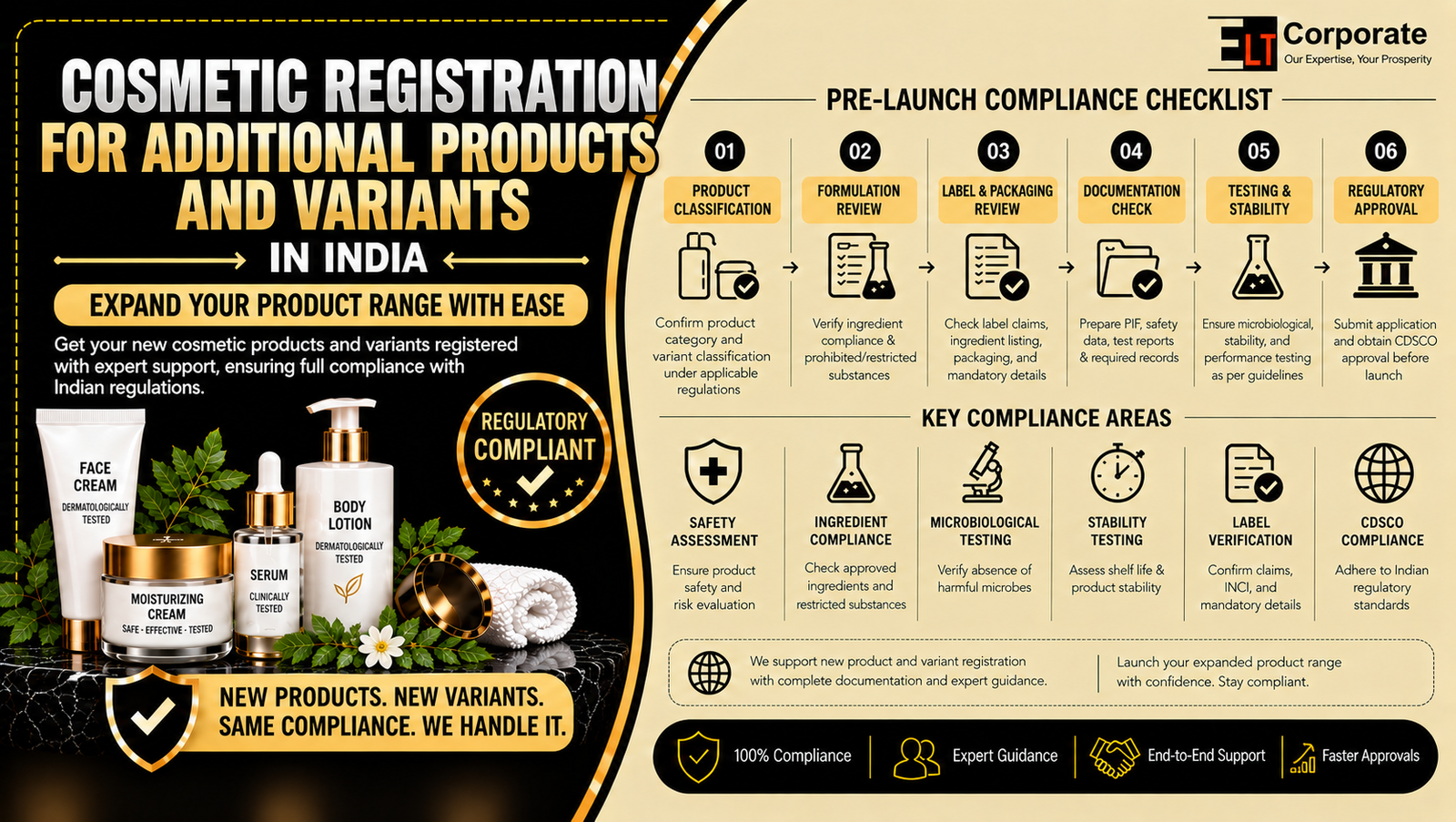

Businesses importing cosmetics into India may expand their product range by introducing new shades, fragrances, pack sizes, or additional products. However, businesses must check whether their existing registration covers the proposed products before importing them.
Cosmetic Registration for Additional Products and Variants in India is an important consideration for cosmetic brands, importers, and foreign manufacturers planning to expand their Indian market presence. Cosmetics Regulatory helps businesses understand applicable registration requirements, product documentation, and regulatory compliance considerations.
Adding New Cosmetic Products or Variants?
Get expert guidance on product details, pack sizes, supporting documents and applicable CDSCO registration requirements before expanding your cosmetic range.
Get Free Expert Consultation → WhatsApp an ExpertWhat Is Cosmetic Registration for Additional Products and Variants in India?
Under the Cosmetics Rules, 2020, cosmetics intended for import into India must meet applicable registration requirements. Product details, manufacturing premises, variants, and pack sizes must be addressed in the registration process.
Cosmetic Registration for Additional Products and Variants in India involves determining whether a proposed product is already covered by an existing registration or requires an additional regulatory application.
For example, a brand importing a registered lipstick range may plan to introduce another shade. Alternatively, the company may want to add a new face serum to its portfolio. These situations require different assessments.
According to the official CDSCO Cosmetics FAQ, different colors, shades, and flavors may be considered variants. Different pack sizes are not treated as variants and must be mentioned separately. Cosmetics Regulatory recommends checking the existing certificate and applicable product details before planning an import.
When Do You Need to Add Products or Variants?
Businesses should review their registration whenever they plan to expand their imported cosmetic range.
1. Introducing New Shades or Colors
Makeup brands frequently introduce new lipstick shades, foundations, concealers, and eye makeup colors. These may qualify as variants, depending on the product and applicable regulatory requirements.
Cosmetic Registration for Additional Products and Variants in India should be assessed against the product information recorded in the existing registration certificate.
2. Adding New Fragrances
Perfumes, body care products, and other cosmetics may be available in multiple fragrances. Applicants should verify whether the proposed fragrance is covered by the registered product details.
3. Introducing Different Pack Sizes
A product available in 50 ml packaging may later be offered in 100 ml packaging. Since pack size is recorded separately from variants, importers should confirm the applicable registration requirements before importing the new pack size.
4. Expanding into New Product Categories
A company selling face creams may decide to introduce an eye cream, shampoo, or body lotion. A product from a different category should not automatically be assumed to fall under the existing registration.
Cosmetics Regulatory advises businesses to review the product category, formulation, manufacturer, and existing registration details before expanding their product portfolio.
COSMETIC REGULATORY SUPPORT
Expanding Your Cosmetic Product Range in India?
Planning to introduce new shades, fragrances, pack sizes or additional products? Get expert guidance on registration requirements and supporting documentation for your cosmetic business.
Get Free Expert Consultation → WhatsApp Our Regulatory Team Contact UsCosmetics Regulatory — Regulatory guidance for cosmetic businesses in India.
How to Apply for Additional Cosmetic Products
The correct procedure depends on whether the product is already registered, whether it qualifies as a variant, and whether the proposed product is a new cosmetic.
Step 1: Review the Existing Registration Certificate
Check the current Form COS-2 Import Registration Certificate and its associated product details. Verify the product name, brand, category, pack size, variant, and manufacturing premises.
Step 2: Identify the Required Regulatory Route
Determine whether the proposed product is covered by the existing certificate, requires an additional product application, or needs a different approval route.
For a genuinely new cosmetic requiring prior permission, the applicable process under the Cosmetics Rules must be considered separately.
Step 3: Prepare Supporting Documents
Depending on the case, supporting records may include:
- Product and brand details.
- Manufacturer authorization.
- Product specifications and ingredient information.
- Proposed product labels.
- Relevant manufacturing-site details.
- Applicable declarations and certificates.
The exact requirements depend on the application type and the current CDSCO checklist.
Step 4: Submit Through the Appropriate Process
Applicants should use the official CDSCO SUGAM Portal and follow the applicable application or endorsement instructions. Verify the correct form, checklist, supporting documents, and fees before submission.
Cosmetic Registration for Additional Products and Variants in India should always be planned around the applicable regulatory route rather than an assumed one-size-fits-all process.
Common Mistakes to Avoid
Businesses can experience delays when product information is incomplete or inconsistent.
- Assuming every new shade is automatically covered.
- Treating different pack sizes as variants.
- Using inconsistent product names across documents.
- Overlooking manufacturer or manufacturing-site differences.
- Uploading incomplete supporting records.
- Importing a product before confirming the applicable registration requirements.
Cosmetics Regulatory encourages businesses to verify product details before shipment to help avoid preventable documentation issues.
Why Professional Regulatory Assistance Matters
Expanding a cosmetic range can involve multiple products, manufacturers, variants, and packaging formats. A structured document review can help businesses identify gaps before submitting an application.
Cosmetic Registration for Additional Products and Variants in India requires attention to product classification, existing registration details, and the applicable CDSCO procedure.
Cosmetics Regulatory can assist businesses in understanding documentation requirements, reviewing product information, and identifying the next steps for registration-related compliance.
Whether you are adding a new shade, changing pack sizes, or introducing another product, Cosmetics Regulatory can help you assess the applicable requirements before proceeding.
COSMETIC REGULATORY SUPPORT
Expanding Your Cosmetic Product Range in India?
Planning to introduce new shades, fragrances, pack sizes or additional products? Get expert guidance on registration requirements and supporting documentation for your cosmetic business.
Get Free Expert Consultation → WhatsApp Our Regulatory Team Contact UsCosmetics Regulatory — Regulatory guidance for cosmetic businesses in India.
Frequently Asked Questions
Q1. Are new cosmetic shades considered variants?
Different colors or shades may qualify as variants under the CDSCO guidance. Applicants should verify the relevant product details and registration requirements.
Q2. Are different pack sizes considered variants?
No. The CDSCO FAQ clarifies that different pack sizes are not considered variants and must be addressed separately in the registration details.
Q3. Can I import an additional product under an existing certificate?
It depends on the product, its category, and the existing certificate. Confirm the applicable requirements before importing.
Q4. Is a new cosmetic subject to a separate approval process?
A product qualifying as a new cosmetic may require prior permission under the applicable rules. The regulatory route should be checked before filing.
Q5. Can a consultant help with additional product registration?
Yes. A regulatory consultant can help review product details, organize supporting documents, and identify the applicable application process. Approval cannot be guaranteed.