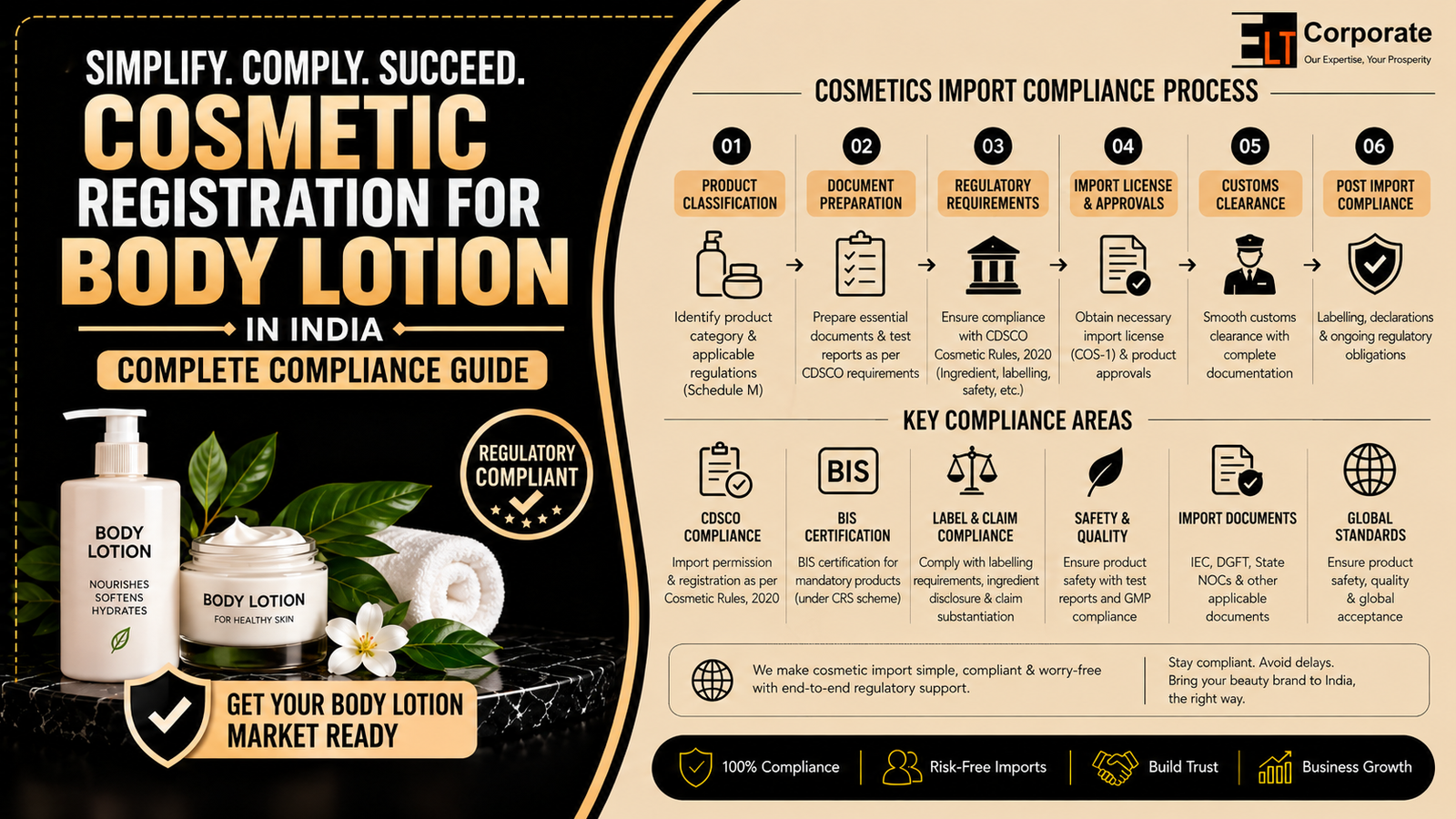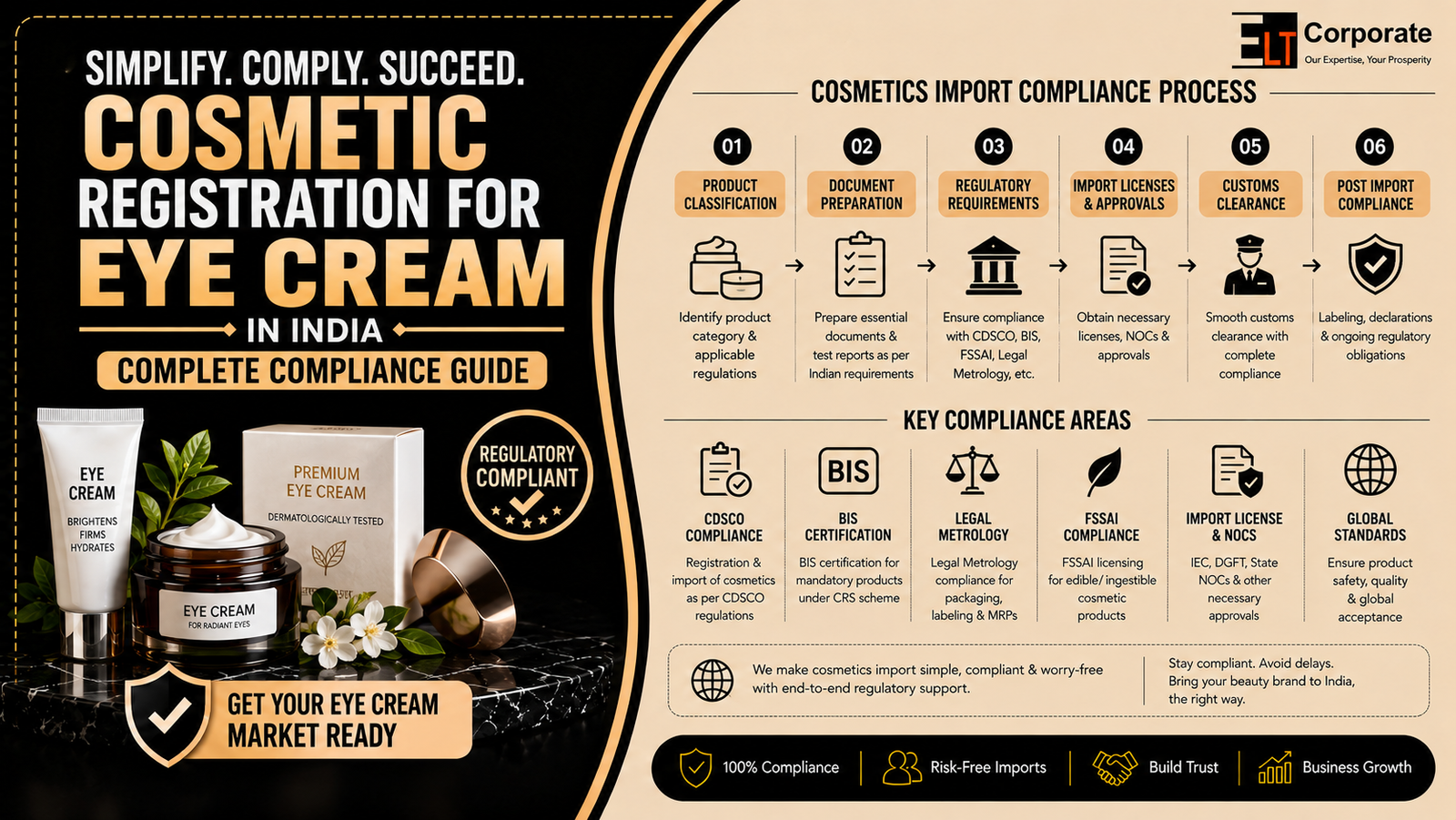


India’s luxury beauty market is experiencing a remarkable transformation. Affluent consumers across Mumbai, Delhi, Bengaluru, Hyderabad, and beyond are increasingly seeking premium international cosmetic brands — French haute couture skincare, Swiss anti-ageing serums, Japanese beauty rituals, South Korean innovation, and Italian luxury fragrances. The appetite for authentic, high-end imported cosmetics has never been stronger.
But importing luxury cosmetics into India — whether you are an authorised brand distributor, a luxury retail chain, a high-end multi-brand beauty platform, or an entrepreneur building a premium beauty import business — demands strict regulatory compliance. Every luxury cosmetic product, regardless of its global prestige or international regulatory standing, must obtain CDSCO approval before it can be legally imported and sold in India.
This guide provides a complete, authoritative walkthrough of the CDSCO approval process for luxury cosmetic imports — tailored specifically for businesses operating in the premium and luxury beauty segment.
Why CDSCO Approval is Mandatory for Luxury Cosmetic Imports
Many luxury cosmetic importers incorrectly assume that the prestige of a brand, its international regulatory approvals (CE, FDA, ISO certifications), or its widespread global availability exempts it from Indian regulatory requirements. This assumption is legally incorrect and commercially dangerous.
Under the Drugs and Cosmetics Act, 1940 and the Cosmetics Rules, 2020, importing cosmetics into India without a valid licence from CDSCO is a criminal offence — irrespective of:
- The brand’s global reputation or prestige
- Whether the product is freely sold in Europe, the USA, Japan, or South Korea
- The quantity being imported (even a single commercial unit)
- The channel of sale — retail store, luxury boutique, e-commerce platform, or direct-to-consumer
- Whether the importer holds other business registrations (GST, FSSAI, IEC, etc.)
Consequences of importing luxury cosmetics without CDSCO approval include:
- Seizure and destruction of imported inventory at the port of entry or in the market
- Criminal prosecution under the Drugs and Cosmetics Act, 1940 — imprisonment up to 3 years and/or fine
- Cancellation of Import Export Code (IEC) and other business registrations
- Marketplace delisting (Amazon, Nykaa, Myntra require CDSCO licence numbers for listed cosmetics)
- Irreversible reputational damage with luxury brand principals who may revoke distribution rights
The Regulatory Framework — Key Laws Governing Luxury Cosmetic Imports
Drugs and Cosmetics Act, 1940
The primary legislation governing cosmetics in India. Defines what constitutes a cosmetic, establishes the licensing requirement for import, and prescribes penalties for non-compliance.
Cosmetics Rules, 2020
The detailed operational rules under the Act — prescribing application forms, documentation requirements, labelling standards, prohibited ingredients, quality standards, and fee structures for cosmetic import licences. The Cosmetics Rules, 2020 replaced the older Drugs and Cosmetics Rules framework for cosmetics with a modernised, dedicated ruleset.
CDSCO — Central Drugs Standard Control Organisation
The national regulatory authority for medical devices and cosmetics in India, functioning under the Ministry of Health and Family Welfare. CDSCO administers the cosmetic import licence process centrally through the SUGAM online portal (sugam.gov.in).
Schedule S — Prohibited and Restricted Substances
A critical schedule under the Drugs and Cosmetics Act listing substances that are prohibited in cosmetics in India and substances that are restricted to specific concentrations or applications. For luxury cosmetic importers, ingredient compliance against Schedule S is a non-negotiable pre-import check.
What Qualifies as a “Luxury Cosmetic” Under Indian Regulatory Law?
Indian cosmetic regulations do not create a separate legal category for “luxury” cosmetics. All cosmetics — mass market or luxury — are regulated under the same Cosmetics Rules, 2020 framework. However, for the purpose of this guide, luxury cosmetics typically include:
Prestige Skincare High-end face creams, serums, essences, eye creams, and treatment products from brands such as La Mer, SK-II, Sisley Paris, Augustinus Bader, La Prairie, Valmont, Tatcha, and Sunday Riley
Luxury Fragrances Eau de parfum, parfum, and cologne from houses such as Chanel, Dior, Guerlain, Hermès, Tom Ford, Creed, Maison Margiela, and niche perfumers
Premium Colour Cosmetics Makeup products from brands such as Charlotte Tilbury, NARS, Hourglass, Armani Beauty, YSL Beauté, and Pat McGrath Labs
High-End Hair Care Professional and prestige hair care from brands such as Kérastase, Sisley Hair Rituel, Oribe, and Davines
Luxury Body Care Premium body creams, oils, and bath products from brands such as Diptyque, L’Occitane en Provence, Byredo, and Aesop
Advanced Anti-Ageing and Cosmeceutical Products High-concentration active ingredient products (retinol, peptides, growth factors, hyaluronic acid, vitamin C) from prestige brands — noting that products crossing into drug territory (therapeutic claims, prescription-strength actives) may require drug rather than cosmetic licensing
Niche and Artisanal International Beauty Independent international beauty brands with high price points and specialised formulations — K-beauty premium lines, J-beauty artisanal brands, and European natural luxury brands
The CDSCO Approval Process — Step by Step for Luxury Cosmetic Imports
Step 1 — Product Regulatory Classification
Before beginning any application, every product in your planned import portfolio must be correctly classified under Indian law.
Key classification questions:
- Is the product a cosmetic or a drug? Products making therapeutic claims (treating skin conditions, curing hair loss, addressing hormonal acne) may be classified as drugs and require a drug import licence — a fundamentally different and more stringent process
- Does the product fall under any restricted category (e.g., certain hair dyes, preservatives above permitted concentrations, sunscreens with drug-level SPF claims)?
- Are there any ingredients in the product that appear on Schedule S (India’s prohibited substances list)?
Practical advice for luxury importers: Many luxury cosmeceutical products — particularly high-concentration vitamin C serums, retinol formulations, AHA/BHA peels, and certain peptide treatments — occupy a borderline space between cosmetics and drugs under Indian law. Correct classification must be determined before applying for any licence. Misclassification — importing a drug-classified product under a cosmetic import licence — is a serious regulatory violation.
Step 2 — Obtain Import Export Code (IEC)
The Import Export Code (IEC) is a 10-digit code issued by the Directorate General of Foreign Trade (DGFT) that is mandatory for any business importing goods into India.
How to obtain:
- Apply online through the DGFT portal (dgft.gov.in)
- Submit PAN, business registration documents, bank account details, and digital signature
- IEC is typically issued within 2 to 5 working days
- Government fee: ₹500
Important: The IEC must be obtained before applying for the CDSCO Cosmetic Import Licence. It is a mandatory prerequisite document in the COS-1 application.
Step 3 — GST Registration
All luxury cosmetic importers must hold a valid GST registration (GSTIN). Under the GST Act, businesses engaged in imports are mandatorily required to register for GST, regardless of annual turnover threshold.
GST applies to imported luxury cosmetics at the time of customs clearance. The applicable GST rates on cosmetics in India are:
- Most cosmetics: 18% GST
- Certain specific items (some hair care, oral care): 12% GST
- Luxury/prestige cosmetics and fragrances above certain price points may attract additional cess
Step 4 — Gather Documentation from the Overseas Luxury Brand / Manufacturer
This is the most time-consuming step in the entire CDSCO approval process for luxury cosmetic imports — and the step most likely to cause delays if not managed proactively.
Luxury brand principals and their manufacturing facilities are often located in France, Italy, South Korea, Japan, the USA, or the UK. Obtaining regulatory documents from these entities requires:
- Clear communication of India’s specific documentation requirements
- Understanding that some documents (particularly the Certificate of Free Sale) require action by government authorities in the manufacturer’s country
- Apostille or legalisation of foreign official documents for use in India
- Translation of any foreign-language documents
Documents required from the overseas brand / manufacturer:
a) Certificate of Free Sale (CFS)
The most critical foreign document. The CFS is issued by the competent government authority in the manufacturer’s country confirming that:
- The cosmetic product is freely manufactured and sold in that country
- It is not subject to any ban, restriction, or recall
- The manufacturer is in good regulatory standing
How it is obtained and authenticated:
- France/EU: Issued by the relevant national authority (e.g., ANSM in France, BfArM in Germany) or a designated chamber of commerce with government authorisation
- South Korea: Issued by the Ministry of Food and Drug Safety (MFDS) or Korea Cosmetics Association
- Japan: Issued by the relevant prefectural authority or the Japan Cosmetic Industry Association
- USA: Issued by the FDA or by state-level authorities; can also be issued by the American Chamber of Commerce in some cases
- UK: Issued by relevant UK authorities post-Brexit
Authentication for India: The CFS must be apostilled (for countries that are signatories to the Hague Apostille Convention) or legalised (for countries that are not) by the Indian Embassy or High Commission in the manufacturer’s country before it can be accepted by CDSCO.
This apostille/legalisation process typically takes 2 to 6 weeks and is a significant lead-time item. For luxury brands from multiple countries, this must be initiated very early in the process.
b) Certificate of Analysis (CoA)
A laboratory test report for each product confirming its physicochemical properties, microbiological safety, and conformity with the manufacturer’s own specifications. Must be issued by the manufacturer’s quality control laboratory or an accredited third-party laboratory.
c) Complete INCI Ingredient List
A full list of all ingredients in the product, declared in INCI (International Nomenclature of Cosmetic Ingredients) format, in descending order of concentration. For luxury formulations with complex, multi-active ingredient profiles, this list must be complete — no ingredient may be omitted even if it constitutes a proprietary trade secret claim.
Luxury brand sensitivity: Many prestige brands are reluctant to share full formulation details due to IP concerns. However, INCI ingredient disclosure is a non-negotiable regulatory requirement in India. Brands that refuse to provide INCI lists cannot be legally imported.
d) GMP Certificate / ISO 22716 Certificate
Documentary proof that the manufacturing facility operates under Good Manufacturing Practices (GMP) for cosmetics. The internationally recognised GMP standard for cosmetics is ISO 22716 (Cosmetics GMP). An ISO 22716 certificate from an accredited certification body, or a GMP certificate issued by the national regulatory authority, is required.
e) Site Master File (SMF)
A comprehensive document describing the manufacturing facility — its location, infrastructure, organisational structure, manufacturing processes, quality management system, and regulatory compliance history. The SMF provides CDSCO with assurance about the manufacturing facility’s standards without requiring a physical inspection of the foreign site.
f) Manufacturer’s Authorisation Letter / Appointment of Indian Importer
A formal letter from the foreign brand / manufacturer:
- Explicitly authorising the Indian applicant to import and market their cosmetic products in India
- Listing all products (by name and product code) covered by the authorisation
- Confirming the territory of appointment (India)
- Signed by a duly authorised representative of the foreign entity
For luxury brands with exclusive distribution agreements, this letter also serves as proof of the authorised distributor relationship.
g) Product Safety Data / Safety Assessment Report
For luxury cosmetics making specific performance or safety claims, a product safety assessment prepared by a qualified cosmetic safety assessor (pursuant to EU Cosmetics Regulation 1223/2009 or equivalent) may be required or highly beneficial in substantiating the safety of the product for CDSCO.
Step 5 — Prepare Indian Applicant Documents
While foreign documents are being gathered, the Indian applicant prepares their own set of documents:
- Business Registration Certificate — Certificate of Incorporation (for Pvt Ltd/LLP), Partnership Deed, or equivalent
- IEC Certificate (obtained in Step 2)
- GST Registration Certificate (obtained in Step 3)
- PAN Card of the business entity
- Affidavit / Undertaking — sworn on stamp paper by proprietor/directors declaring compliance with Cosmetics Rules, 2020 and accuracy of all submitted information
- Authorisation / Power of Attorney — if a regulatory consultant is filing on behalf of the company
Step 6 — Ingredient Compliance Screening (Schedule S Check)
Before submitting the application — and ideally before even negotiating supply agreements with overseas brands — every product’s full INCI ingredient list must be screened against:
- Schedule S of the Drugs and Cosmetics Act — prohibited substances in cosmetics in India
- Restricted substances list — ingredients permitted only below certain concentrations or in specific product types
- CDSCO permitted colourant list — colourants not on India’s permitted list cannot be used in cosmetics
- UV filter permitted list — sunscreen filters approved for use in India (which differ from EU and US permitted lists)
Why this is especially critical for luxury cosmetics:
Luxury and prestige beauty products often incorporate cutting-edge active ingredients, exotic botanical extracts, novel delivery systems, and advanced preservative systems. Some of these — particularly certain preservatives (e.g., some parabens at concentrations exceeding Indian limits), certain UV filters (commonly used in EU/US sunscreens but not permitted in India), certain hair dye intermediates, and some heavy metal-containing colourants — are restricted or prohibited in India even if freely used in the product’s home market.
Discovering a prohibited ingredient after importing inventory is a catastrophic outcome. Ingredient compliance screening before application is not optional — it is the most important pre-application step.
Step 7 — Prepare and Review Product Labels for Indian Market
Every luxury cosmetic product imported into India must bear a label compliant with the Cosmetics Rules, 2020. For luxury brands, this typically means creating an additional Indian compliance sticker to be affixed over or alongside the original product label.
Mandatory label elements for imported cosmetics (Cosmetics Rules, 2020):
- Name of the cosmetic product
- Name and address of the foreign manufacturer
- Country of origin / country of manufacture (mandatory for imports)
- Net content — weight or volume in metric units
- Complete INCI ingredient list in descending order of concentration
- Batch number or lot number
- Manufacturing date (month and year)
- Best before / expiry date (month and year) — “Use before” or “Best before” followed by the date
- Directions for use (where necessary for safe use)
- Precautions and warnings (where required)
- Name and address of the Indian importer — the licensed COS-1 holder
- Import licence number (COS-1 licence number)
- MRP (Maximum Retail Price) inclusive of all taxes
Luxury brand label challenges:
Luxury cosmetics frequently use minimalist packaging design where space for additional regulatory text is extremely limited. The following practical considerations arise:
- A clearly readable Indian compliance label sticker must be designed that fits the packaging without obscuring the brand’s aesthetic or the original product information
- INCI lists for complex luxury formulations can be very long — fitting them legibly on a sticker requires careful typographic planning
- MRP must be determined and printed for the Indian market
- For travel-size or sample products — the same label requirements apply, with size adjustments where permitted
Step 8 — SUGAM Portal Registration and Application Filing
All CDSCO Cosmetic Import Licence applications are filed through the SUGAM online portal (sugam.gov.in).
Portal setup:
- Create an account on the SUGAM portal as an applicant
- Set up Digital Signature Certificate (DSC) access for authorised signatory
- Link IEC, GST, and business registration details to the portal account
Application filing:
- Select the Cosmetics Import Licence (Form COS-1) application type
- Enter accurate details of the Indian applicant, the foreign manufacturer, and each product to be imported
- Upload all required documents in PDF format within prescribed file size limits
- Pay the government application fee online — ₹3,000 per foreign manufacturer (as prescribed under Cosmetics Rules, 2020; subject to revision by the Government of India)
- Submit the completed application and receive the application reference number
Critical filing tip for luxury importers with multiple brands: Each foreign manufacturer requires a separate Form COS-1 application. If your luxury beauty import portfolio spans five different European and Asian manufacturers, you need five separate applications — each with its own complete document set, fee payment, and CDSCO processing timeline. Plan your portfolio registration strategy carefully to prioritise your highest-value brands first.
Step 9 — CDSCO Technical Scrutiny and Query Response
After submission, CDSCO’s technical team reviews the application and supporting documents. The review covers:
- Completeness and authenticity of the CFS and manufacturer documents
- Ingredient compliance against Schedule S
- Label compliance review
- Manufacturing facility GMP adequacy (based on SMF and GMP certificate)
- Product safety data adequacy
CDSCO queries: CDSCO frequently raises queries — requesting additional information, clarification of ingredient details, revised label submissions, or updated documents. Responses to CDSCO queries must be:
- Submitted through the SUGAM portal
- Technically accurate and complete
- Supported by additional documentation where requested
- Submitted within the timeframe specified by CDSCO
Slow or inadequate query responses are the most common cause of application delays for luxury cosmetic importers. Having a regulatory expert manage query responses significantly reduces delay risk.
Step 10 — Licence Issuance — Form COS-1 Approval
Upon successful review of the application and satisfactory resolution of all queries, CDSCO issues the Cosmetic Import Licence — colloquially referred to as the COS-1 licence — through the SUGAM portal.
The licence specifies:
- The name of the licensed Indian importer
- The name and address of the foreign manufacturer
- The list of approved cosmetic products covered by the licence
- Conditions of the licence
- Validity period — typically 5 years from the date of issue
Once the COS-1 licence is issued, the Indian importer can begin legally importing the approved cosmetic products from the specified foreign manufacturer.
Step 11 — Customs Clearance of Luxury Cosmetics
With the COS-1 licence in hand, imported luxury cosmetics must clear customs at the port of entry. Key customs clearance requirements:
- Bill of Entry filed with Indian Customs
- Commercial invoice and packing list
- Bill of Lading / Airway Bill
- COS-1 Import Licence (copy)
- Certificate of Analysis for the imported batch
- Country of origin certificate
- Payment of applicable customs duties and GST
Customs duty on luxury cosmetics: The basic customs duty on imported cosmetics in India is typically 20% of the assessable value. Additional duties (IGST at 18% or 12%, Social Welfare Surcharge at 10% of basic customs duty) apply. For luxury fragrances and certain prestige products, the total duty incidence (including all applicable duties, surcharges, and GST) can reach 40% to 50% or more of the CIF (Cost, Insurance, Freight) value. This is a significant cost factor for luxury cosmetic import business models.
Validity, Renewal, and Amendments
Validity
The Cosmetic Import Licence (COS-1) is valid for 5 years from the date of issuance.
Renewal
Renewal application must be submitted through the SUGAM portal before the licence expiry date. Failure to renew before expiry results in the licence lapsing — and all imports of the licensed products must cease until a renewed or fresh licence is obtained. Renewal requires:
- Updated CFS from the manufacturer (typically valid for 3 years from issue)
- Updated ISO 22716 / GMP certificate
- Renewal fee payment (prescribed under Cosmetics Rules, 2020)
Amendments
Amendments to an existing COS-1 licence are required when:
- New products from the same manufacturer are to be added
- The importer’s name, address, or contact details change
- The manufacturer’s name or address changes
- Significant changes to the product formulation, labelling, or manufacturing site occur
Amendment applications are filed through the SUGAM portal with supporting documentation and the prescribed amendment fee.
Timeline for CDSCO Approval of Luxury Cosmetic Imports
| Application Phase | Estimated Duration |
| IEC application and issuance | 2 – 5 working days |
| GST registration | 3 – 7 working days |
| CFS apostille / legalisation from foreign country | 2 – 8 weeks (varies significantly by country) |
| Collection of all other foreign manufacturer documents | 2 – 6 weeks |
| INCI ingredient compliance screening | 1 – 2 weeks |
| Label design and compliance review | 1 – 3 weeks |
| SUGAM application preparation and filing | 1 – 2 weeks |
| CDSCO technical review and query resolution | 6 – 16 weeks |
| Total estimated timeline (complete application) | 3 – 6 months |
Important timeline notes for luxury importers:
- The timeline above assumes a complete, accurate, well-prepared application. Incomplete applications or significant CDSCO queries substantially extend this timeline
- The CFS apostille process is the longest single lead-time item and should be initiated immediately once the decision to import is made
- For luxury brands from multiple countries, the CFS processes must be managed simultaneously across different countries and Indian embassy offices
- CDSCO processing times vary based on workload and are not guaranteed — plan conservatively
Special Considerations for Luxury Cosmetic Importers
Exclusive Distribution Agreements and CDSCO Licensing
Luxury brands typically appoint exclusive authorised distributors in India. The COS-1 import licence is issued in the name of the Indian importer / authorised agent. This means:
- Only the COS-1 licence holder can legally import the licensed products into India
- If the exclusive distribution agreement changes or is transferred to a new entity, a fresh COS-1 application in the name of the new importer is required
- Sub-distributors and retailers purchasing from the licensed importer do not need their own COS-1 licences — but they must purchase from the licensed importer and can only sell products bearing compliant labels
Private Label / White Label Luxury Imports
Some luxury beauty entrepreneurs source formulations from overseas manufacturers (particularly from France, Italy, or South Korea) and import them under their own private label brand. This is permitted — but the COS-1 licence and all product labelling must reflect the actual manufacturer (the overseas factory) and the Indian importer (the private label brand owner). The private label brand name can appear on the product, but the manufacturer and importer details must be accurately stated.
Parallel Imports and Grey Market Luxury Cosmetics
Parallel imports — importing genuine luxury cosmetics through unofficial channels, bypassing the authorised distributor — are common in the luxury segment. However:
- Parallel imports of cosmetics without a valid COS-1 licence are illegal in India
- Even if the product is genuine and freely sold abroad, importing without an Indian import licence is an offence
- Luxury brand principals increasingly work with CDSCO and customs authorities to identify and stop parallel imports that undermine their authorised distribution arrangements
Luxury Cosmetic Subscription Boxes and Curated Sets
E-commerce businesses offering curated luxury beauty subscription boxes or gift sets combining multiple imported cosmetic brands must ensure that every individual product in the box is covered by a valid COS-1 licence. There is no blanket exemption for curated sets or sample sizes.
Travel Retail and Airport Luxury Cosmetics
Cosmetics sold in duty-free zones and airport retail in India — including luxury fragrances and prestige skincare — are subject to the same CDSCO import licensing requirements. Duty-free status affects customs duty computation but does not exempt the importer from cosmetic import licence obligations.
Cosmeceuticals and Borderline Luxury Products
Many prestige and luxury beauty products occupy a regulatory borderline — particularly high-concentration vitamin C, retinol, or AHA products; products with SPF that may trigger drug classification based on claims; and products marketed with medical terminology or skin condition references. Before applying for a cosmetic import licence for these products, a detailed regulatory classification opinion is essential. Importing a drug-classified product under a cosmetic licence is a serious regulatory violation.
Documents Summary Checklist for CDSCO Luxury Cosmetic Import Approval
From the Indian Importer:
- Completed Form COS-1 application (SUGAM portal)
- Business Registration Certificate (Certificate of Incorporation / Partnership Deed / LLP Agreement)
- Import Export Code (IEC) certificate
- GST Registration Certificate (GSTIN)
- PAN Card of the business entity
- Affidavit / Undertaking from proprietor/directors
- Power of Attorney (if filing through consultant)
From the Foreign Manufacturer / Luxury Brand:
- Certificate of Free Sale (CFS) — apostilled / legalised by Indian Embassy
- Certificate of Analysis (CoA) for each product
- Complete INCI ingredient list for each product
- GMP Certificate / ISO 22716 Certificate of the manufacturing facility
- Site Master File (SMF) of the manufacturing facility
- Manufacturer’s authorisation letter appointing the Indian importer
- Product safety data / safety assessment report (where required)
- Proposed product labels / artwork compliant with Cosmetics Rules, 2020
Government Fees
| Application Type | Government Fee |
| New Cosmetic Import Licence — per manufacturer | ₹3,000 |
| Amendment — addition of new products | ₹1,000 per product (subject to applicable limits) |
| Renewal of Import Licence | ₹2,000 |
| Duplicate Licence | ₹500 |
| Amendment — change of name / address | ₹500 |
Government fees are subject to revision. Always verify current fees on the SUGAM portal before application.
Post-Import Compliance Obligations for Luxury Cosmetic Importers
Regulatory compliance does not end when the COS-1 licence is issued. Luxury cosmetic importers must maintain ongoing compliance:
Labelling of Every Consignment Every imported consignment must be labelled with compliant Indian market labels before products are placed on sale. Compliance is per-unit — a single non-labelled unit is a violation.
Import Records Maintain detailed records of all import transactions — commercial invoices, customs clearance documents, Certificates of Analysis for each batch, stock records — for a minimum of 5 years.
No Prohibited Ingredients Even after licence issuance, the importer is responsible for ensuring no subsequent batch of an imported product contains prohibited substances. If a foreign manufacturer changes a formulation, the importer must obtain an updated INCI list and recheck compliance before importing the new batch.
Adverse Event Reporting If any consumer in India reports a serious adverse reaction to an imported luxury cosmetic — allergic reaction, chemical burn, eye injury, or other harm — the importer must report this to CDSCO and cooperate with any investigation.
Licence Renewal Tracking Monitor licence expiry dates for all COS-1 licences in your portfolio and initiate renewal applications well in advance of expiry.
Marketplace Compliance Keep licence documentation updated on all marketplace platforms where your products are listed — Amazon, Nykaa, Myntra, Tira, and others increasingly require current, valid import licence documentation.
Why Luxury Cosmetic Importers Need Specialist Regulatory Support
The CDSCO approval process for luxury cosmetic imports involves a unique combination of challenges that specialist regulatory support is best placed to navigate:
Multi-Country Document Coordination Managing CFS apostille processes across France, South Korea, Italy, Japan, and the USA simultaneously — each with different government authorities, different processing times, and different Indian embassy procedures — requires experienced coordination.
Luxury Brand Relationship Management Persuading prestige brand principals and their legal / regulatory teams to provide complete INCI lists, SMFs, and Declarations that are standard in the Indian regulatory process but may not be routinely provided in other markets — requires skilled communication and regulatory credibility.
Ingredient Compliance Expertise Identifying the nuanced ingredient compliance risks in complex luxury formulations — not just obvious prohibited substances but restricted concentrations, colourant list compliance, UV filter restrictions, and cosmeceutical borderline classification — requires deep technical knowledge.
CDSCO Portal and Query Management Navigating the SUGAM portal’s technical requirements, formatting documents correctly for upload, and responding to CDSCO queries with precision and speed — requires hands-on portal experience that most luxury brand businesses do not have in-house.
Label Design Compliance Balancing the aesthetic demands of luxury brand packaging with the legal requirements of Indian cosmetic labelling — creating compliance stickers that satisfy CDSCO without compromising the luxury unboxing experience — requires both regulatory and design sensitivity.
Our CDSCO Approval Services for Luxury Cosmetic Importers
We provide specialised regulatory support for luxury and prestige cosmetic import businesses in India:
Regulatory Classification and Eligibility Review We assess each product in your luxury portfolio for correct regulatory classification (cosmetic vs drug), ingredient compliance, and import eligibility under Indian law.
Complete Document Preparation and Coordination We prepare all Indian applicant documents and coordinate with your overseas brand principals to obtain all required manufacturer documents — including CFS apostille coordination, SMF review, and INCI compliance screening.
SUGAM Portal Application Management We manage the complete SUGAM portal filing — account setup, Form COS-1 preparation, document upload, fee payment, and application tracking — for your entire brand portfolio.
Label Compliance Review and Design Advisory We review all proposed label artwork for Indian regulatory compliance and provide specific guidance on creating compliant Indian market labels that respect your brand’s luxury aesthetic.
CDSCO Query Response We handle all CDSCO query responses — preparing technically precise, well-documented replies that resolve queries efficiently and keep your applications moving forward.
Post-Licence Compliance Programme We provide ongoing compliance support — renewal tracking, amendment filings, ingredient change monitoring, adverse event reporting guidance, and marketplace documentation management.
Multi-Brand Portfolio Registration Strategy For importers managing multiple luxury brands, we develop a prioritised, phased registration strategy — maximising the value of your regulatory investment and ensuring your highest-revenue brands are licensed first.
Frequently Asked Questions (FAQs)
Q1. My luxury skincare brand has FDA approval and a CE mark in Europe. Do I still need CDSCO approval in India?
Yes, without exception. FDA and CE approvals are recognised as the product’s free sale status in the USA and EU respectively — and copies of these approvals are submitted as supporting documents in the CDSCO application (as the Free Sale Certificate). However, they do not substitute for a separate Indian CDSCO import licence. Every cosmetic imported into India requires a valid COS-1 licence issued by CDSCO.
Q2. Can I use my existing COS-1 licence to import new products from the same brand?
Not automatically. Additional products from the same manufacturer may be added to an existing licence through an amendment application, subject to CDSCO approval. You cannot begin importing new products before the amendment is approved. Our team manages amendment applications alongside your portfolio expansion planning.
Q3. How long is the COS-1 Cosmetic Import Licence valid?
The licence is valid for 5 years from the date of issuance. Renewal must be applied for before expiry. We provide renewal tracking and manage the complete renewal process as part of our post-licence compliance programme.
Q4. I want to import cosmetic samples for press events and beauty editors before obtaining a COS-1 licence. Is this allowed?
Importing cosmetics for commercial purposes — including samples intended for promotional distribution — without a valid COS-1 licence is not permitted. Limited quantities of samples may be importable under specific non-commercial sample import provisions, but this requires careful navigation. Consult with a regulatory expert before importing any cosmetic samples.
Q5. My French luxury skincare brand principal refuses to share the full INCI ingredient list, claiming it is a trade secret. What can I do?
The full INCI ingredient list is a non-negotiable requirement under Indian cosmetic regulations. Without it, the COS-1 application cannot be processed and approved. If the brand principal will not provide it to you directly, explore whether they will provide it confidentially to CDSCO under a confidentiality arrangement, or whether they have a regulatory representative who can manage the Indian submission on their behalf. Brands that refuse entirely cannot be legally imported into India.
Q6. We are building a luxury beauty D2C platform selling multiple imported brands. How do we manage the licensing for our entire catalogue?
Each foreign manufacturer requires a separate COS-1 application. For a multi-brand luxury platform, this means developing a phased registration strategy — prioritising brands by revenue potential, initiating the highest-priority applications first, and staggering applications to manage the document coordination workload. Our team specialises in multi-brand portfolio registration strategy for luxury beauty platforms.
Q7. What is the customs duty on luxury cosmetics imported into India? The basic customs duty on imported cosmetics is generally 20% of the CIF value. With the Social Welfare Surcharge (10% of basic duty) and IGST (18% for most cosmetics), the total import duty incidence is typically 40% to 50%+ of the CIF value. This is a significant cost factor that must be built into pricing models for luxury cosmetic import businesses.
Q8. Are there any fast-track or expedited CDSCO approval options for luxury cosmetics?
CDSCO does not offer a formal fast-track approval pathway for cosmetics. However, a complete, accurate, well-prepared application with zero document gaps consistently achieves faster processing than an incomplete or poorly prepared application. Our team’s expertise in preparing complete, first-time-right applications is the most effective strategy for minimising approval timelines.