
Imported cosmetics are becoming increasingly popular in India. Indian market, as consumers are looking for international makeup, skincare and haircare products, fragrances and products for personal use. But before any cosmetic imported from abroad is legal to sell in India, the product must be registered as a Cosmetic Registry from the Central Drugs Standard Control Organization (CDSCO) as per the Cosmetics Rules, 2020.
The answer will depend on many factors, including the accuracy of documents, the complexity of the product, regulatory review, and timely responses to CDSCO questions. Understanding the timeline of registration can help businesses plan launches of new products as well as inventory management and market entry with greater efficiency.
This guide provides the anticipated time frame to register for cosmetics in India. The factors that impact the processing times, as well as practical ways to prevent delays.
What Is Cosmetic Registration?
Cosmetic registration is the authorization needed for cosmetic products imported prior to their being sold or distributed in India. It is issued by CDSCO after scrutinizing the application and any supporting documents to verify that the product meets Indian regulations.
The products that typically need registration include:
- Creams for the face
- Serums
- Lipsticks
- Foundations
- Sunscreens
- Shampoos
- Hair oils
- Masks for faces
- Perfumes
- Body lotions
- Baby products for baby’s care
- Cosmetics
Without a valid registration certificate, imported cosmetics are not legal in India.
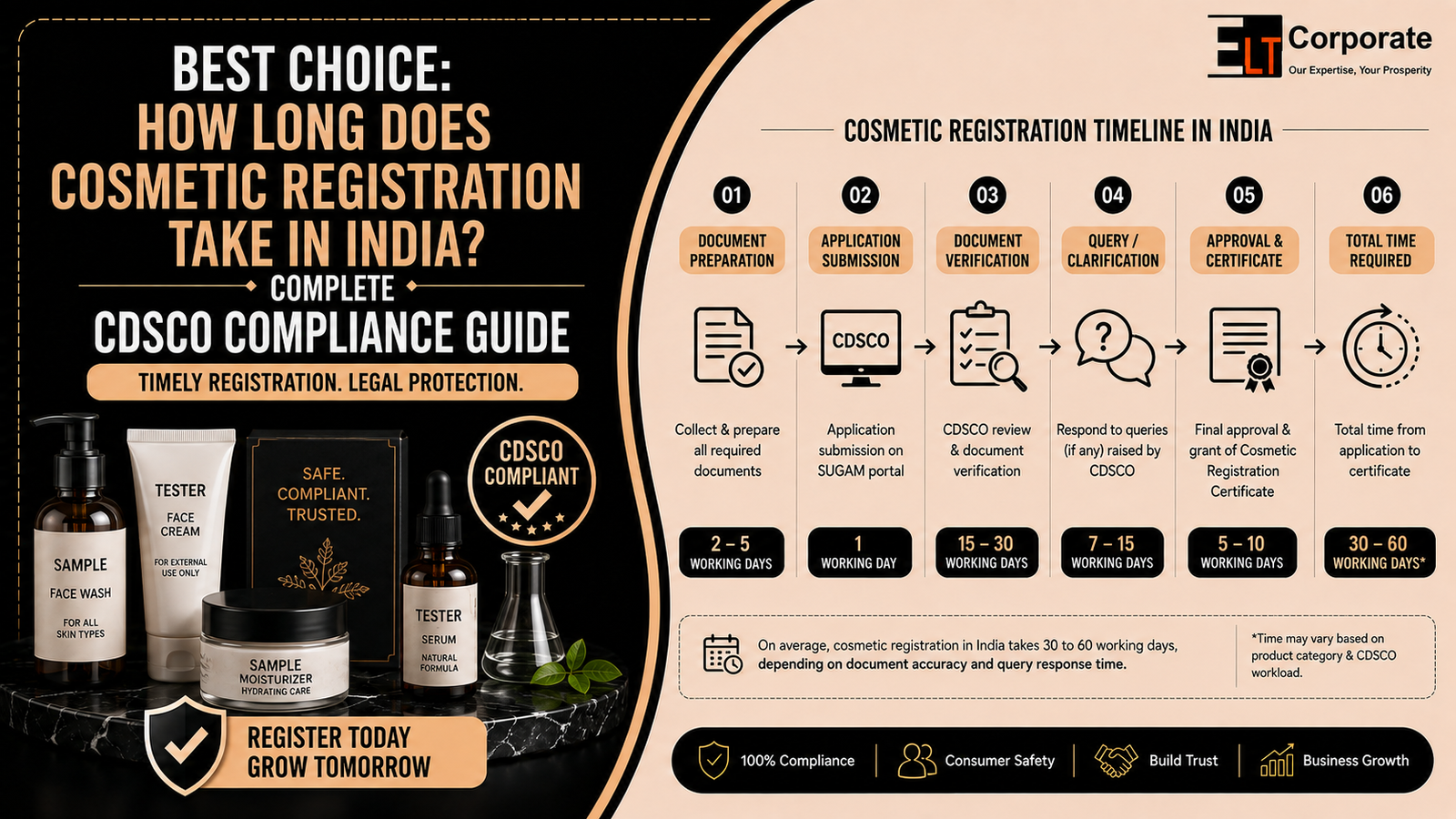
Average Time Required for Cosmetic Registration in India
If a proper application is submitted, the cosmetic registration process usually lasts between 3 and 6 months from the time of submission until approval.
The timing of the timeline can vary based on:
- Documentation is complete
- Amount of products registered
- Formulation of the product
- CDSCO workload
- Review of the review
- The time it takes for a response from the applicant
While certain applications might be processed faster, others might take longer if further documents or clarification are needed.
Typical Cosmetic Registration Timeline
The registration process is broken down into multiple steps.
| Stage | Estimated Time |
| Document collection | Between 2 and 4 weeks |
| Application preparation | 1 to 2 weeks |
| CDSCO application submission | 1 to 3 days |
| Preliminary examination | Between 2 and 4 weeks |
| Technical review | 4-8 weeks |
| The query response (if there is any) | 1 – 4 weeks |
| Final approval and registration certificate | 2 to 4 weeks |
Estimated Total Timeline: 3-6 Months
Step 1: Document Preparation (2-4 Weeks)
The first step involves obtaining all documents that are required.
Common documents include:
- Cover letter
- Power of Attorney
- Product ingredient list
- Labels for products
- Specifications of the product
- Free Sale Certificate
- Manufacturing license (if required)
- The declaration on the compliance of animal testing
- Product pack images
- Authorization documents
Making sure that the documentation is complete and precise in this phase significantly decreases the likelihood of delays in the future.
Step 2: Application Preparation (1-2 Weeks)
After all documents are in place The application is then evaluated and organized in accordance with CDSCO specifications.
At this point:
- The product information is verified.
- The information on the ingredients is inspected.
- Labels are analyzed.
- Categories of products are confirmed.
- The supporting documents are vetted.
Any ambiguity discovered prior to submission could save a few weeks of review time during the regulatory process.
Step 3: Submission to CDSCO
After the application is completed, the application is submitted via an online application on the CDSCO web portal.
After the submission:
- The application is acknowledged.
- The initial verification process commences.
- The application goes through the process of regulatory review.
Step 4: Preliminary Scrutiny
During the initial examination, CDSCO checks whether:
- Documents required are included.
- Complete application forms have been submitted.
- The information provided by the applicant is correct.
- Details of the product are uniform.
If the documents that are required are not available, CDSCO may request clarification prior to moving forward.
Step 5: Technical Evaluation
This is the most crucial phase of the registration process.
Regulators evaluate:
- Formulation of the product
- Ingredient safety
- Product category
- Label compliance
- Certificates that support the certification
- Manufacturer details
- Regulation declarations
If all is in line with Indian regulations If everything is in compliance with Indian regulations, the application can proceed to the next step.
Step 6: CDSCO Queries (If Applicable)
Many applications get clarification requests.
Common queries relate to:
- Missing documents
- Corrections to labels
- Ingredient clarification
- Composition of the product
- Authorization letters
- Validity of the certificate
The quicker applicants can provide complete information, the more quickly the process will be able to continue. Responses that are delayed can significantly extend the duration of registration overall.
Step 7: Registration Approval
After a successful test, CDSCO issues the Cosmetic Registration Certificate.
After approval, importers are able to legally import and sell cosmetics that are registered in India in conformity with the applicable laws and regulations.
Factors That Affect Registration Time
Many factors impact the processing speed of your system.
1. Complete Documentation
Applications made with all the necessary documents typically go through the process of review more quickly.
2. Product Complexity
Certain products with several active ingredients, new formulations, or claims that are specialized might require more thorough scrutiny.
3. Number of Products
Registration of multiple products on one application might require more review when compared to registering one product.
4. CDSCO Workload
The time for processing can be different based on the number of applications dealt with by the authorities.
5. Accuracy of Product Labels
Incorrect or inconformant labels frequently lead to additional inquiries and/or revisions.
6. Prompt Query Responses
Responding promptly to CDSCO inquiries generally receives approvals faster than those who wait for responses.
Common Reasons for Registration Delays
The following problems are frequently a reason for delay in cosmetic registration:
- Incomplete documentation
- Signs not in the correct order
- Expired certificates
- Incorrect ingredient information
- Non-compliant labels
- Inconsistent product details
- Improper Power of Attorney
- Responses to CDSCO queries are delayed. CDSCO questions
- Incorrect categorization of the product
A thorough review of the application prior to making it available for submission could help avoid the problems.
Tips to Speed Up Cosmetic Registration
Companies can increase the efficiency of their processing by adopting these best practices.
- Do your best to prepare documents ahead of time.
- Check all information on the product prior to the submission.
- Make sure labels are in line with Indian specifications.
- Maintain certificates current and up-to-date.
- Submit high-quality, scanned documents in high-quality scans.
- Monitor application status regularly.
- Respond to CDSCO inquiries promptly.
- Get professional help with regulatory issues in the event of need.
While no one can ensure acceptance within a certain time frame, careful planning can minimize the risk of delays.
Does Every Imported Cosmetic Require Registration?
Most cosmetics imported to be sold in India need registration prior to them being able to be imported.
Examples include:
- Cleansers for your face
- Moisturizers
- Sunscreens
- Cosmetics
- Products for hair care
- Perfumes
- Nail care products
- Cosmetics for babies
- Products for grooming and men’s grooming
- Cosmetics for treating skin
Importers must verify the requirements of the relevant regulatory authorities prior to importation of any cosmetic item.
Can Cosmetic Registration Be Rejected?
Yes. CDSCO can deny the application in case it doesn’t conform to the requirements of regulatory agencies.
Common reasons for this include:
- Incorrect documentation
- The use of ingredients that are not allowed
- Inaccurate claims about products
- Non-compliant labels
- Application incomplete
- Inability to answer official questions
Complete and precise application greatly increases the chances of getting approval.
Why Early Registration Planning Matters
Many companies plan their launch of their products around promotional campaigns such as retail agreements and seasonal demand. Beginning registration early will help to avoid delays that can delay the timeframes for business.
Planning ahead can bring many benefits:
- Timely market entry
- Improved plan of inventory
- Clearer customs clearance
- Risks of compliance reduced
- Improved launch scheduling
- Greater confidence in readiness for regulatory compliance
Best Practices for Importers
In order to make registration more efficient:
- Check all documentation prior to submission.
- Check that ingredients are in compliance with Indian rules.
- Check that labels for products meet all requirements.
- Be in constant contact with the manufacturer in China.
- Keep track of the application’s progress frequently.
- Make the digital versions of each document submitted.
These procedures help ensure an orderly registration process and decrease the chance of delays that could be avoided.
Conclusion
Understanding the length of time that cosmetic registration is in India is vital for companies looking to import cosmetics to India. Indian market. Although the typical registration timeframe is usually three to six months however, the actual timeframe is contingent on the quality of the document and accuracy of the application, as well as regulatory review, and prompt responses to CDSCO questions.
Companies that complete their documents, adhere to the Cosmetics Rules, 2020, and take care to meet the requirements of regulatory agencies in advance will have a better chance of completing smooth registration. Making plans ahead and making sure compliance right from the beginning will aid importers in avoiding delays and get their product to the market confidently.
Frequently Asked Questions (FAQs)
Q1. How long will cosmetic registration require in India?
The registration process for importing cosmetics usually takes between 3 and 6 months, based on the quality of the documentation and completeness of the application. CDSCO review times.
Q2. What is the main motive behind delays in registration?
Incomplete documentation, erroneous labeling, and certificates that are expired, as well as delayed responses to CDSCO inquiries, are among the top reasons for delays.
Q3. Is it possible to have the registration process done faster?
A properly written application, complete with documentation and timely responses to regulatory inquiries, will help to reduce delays that could be avoided; however, approval timeframes are dependent on CDSCO review.
Q4. Is registration of cosmetics required for imports of cosmetics?
Yes. Cosmetic products imported from abroad typically need registration at CDSCO before they are legally imported or sold within India.
Q5. Do businesses need to prepare well prior to the launch of their product?
Yes, applying several months ahead allows enough time to prepare documents as well as regulatory review and any other clarifications that might be required in the course of the process.
Contact Our Experts