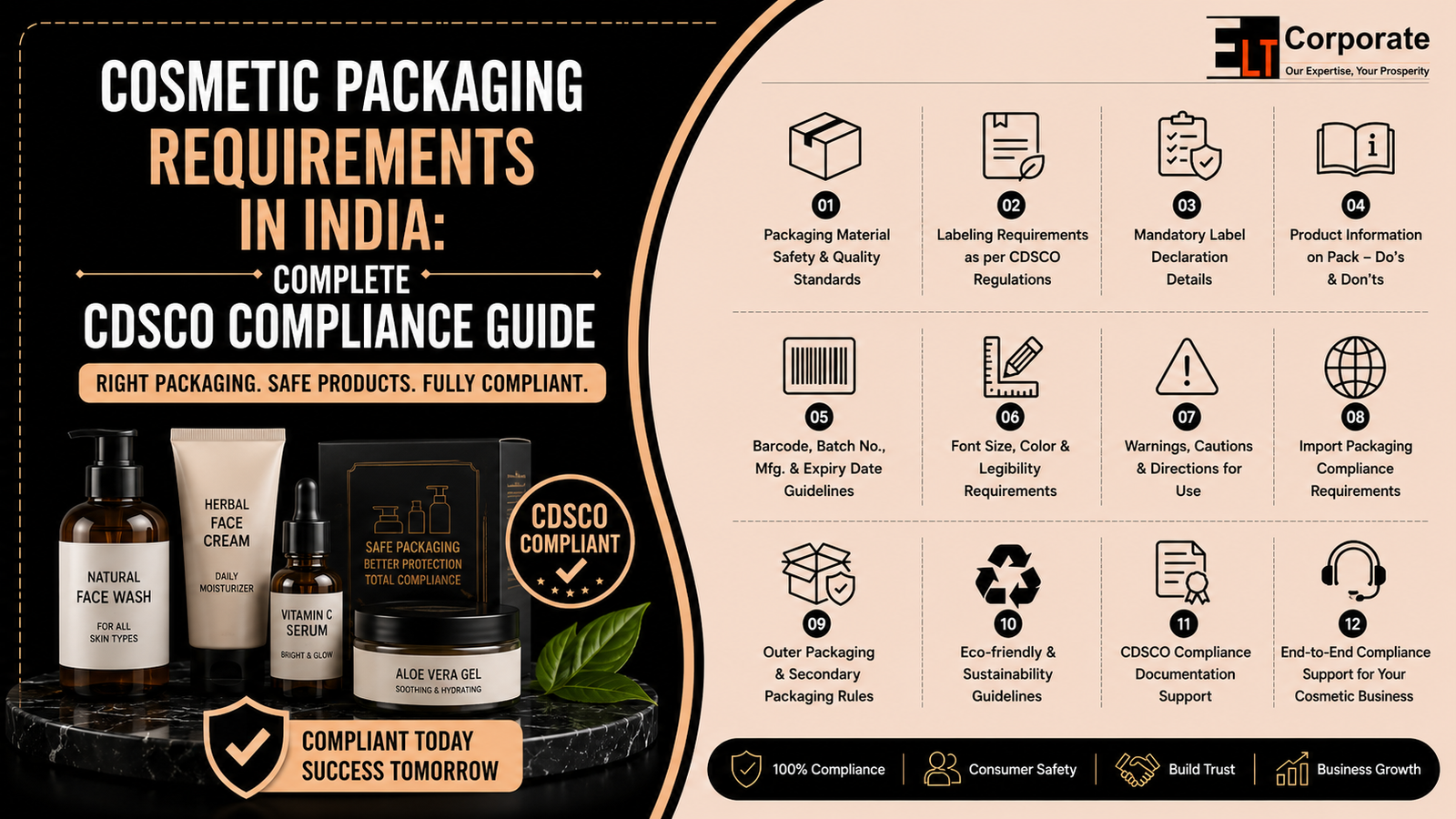

However, there is a rapidly growing demand for cosmetics in India, with both locally produced and imported goods reaching millions of people annually. Nonetheless, before making a certain cosmetic product legally available on the market of India, it is obligatory that the product meets all the cosmetic packaging requirements in India according to the Drugs and Cosmetics Act, 1940, as well as the Cosmetics Rules, 2020.
Packaging does not only concern the appearance of the product. Rather, it is a factor that contributes to the safety of the product and is crucial for meeting the regulations and informing consumers. Unusual packaging or lack of required information may result in product confiscation, delays in imports, and fines.
In this document we will explain the requirements for packaging that apply to cosmetics regulatory importers, manufacturers, distributors, and foreign brands that are looking to join the Indian market.
📦 Need Help with Cosmetic Packaging Compliance?
Our regulatory experts help manufacturers and importers comply with CDSCO cosmetic packaging and labeling requirements. Get accurate guidance for registration, packaging review, and documentation.
🚀 Get Expert Consultation 💬 WhatsApp NowWhat Are Cosmetic Packaging Requirements in India?
“Cosmetic Packaging Requirements in India” refers to the compulsory guidelines for how cosmetics are packaged, labeled, and presented before they can be sold in India, the Indian market.
The regulations are designed to:
- Make sure that consumers are safe and healthy.
- Prevent misleading claims
- Ensure product traceability
- Provide essential product information
- Maintain high quality during transportation and storage
- Assist in regulatory inspections
Each cosmetic product, whether made in India or imported, must meet these guidelines.
Regulatory Authorities Governing Cosmetic Packaging
The following authorities are responsible for regulating cosmetic packaging and cosmetics in India:
- Central Drugs Standard Control Organisation (CDSCO)
- State Licensing Authorities
- Ministry of Health & Family Welfare
- Customs Authorities (for imports of cosmetics)
Importers and manufacturers are accountable for ensuring that each package conforms to the standards of distribution before it is distributed.
Why Cosmetic Packaging Compliance Is Important
The proper compliance with packaging is beneficial to businesses:
- Sell legal products in India
- Avoid customs clearance delays
- Prevent product recalls
- Create trust among consumers
- Make sure you meet CDSCO registration requirements
- Reduce the legal risk
- Increase the authenticity of your product
Failure to adhere could cause regulatory action or financial loss.
Mandatory Information Required on Cosmetic Packaging
Each cosmetic packaging must show specific mandatory information clearly and easily.
1. Product Name
The packaging must clearly indicate the brand name.
Example:
- Face Wash
- Shampoo
- Moisturizer
- Lip Balm
2. Name and Address of Manufacturer
The full name and address of the manufacturer should be supplied.
For imported cosmetics:
- Foreign manufacturer details
- Indian importer details
Both must be present when applicable.
3. Country of Origin
Cosmetics imported from abroad must clearly identify:
Country of Origin
Example:
- Made in Korea
- Made in France
4. Manufacturing Batch Number
Every cosmetic should display:
- Batch Number
- Lot Number
- Manufacturing Code
This allows for traceability of the product when recalls or inspections are conducted.
5. Manufacturing Date
The year and month of production must be noted if necessary.
Example:
Manufactured: July 2026
6. Expiry Date or Best Before
Cosmetic products should clearly state the following:
- Expiry Date
- Best Before
- Use Before
Consumers should be aware of the safe use period.
7. Net Quantity
The package should specify the quantity in the standard units.
Examples:
- 100 ml
- 200 ml
- 50 g
8. Ingredient Declaration
- Ingredients should be listed in ascending order of the amount.
- Ingredients that are present in small amounts are typically listed after the principal ingredients.
- International nomenclature (INCI names) is widely employed.
9. Directions for Use
Consumers need to be provided with clear instructions on:
- Method of application
- Frequency
- Conditions of storage
Example:
“Apply evenly to clean skin twice daily.”
10. Warnings and Precautions
When appropriate, cosmetic products are required to include warnings like the following:
- For use outside only.
- Keep away from reach of children.
- Avoid eye contact
- A patch test is recommended
- If irritation develops, stop using the product.
📦 Ensure Your Cosmetic Packaging is CDSCO Compliant
Our regulatory experts help manufacturers and importers comply with CDSCO cosmetic packaging and labeling requirements. Get accurate guidance for registration, packaging review, and documentation.
🚀 Get Expert Consultation 💬 WhatsApp NowPackaging Material Requirements
Cosmetics packaging materials must be protected against:
- Moisture
- Dust
- Sunlight
- Chemical contamination
- Physical injury
Common packaging materials are
- Glass
- Plastic
- Aluminum
- Tubes with laminated coating
- PET bottles
- HDPE containers
The material chosen should not be able to react in any way with cosmetic formulas.
Primary and Secondary Packaging
Primary Packaging
The primary packaging comes into direct contact with it.
Examples include:
- Bottles
- Tubes
- Jars
- Pumps
- Containers
It must be safe, clean, and non-reactive.
Secondary Packaging
The secondary packaging is used to protect the container that is used as the primary one and gives additional information.
Examples include:
- Cartons
- Boxes
- Sleeves
- Wrappers for outer wrappers
Packaging Requirements for Imported Cosmetics
Imported cosmetics need additional approval.
Importers must be sure to do the following:
- CDSCO Cosmetic Import Registration
- Properly labeling the sale prior to purchase
- of Origin declaration. of Origin declaration
- Name and address of the importer
- Batch identification
- Information about registration, if applicable
The incorrect packaging is among the most frequent reasons for delays in customs.
Label Language Requirements
Mandatory declarations must include:
- Clear
- It is easy to read
- Permanent
- Printed in English
Other languages from other regions can also be utilized, provided that the information required by law is accurate.
Font Size and Visibility
Labels should not include:
- Hidden information
- Printing that is smudged
- Illegible text
- Labels that are easily removed
The information should be accessible all the time during the shelf life of the product.
Tamper-Evident Packaging
A variety of cosmetics benefit from the use of tamper-evident packaging. Examples include:
- Shrink seals
- Security stickers
- Caps to protect yourself
- Breakable seals
These features increase confidence among consumers and ensure the integrity of the product.
Packaging Requirements for Different Cosmetic Categories
Different cosmetics may require packaging that is specific to the category.
| Cosmetic Category | Special Packaging Consideration |
| Shampoo | Bottles that are leak-proof |
| Face Cream | Tubes and jars that are air-tight |
| Serum | UV-protected bottles |
| Lipstick | Twist-lock containers |
| Sunscreen | Light-resistant packaging |
| Hair Oil | Caps that are spill-proof |
| Nail Polish | Glass bottles with safe closures |
| Perfume | Bottles that resist pressure |
Common Packaging Mistakes
Many businesses do not intend to violate packaging laws.
Common errors are
- The manufacturer address is not correct.
- Incorrect ingredient list
- No batch number
- Incorrect expiry date
- Wrong net quantity
- Missing importer information
- False claims about products
- Labeling that is not approved
- Packaging damaged
- Poor print quality
By avoiding these problems, you can ensure that regulatory approval is smooth.
Best Practices for Cosmetic Packaging Compliance
Businesses must:
- Review packaging prior to printing
- Make sure you have all the required declarations
- Use durable packaging materials
- Keep trackability of batches
- Conduct quality checks on packaging
- Update labels following regulatory changes
- Maintain packaging documentation
- Make sure compliance teams are trained regularly
How Professionals Can Help
The regulatory consultants can help in:
- Review of compliance with packaging
- Cosmetic registration support
- Label verification
- Import documentation
- Audits for regulatory compliance
- CDSCO Compliance Guidance
Professional help reduces risks to regulatory compliance and speeds up entry into markets.
Conclusion
Compliance with the cosmetic packaging requirements in India is crucial for every cosmetics manufacturer, importer, or brand’s proprietor. Properly packaged products ensure compliance with regulatory requirements, improve product safety, and increase trust among consumers. If you adhere to the guidelines of the Cosmetics Rules, 2020, and ensure accurate labeling, companies can avoid legal issues and ensure a smooth distribution all over the Indian market.
If you’re planning to produce or import cosmetics into India. Conducting an extensive review of the compliance of packaging prior to the launch of your product can help you save time, money, and legal hurdles.
Need Help with Cosmetic Packaging Compliance?
Ensure your cosmetic products comply with CDSCO packaging and labeling requirements. Our experts can assist you with cosmetic registration, packaging review, import compliance, and regulatory documentation.
📩 Talk to Our Experts 💬 WhatsApp Now📞 Call Us: +91 85859 19582
Frequently Asked Questions (FAQs)
Q1. Do cosmetic packaging requirements apply in India?
Each cosmetic item that is sold in India must conform to the labeling and packaging requirements stipulated in the Cosmetics Rules, 2020.
Q2. Can imported cosmetics have foreign labels?
No. Cosmetics that are imported must comply with Indian labels and packing regulations before they can be available for purchase in India.
Q3. Does the ingredient list have to be included?
Yes. Cosmetic products are usually required to disclose ingredients according to the applicable regulatory requirements.
Q4. What happens if a cosmetic package isn’t compliant?
Products that aren’t compliant may be subject to delays at customs, fines, recalls, and restrictions on sales.
Q5. Does CDSCO examine cosmetic packaging?
Yes. Cosmetic packaging can be scrutinized at the time of registration, import clearance, inspections, or even regulatory audits.