
For any cosmetic manufacturer in India — whether you are applying for a fresh manufacturing licence, facing a renewal inspection, or operating under an existing licence that is subject to periodic surveillance factory — the inspection by the State Drug Control Authority is the defining moment in your regulatory journey.
A well-prepared, GMP-compliant manufacturing unit sails through inspection with a clean report and swift licence issuance or renewal. A facility that is unprepared — with documentation gaps, infrastructure shortfalls, or process non-conformances — faces observations, re-inspection delays, licence rejection, or in serious cases, licence cancellation and business shutdown.
Under the Drugs and Cosmetics Act, 1940 and the Cosmetics Rules, 2020, cosmetic manufacturing must comply with prescribed Good Manufacturing Practices (GMP) — aligned with ISO 22716:2007 (Cosmetics GMP International Standard). State Drug Control Authority inspectors assess your facility against these standards during every inspection visit.
This guide provides a comprehensive, category-wise factory inspection checklist for cosmetic manufacturing units in India — covering every area that inspectors evaluate, with practical guidance on what to prepare, what to document, and what common deficiencies to avoid.
How Cosmetic Factory Inspections Work in India
Who Conducts Inspections?
Cosmetic manufacturing unit inspections are conducted by Drug Inspectors (DIs) appointed by the State Drug Control Authority — the state-level drug regulatory body where your manufacturing facility is located.
- Karnataka: Karnataka State Drug Control Department (KSDCD)
- Maharashtra: Maharashtra FDA
- Rajasthan: Rajasthan Drug Control Organisation (RDCO)
- Gujarat: Gujarat FDCA
- Delhi: Delhi Pharmaceuticals Sciences and Research University / Delhi State Drug Authority
- And so on for each state
When Do Inspections Occur?
Factory inspections for cosmetic manufacturing units occur in the following circumstances:
- Pre-licence inspection: Before a new manufacturing licence is granted — to verify that the facility meets the prescribed GMP and infrastructure requirements
- Renewal inspection: At the time of licence renewal — to verify continued GMP compliance
- Periodic surveillance inspection: Routine inspections by Drug Inspectors during the licence validity period — may be announced or unannounced
- Complaint-triggered inspection: Following a consumer complaint, adverse event report, or regulatory intelligence about a facility
- Market surveillance follow-up: After a product sample collected from the market is found to be sub-standard or adulterated
What Do Inspectors Assess?
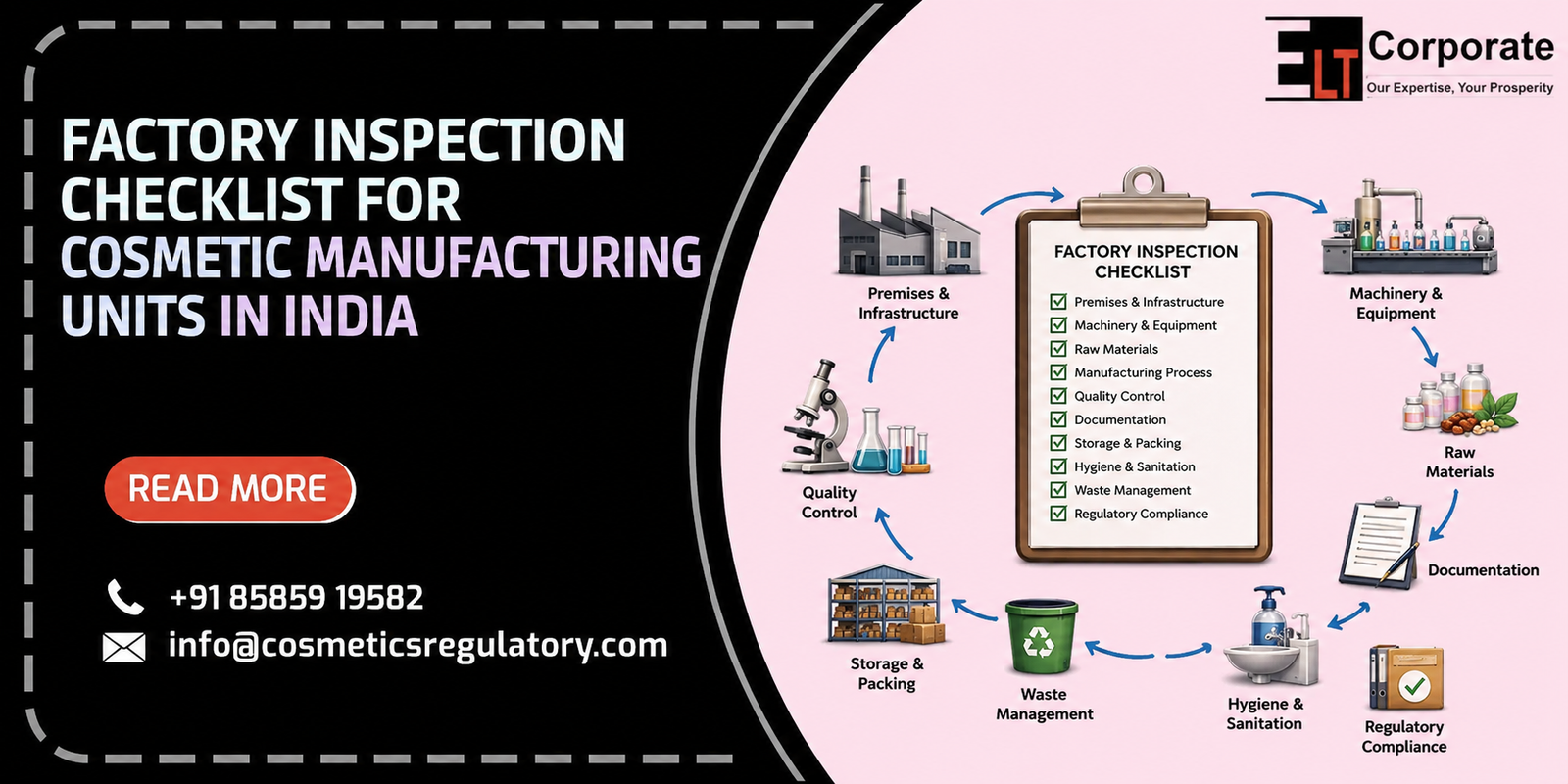
Drug Inspectors assess your facility against the GMP requirements prescribed under the Cosmetics Rules, 2020 — which are broadly aligned with the internationally recognised ISO 22716:2007 (Good Manufacturing Practices for Cosmetics) standard. The assessment covers:
- Physical infrastructure and premises
- Equipment and utilities
- Personnel qualifications and hygiene
- Raw material management
- Manufacturing and quality control processes
- Documentation and record-keeping
- Labelling and packaging operations
- Storage and distribution
- Complaint handling and adverse event reporting
THE COMPREHENSIVE INSPECTION CHECKLIST
SECTION 1 — PREMISES AND PHYSICAL INFRASTRUCTURE
1.1 General Premises Requirements
- Manufacturing premises are of adequate size for the operations conducted — sufficient space for manufacturing, quality control, storage, changing rooms, and utilities without overcrowding
- Premises are of permanent construction — brick, concrete, or other solid materials. Temporary, makeshift, or kutcha structures are not acceptable
- Floors are smooth, non-porous, non-slip, easily cleanable, and resistant to cosmetic raw materials and cleaning agents
- Walls are smooth, non-porous, washable, light-coloured, and free of cracks, flaking paint, or exposed masonry
- Ceilings are smooth, sealed, and free of cracks, exposed beams, pipes, or structural elements that can harbour dust and contaminants
- Doors are solid, smooth-surfaced, well-fitting, and easy to clean. No wooden doors with rough or porous surfaces in production areas
- Windows are sealed or fitted with fly-proof, cleanable mesh screens where they open to the outside
- Adequate natural and artificial lighting in all work areas — manufacturing, QC laboratory, storage, and corridors
- Adequate ventilation in all areas — HVAC system or mechanical ventilation where required to control temperature, humidity, and airborne contamination
- Drains are present, properly sealed, fitted with traps to prevent back-flow and pest ingress, and located to allow easy cleaning
1.2 Area Segregation
- Clear physical separation between the following areas, either by walls, barriers, or controlled access:
- Raw material storage (quarantine vs approved vs rejected)
- Manufacturing / production area
- Quality control (QC) laboratory
- Finished goods storage (quarantine vs approved vs rejected)
- Packaging and labelling area
- Personnel changing / locker rooms
- Toilets and wash facilities (must not open directly into production areas)
- Waste collection / disposal area
- Unidirectional flow of materials — raw materials → manufacturing → packaging → finished goods storage — without cross-contamination risk from backflow or crossing of paths
- Dedicated filling and packaging areas for different product categories (e.g., aerosols separately from liquids; eye products separately from general products)
- No unapproved access between production areas and non-production areas
1.3 Controlled Environment Areas (Where Applicable)
- For sterile or near-sterile cosmetic products (e.g., eye area products) — cleanroom or controlled-environment areas with defined and verified air quality standards
- Temperature and humidity control in sensitive production and storage areas — with calibrated monitoring instruments and continuous records
- Positive/negative pressure differentials maintained where required — documented and verified
1.4 Pest Control
- Active pest control programme in place — with a documented contract with a licensed pest control service provider
- Pest control treatment records maintained — including date, type of treatment, areas treated, and chemicals used
- No evidence of pest activity (rodents, insects, birds) anywhere in the facility
- Fly screens, door sweeps, and gap sealing in place to prevent pest entry
- Pest monitoring devices (glue boards, UV traps) in place and regularly inspected and replaced
SECTION 2 — EQUIPMENT AND UTILITIES
2.1 Manufacturing Equipment
- All manufacturing equipment (mixers, homogenisers, filling machines, reactors, mills, etc.) is listed in the manufacturing licence application and corresponds to what is actually installed
- Equipment is made of materials that are non-reactive, non-porous, non-shedding, and easy to clean — stainless steel (SS 316L preferred for product-contact surfaces)
- No equipment with corroded, damaged, or cracked product-contact surfaces
- Equipment is of adequate capacity for the batch sizes manufactured
- Equipment is clearly labelled with identification number, current status (Clean, Dirty, Under Maintenance), and product/batch for which it was last used
- Equipment is positioned to allow easy cleaning, maintenance, and access around all sides
- Dedicated equipment for each product category where cross-contamination risk requires it
2.2 Measuring and Test Equipment
- All weighing balances, scales, and measuring instruments are calibrated — with current, valid calibration certificates from accredited calibration laboratories
- Calibration labels affixed to each instrument showing calibration date and next due date
- Calibration programme documented — specifying frequency, method, acceptable tolerance, and responsible personnel
- Thermometers, hygrometers, pH meters, viscometers, and other test instruments — all calibrated and with current certificates
- Out-of-calibration instruments are removed from use and clearly tagged “Do Not Use”
2.3 Utilities — Water Systems
- Water quality meets the requirements for cosmetic manufacturing — at minimum, potable water for cleaning; purified water (demineralised or RO water) for product incorporation where required
- Water quality is tested regularly — records of water testing (pH, conductivity, microbial counts) maintained
- Purified water system (RO/DM plant) installed where required — with maintenance and sanitisation records
- Water pipes labelled and a water flow diagram available
- No dead legs or stagnant water accumulation points in the water distribution system
2.4 Utilities — Compressed Air and Gases
- Compressed air used in product-contact applications is filtered and of appropriate quality — oil-free, moisture-free
- Nitrogen, carbon dioxide, and other process gases used are of appropriate grade with supplier certificates
- Gas cylinders properly stored, secured, and labelled
2.5 Equipment Cleaning and Maintenance
- Cleaning validation or cleaning verification documented for all product-contact equipment — demonstrating that cleaning procedures effectively remove product residues and cleaning agents
- Cleaning SOPs in place for all equipment — specifying cleaning agents, concentrations, contact times, rinse procedures, and acceptance criteria
- Equipment cleaning logs maintained for every cleaning event — date, time, equipment ID, product cleaned, cleaning agent used, operator, and sign-off
- Preventive maintenance programme documented — specifying maintenance tasks, frequency, responsible personnel, and records
- Equipment maintenance logs maintained
SECTION 3 — PERSONNEL
3.1 Qualified / Competent Technical Person
- A Qualified / Competent Technical Person (QTP) is appointed as required under the Cosmetics Rules, 2020 — with educational qualifications in Pharmacy, Chemistry, or related science
- Appointment letter and employment proof of the QTP is available
- Original qualification certificates of the QTP are available and verified
- The QTP is present at the facility and actively involved in manufacturing and quality oversight
3.2 Personnel Hygiene
- All production and QC personnel are provided with and wear appropriate protective clothing — gowns, hair covers/caps, shoe covers/dedicated footwear, gloves (where required), and masks (where required)
- Changing rooms with lockers for personal items are available before entry into production areas
- Changing SOP is in place and followed — personnel change out of street clothes and into production attire before entering manufacturing areas
- No eating, drinking, smoking, or chewing of food or tobacco in production areas — signage visible
- Personnel with skin conditions, open wounds, or communicable illnesses are temporarily restricted from product-contact operations — medical fitness assessment records available
- Jewellery, watches, and other items that could contaminate products are not worn in production areas
- Hand-washing facilities available at entry to all production areas — with soap, clean water, and drying facilities or hand sanitiser dispensers
3.3 Training
- Training records maintained for all personnel involved in manufacturing, QC, and related activities — covering:
- GMP awareness training
- Job-specific technical training (equipment operation, cleaning procedures, documentation)
- Hygiene and personal conduct training
- Safety training (chemical handling, fire safety, emergency procedures)
- Role-specific SOPs
- Training programme is documented — specifying training topics, frequency, trainers, and assessment methods
- Training is conducted at induction and at periodic intervals (typically annually or when SOPs change)
- Training effectiveness is assessed — written tests, practical assessments, or supervisor evaluation
3.4 Contractor and Visitor Control
- Contractors, maintenance personnel, and visitors are accompanied by authorised personnel in production areas
- Visitor log maintained
- Protective clothing provided to visitors entering production areas
SECTION 4 — RAW MATERIAL MANAGEMENT
4.1 Supplier Qualification
- Approved Vendor / Supplier List maintained — listing all approved suppliers of raw materials and packaging materials
- Supplier qualification process documented — criteria for approving new suppliers (technical review, sample testing, audit or questionnaire)
- Supplier qualification records available for all key raw material suppliers
4.2 Raw Material Receipt and Incoming Inspection
- Incoming inspection SOP in place — specifying inspection procedure for every incoming material
- All incoming raw materials are received in the quarantine area before inspection and approval
- Goods Receipt Note (GRN) prepared for every incoming material — recording supplier, material name, lot number, quantity, date, and condition on receipt
- Incoming materials tested or verified against Certificates of Analysis (CoA) before release to production
- Incoming materials labelled with Quarantine status on receipt
- Approved, Rejected, and Quarantine areas physically separated or clearly demarcated — with appropriate labelling on containers and storage areas
- Rejected materials are segregated, clearly labelled “Rejected,” and disposed of promptly per the rejection SOP
4.3 Raw Material Storage
- Raw materials stored in appropriate conditions — correct temperature, humidity, and light conditions as specified on the material’s technical data sheet or specification
- Flammable materials (solvents, alcohols) stored in a dedicated, appropriately ventilated, fire-rated flammables store — with no ignition sources
- Hazardous materials — strong acids, alkalis, oxidisers — stored separately from each other and from other materials in designated, labelled, and appropriately constructed storage areas
- First-In First-Out (FIFO) stock rotation practised and documented
- Raw materials are stored off the floor — on pallets, shelves, or racking — with space around them for ventilation and inspection
- All raw material containers are labelled with material name, supplier lot number, internal batch number, quantity, date of receipt, and expiry date
- No expired or obsolete materials remaining in storage — regular stock review conducted
4.4 Raw Material Documentation
- Material specification sheets available for every raw material — specifying identity tests, purity requirements, physical properties, and acceptance criteria
- Certificates of Analysis (CoA) from suppliers for each incoming lot
- Internal test reports / raw material test records for each incoming lot
- Material usage records (batch records reference which lots of which materials were used in each batch)
SECTION 5 — MANUFACTURING OPERATIONS
5.1 Batch Manufacturing Records (BMRs)
The Batch Manufacturing Record is the single most scrutinised document in a cosmetic factory inspection. Every batch of every product must have a complete, accurate, and contemporaneously maintained BMR.
- BMR format is pre-printed or electronically generated — not handwritten blank sheets
- BMR references the approved Master Formula Record for the product
- BMR captures all of the following:
- Product name, product code, and batch number
- Batch size
- Manufacturing date and date of each manufacturing step
- Equipment used (equipment ID numbers)
- Raw materials used — name, internal batch number, quantity weighed/added
- Weight of each raw material — recorded at the time of weighing by the operator, checked by a second person (two-person verification)
- Step-by-step manufacturing instructions followed
- In-process checks performed — results recorded
- Yield calculations
- Deviations (if any) — and how they were handled
- Operator signatures at each step
- QC approval / release sign-off
- BMRs are filled in real time — not retrospectively
- All entries are in indelible ink — pencil entries are not acceptable
- Corrections to BMR entries are made by drawing a single line through the incorrect entry, writing the correct entry, signing, and dating — no overwriting, correction fluid, or obliteration
5.2 Master Formula Records (MFRs)
- Master Formula Record exists for every product manufactured — specifying the approved formula (quantitative composition), manufacturing method, equipment, in-process controls, and specifications
- MFRs are approved by the Qualified Technical Person and maintained under document control
- MFRs are not altered without formal change control procedures
- Current, approved versions of MFRs are accessible to production personnel at point of use
5.3 Manufacturing Process Controls
- Weighing of raw materials conducted on calibrated balances — with a second operator verification
- In-process controls conducted and recorded at defined stages — pH measurement, viscosity check, appearance assessment, fill weight verification
- Environmental monitoring of production areas — temperature and humidity recorded during manufacturing where specified
- Batch segregation — different batches not manufactured simultaneously in the same area without adequate segregation
- Line clearance performed and documented before starting a new batch or product — removal of all materials from the previous batch, cleaning and verification of equipment
5.4 Water-in-Manufacturing
- Purified / demineralised water used in formulations where required — with water quality records confirming suitability
- Water used for equipment rinsing of appropriate quality — records maintained
SECTION 6 — QUALITY CONTROL
6.1 QC Laboratory Setup
- Dedicated QC laboratory physically separated from production areas
- QC laboratory is of adequate size for the tests conducted
- Adequate laboratory equipment — pH meter, viscometer, microbiological testing equipment, analytical balances, HPLC or UV-Vis spectrophotometer (as required for the products manufactured)
- All QC laboratory instruments are calibrated — current calibration certificates available
- QC laboratory has appropriate reference standards and reagents — with records of receipt, preparation, and expiry
6.2 Finished Product Testing
- Finished product specifications exist for every product — specifying tests, methods, and acceptance criteria
- Every batch is tested against finished product specifications before release
- Certificate of Analysis (CoA) prepared for every batch released
- Retain samples (reference samples) of every batch are stored — clearly labelled and retained for a minimum period (typically twice the shelf life or until the product is no longer on the market)
- Stability testing programme in place for all products — supporting the assigned shelf life and expiry date
- Microbiological testing conducted on all products that require it — preservative efficacy testing (Challenge test) conducted for relevant products
6.3 Batch Release Procedure
- Formal batch release procedure documented — specifying the checks and approvals required before a batch is released for sale
- Batch release is authorised by the Qualified Technical Person — signature on batch release record
- No batch is released without completion of all required QC tests and satisfactory results
- Out-of-specification (OOS) results procedure in place — specifying investigation process, root cause analysis, and disposition decision
6.4 Non-Conforming Product
- Non-conforming product procedure documented — covering identification, segregation, investigation, disposition (rework, re-processing, rejection, or destruction)
- Non-conforming product area clearly labelled and physically segregated
- Non-conformance records maintained
SECTION 7 — DOCUMENTATION AND RECORD KEEPING
This section is scrutinised with particular care during factory inspections — because documentation is the primary evidence that your GMP system is real and consistently implemented.
7.1 Document Control System
- Document control SOP in place — covering document creation, approval, distribution, revision, and archival
- All documents (SOPs, specifications, BMRs, forms) have a document number, version number, approval date, and authorised signatures
- Controlled copy distribution — production personnel have access only to the current, approved version of relevant documents
- Superseded documents are archived — with clear indication that they are obsolete
- No obsolete or unauthorised documents in use in production areas
7.2 Standard Operating Procedures (SOPs)
All of the following SOPs must be present, current, and actively used:
Premises SOPs:
- Premises cleaning and sanitisation SOP
- Pest control SOP
- Environmental monitoring SOP
Equipment SOPs:
- Equipment cleaning SOPs (one per critical piece of equipment)
- Equipment preventive maintenance SOP
- Equipment calibration SOP
Personnel SOPs:
- Personnel hygiene and gowning SOP
- Visitor and contractor management SOP
- Personnel training SOP
Raw Material SOPs:
- Incoming raw material receipt and inspection SOP
- Raw material sampling SOP
- Raw material storage and handling SOP
- Approved vendor list maintenance SOP
Manufacturing SOPs:
- Line clearance SOP
- Batch manufacturing SOP (general)
- In-process control SOP
- Weighing and dispensing SOP
QC SOPs:
- Sampling SOP (raw materials, in-process, finished goods)
- Finished product testing SOP (one per test method)
- Out-of-specification (OOS) investigation SOP
- Retain sample management SOP
- Stability testing SOP
- Microbiological testing SOP
Packaging and Labelling SOPs:
- Packaging material receipt and inspection SOP
- Labelling and packaging SOP
- Label reconciliation SOP
Storage and Distribution SOPs:
- Finished goods storage SOP
- Dispatch and distribution SOP
- Product recall SOP
Quality System SOPs:
- Change control SOP
- Deviation and non-conformance handling SOP
- Internal audit SOP
- Complaint handling SOP
- Adverse event reporting SOP
7.3 Record Retention
- All GMP records (BMRs, QC test records, cleaning logs, training records, calibration certificates) are retained for a minimum of 5 years — or longer if required by specific regulatory provisions
- Records are stored in a manner that prevents deterioration, loss, or unauthorised access
- Electronic records (where used) are backed up, access-controlled, and audit-trail enabled
SECTION 8 — PACKAGING AND LABELLING
8.1 Packaging Materials Management
- Incoming packaging materials received and inspected in the quarantine area before release
- Packaging material specifications maintained — for primary packaging (bottles, tubes, jars) and secondary packaging (cartons, leaflets)
- Packaging material test / inspection records for each incoming lot
8.2 Labelling Operations
- Label reconciliation conducted for every batch — number of labels issued vs number used vs number destroyed / returned — with explanation for any discrepancy
- Labels are stored securely — access controlled to prevent unauthorised use
- Labels checked before use to ensure they are correct for the product and batch being packed
- Artwork control — only approved, current artwork versions are used for production labels
- Label approval process documented — new labels and label changes go through formal review and approval before use
8.3 Label Compliance (Cosmetics Rules, 2020)
- Every finished product label includes all mandatory elements under the Cosmetics Rules, 2020:
- Product name
- Manufacturer name and address
- Manufacturing licence number
- Net content (weight or volume)
- Complete INCI ingredient list (descending order of concentration)
- Batch number
- Manufacturing date (month and year)
- Expiry / Best before date (month and year)
- Directions for use (where required)
- Precautions and warnings
- MRP inclusive of all taxes
- No drug claims on any cosmetic product label (no claims of treating, curing, or healing any medical condition)
- Colourants listed using CI numbers where applicable
- Labels in English (or bilingual as required)
SECTION 9 — STORAGE AND FINISHED GOODS MANAGEMENT
9.1 Finished Goods Storage
- Finished goods are stored in appropriate conditions — temperature, humidity, and light as required by each product’s specifications
- Quarantine area for finished goods awaiting QC release approval — clearly demarcated and labelled
- Released goods area — for finished goods that have passed QC and are approved for sale
- Rejected goods area — clearly segregated and labelled. Rejected goods managed per the non-conforming product procedure
- FIFO stock rotation practised for finished goods
- Finished goods stored off the floor on racking or pallets
- No expired stock in the finished goods area
9.2 Dispatch and Distribution Records
- Dispatch records maintained — linking each outgoing consignment to specific batch numbers, customer details, quantity, and date
- Batch traceability enabled — ability to recall all units of a given batch from the market within a defined timeframe
- Distribution chain documented — who received which batch, in what quantity, and when
SECTION 10 — COMPLAINTS AND ADVERSE EVENT HANDLING
- Complaint handling SOP in place — covering receipt, logging, investigation, and response to consumer complaints
- Complaint log maintained — recording all complaints received, investigation findings, and actions taken
- Trend analysis of complaints conducted — to identify patterns that may indicate systematic product or process issues
- Adverse event reporting procedure in place — for serious consumer adverse reactions (allergic reactions, chemical burns, eye injuries) — with timelines for reporting to State Drug Control Authority and CDSCO
- Adverse event records maintained
SECTION 11 — PRODUCT RECALL SYSTEM
- Product recall SOP in place — covering the procedure for initiating, managing, and completing a product recall
- Recall procedure specifies:
- Criteria for initiating a recall (safety, quality, labelling defect)
- Recall classification (Class I, II, III by severity)
- Communication procedures to customers, distributors, State Drug Control Authority, and CDSCO
- Product retrieval and disposition procedures
- Recall effectiveness check procedures
- Mock recall exercise conducted periodically — to test the effectiveness of the recall system and traceability
- Mock recall records documented — with time taken to trace and retrieve batches, and any gaps identified
SECTION 12 — CHANGE CONTROL AND DEVIATION MANAGEMENT
12.1 Change Control
- Change control SOP in place — covering the procedure for managing any change to facilities, equipment, materials, processes, or documentation
- Change requests are documented, reviewed, and approved before implementation
- Impact assessment conducted for each proposed change — including whether the change requires licence amendment notification to the State Drug Control Authority
- Post-implementation review of changes conducted and documented
12.2 Deviation Management
- Deviation procedure in place — for managing unplanned departures from approved procedures during manufacturing
- Deviations recorded, investigated (root cause analysis), and closed with appropriate corrective actions
- Significant deviations are reviewed by the Qualified Technical Person before batch release
SECTION 13 — INTERNAL AUDIT SYSTEM
- Internal audit programme documented — specifying audit scope, frequency (at least annually), auditors, and reporting format
- Internal audits conducted by personnel independent of the area being audited (where possible)
- Internal audit reports prepared after each audit — documenting findings, their severity, and required corrective actions
- Corrective Action and Preventive Action (CAPA) plans prepared for all internal audit findings — with responsible persons and target completion dates
- CAPA completion verified and closed — evidence of corrective action implementation maintained
- Internal audit records retained
SECTION 14 — WASTE MANAGEMENT AND ENVIRONMENTAL COMPLIANCE
- Waste management SOP in place — covering classification, segregation, collection, storage, and disposal of manufacturing waste
- Waste types segregated at source:
- General waste (non-hazardous)
- Chemical waste (solvents, reagents, cleaning chemicals)
- Microbiological waste (from QC lab)
- Packaging waste
- Rejected / expired raw materials and finished goods
- Hazardous waste disposed of through authorised waste disposal contractors — with waste disposal manifests and contractor licences maintained
- Consent to Operate from State Pollution Control Board (SPCB) — where required for cosmetic manufacturing operations
- Effluent treatment or pre-treatment in place where required by SPCB conditions
COMMON INSPECTION FINDINGS — AND HOW TO AVOID THEM
The following are the most frequently cited deficiencies during cosmetic manufacturing unit inspections in India:
Critical Findings (May Result in Licence Rejection or Suspension)
1. Qualified Technical Person Not Present or Unqualified The QTP is absent during the inspection, or their qualifications do not match the required educational background. Ensure your QTP is present, their original certificates are available, and they can demonstrate active involvement in the facility’s operations.
2. Manufacturing in Unlicensed Areas / Products Outside Licence Scope Products being manufactured that are not covered by the licence, or manufacturing being conducted in premises not covered by the licence. Maintain strict alignment between licensed activities and actual operations.
3. No Batch Manufacturing Records or Falsified Records Absence of BMRs, or BMRs that are clearly retrospectively fabricated. Contemporaneous, complete BMRs are non-negotiable.
4. No Separation Between Approved and Rejected / Quarantined Materials Raw materials and finished goods of different status (quarantine, approved, rejected) stored together without physical segregation or clear labelling.
5. Non-Compliant Product Labels Products with labels missing mandatory elements — no INCI list, no batch number, no expiry date, or making drug claims.
Major Findings (Require Prompt Corrective Action)
6. No Calibration Records for Weighing Balances Weighing balances used in production or QC without current calibration certificates.
7. Missing or Unsigned SOPs SOPs that are undated, unsigned, or clearly not current.
8. No Pest Control Programme No pest control contract, no treatment records, or evidence of active pest infestation.
9. Inadequate QC Laboratory QC lab is insufficient for the testing required — missing key instruments, no reference standards, or inadequate space.
10. No Retain Samples Absence of retain/reference samples for released batches.
11. No Training Records Personnel with no documented training history for their current roles.
12. No Product Recall SOP Absence of any documented product recall procedure.
Pre-Inspection Preparation — Action Checklist
Use this condensed checklist in the weeks leading up to a scheduled or anticipated factory inspection:
4 Weeks Before Inspection:
- Conduct a complete internal GMP audit against this checklist
- Identify all gaps and assign corrective action owners with deadlines
- Verify all calibration certificates are current — arrange calibration for any due or overdue instruments
- Review all SOPs — ensure they are current, signed, and dated
- Verify Qualified Technical Person’s appointment letter and original qualification documents are on file
2 Weeks Before Inspection:
- Ensure all BMRs for recent batches are complete, signed, and properly maintained
- Verify raw material and finished goods areas are properly labelled and segregated
- Check pest control treatment records are up to date
- Confirm all equipment cleaning logs are maintained and up to date
- Verify retain samples are in place for all recent batches
1 Week Before Inspection:
- Brief all production and QC staff on expected inspector questions and inspection protocol
- Ensure the Qualified Technical Person will be present on the inspection day
- Organise all documentation in a structured file — licences, personnel qualifications, BMRs, test records, calibration certificates, SOPs
- Conduct a final walk-through of all facility areas — ensuring cleanliness, labelling, and order
- Resolve any outstanding minor housekeeping issues
On Inspection Day:
- QTP and senior management available to receive inspectors
- Escort inspectors professionally — answer questions honestly and directly
- Provide requested documents promptly
- Do not obstruct the inspection or deflect from legitimate observations
- Note all observations raised — they will form the basis of the inspection report
Frequently Asked Questions
Q1. How much advance notice will we receive before a factory inspection?
For new licence and renewal inspections, CDSCO or State Drug Control Authorities typically schedule an inspection appointment — giving you advance notice. For periodic surveillance or complaint-triggered inspections, Drug Inspectors may arrive unannounced. Maintaining your facility in continuous inspection-ready condition is the only reliable strategy.
Q2. What happens if observations are raised during the inspection?
Inspectors document observations in an inspection report. Minor observations typically require you to submit a corrective action plan within a specified timeframe. Major observations may result in a re-inspection before the licence is granted or renewed. Critical violations may result in licence rejection, suspension, or show cause notices.
Q3. Is ISO 22716 certification mandatory for cosmetic manufacturers in India?
ISO 22716 certification is not explicitly mandated by the Cosmetics Rules, 2020 — but the GMP requirements prescribed under the Rules are aligned with ISO 22716. Holding ISO 22716 certification from an accredited body is a strong indicator of GMP compliance and is viewed positively by Drug Inspectors. For brands targeting export markets or premium retailers, ISO 22716 certification also provides commercial credibility.
Q4. Can a contract manufacturer’s facility be inspected even if I (the brand owner / loan licensee) am not based there?
Yes. The State Drug Control Authority inspects the physical manufacturing premises — regardless of whether the brand owner is on-site. As a loan licensee (brand owner), you share responsibility for the compliance of products manufactured under your brand at the contract manufacturer’s facility. Vetting your contract manufacturer’s GMP standards before engagement is essential.
Q5. What is the minimum area required for a cosmetic manufacturing facility?
The Cosmetics Rules, 2020 prescribe minimum area requirements for cosmetic manufacturing premises — which vary based on the categories of products being manufactured and the scale of operations. Area requirements are assessed by the inspecting Drug Inspector in the context of the specific products and operations declared in the licence application.
Q6. How long should we retain manufacturing records?
GMP records — including Batch Manufacturing Records, QC test records, calibration certificates, cleaning logs, training records, and SOPs — should be retained for a minimum of 5 years from the date of manufacture. For products with longer shelf lives or for products subject to specific regulatory provisions, longer retention may be required.