
The Indian beauty and personal care industry is creating new opportunities for entrepreneurs, startups, and established businesses looking to launch their own skincare, haircare, and personal care products. Private-label manufacturing allows businesses to introduce products under their own brand name without investing in their own manufacturing facilities. However, starting a cosmetic brand requires proper licensing, product quality checks, and regulatory compliance.
Cosmetics Regulatory helps entrepreneurs, private-label brands, and cosmetic businesses understand the licensing and compliance requirements involved in launching cosmetic products in India. From third-party manufacturing arrangements to license applications, businesses need to follow the applicable provisions of the Cosmetics Rules, 2020.
A Cosmetic Manufacturing License for Private Label Brands in India is an important regulatory consideration for businesses planning to manufacture and sell cosmetic products under their own brand names. Understanding the applicable license, documentation, product standards, and labeling requirements before starting manufacturing can help businesses avoid unnecessary regulatory complications.
Get Free Assistance
Share your business details and get guidance on cosmetic manufacturing licences and registration.
SEND ENQUIRY →Chat on WhatsApp
Have a question? Message our team directly for private-label cosmetic licensing assistance.
CHAT NOW →Contact Our Team
Need more information? Visit our contact page to discuss your cosmetic business requirements.
CONTACT US →What Is a Cosmetic Manufacturing License for Private Label Brands in India?
A Cosmetic Manufacturing License for Private Label Brands in India is an authorization required under the applicable provisions of the Cosmetics Rules, 2020, for manufacturing cosmetics for sale or distribution.
Private-label businesses generally do not manufacture products themselves. Instead, they appoint an existing licensed manufacturer to produce cosmetics according to their brand requirements.
For example, a business may launch:
- Face wash and facial cleansers.
- Moisturisers and face creams.
- Sunscreens and serums.
- Shampoos and conditioners.
- Body lotions and body washes.
- Hair oils and hair masks.
Although the products carry the brand owner’s name, the manufacturing activity must take place through an appropriately licensed arrangement.
Businesses planning Private Label Cosmetic Manufacturing in India should understand the responsibilities of both the manufacturer and the brand owner.
Is a Manufacturing License Required for Private Label Cosmetic Brands?
Yes. Cosmetic manufacturing for sale or distribution must be covered by the appropriate licence under the applicable rules.
The licensing arrangement depends on the proposed business model, manufacturing premises, and role of the applicant.
There are two important arrangements to understand before applying for a cosmetic manufacturing license for private label brands in India.
1. Third-Party Cosmetic Manufacturing License
Third-party manufacturing is a popular option for cosmetic startups and private-label brands.
In this arrangement, a brand appoints an existing licensed cosmetic manufacturer to produce products under its brand name. The manufacturer uses its approved premises, equipment, technical staff, and manufacturing facilities.
Before finalizing the agreement, the brand should verify:
- The manufacturer’s valid manufacturing licence.
- Approved cosmetic product categories.
- Manufacturing facility and infrastructure.
- Quality control and testing arrangements.
- Product specifications and formulation details.
- Labelling and packaging responsibilities.
A third-party cosmetic manufacturing license arrangement should be evaluated carefully to ensure that the manufacturing activity is properly covered by the applicable licence.
Cosmetics Regulatory assists businesses in understanding third-party manufacturing compliance and the documentation required for their proposed arrangements.
2. Cosmetic Loan License in India
A license may be suitable for businesses intending to manufacture cosmetics using the facilities of another existing licensed manufacturer.
Under Rule 23 of the Cosmetics Rules, 2020:
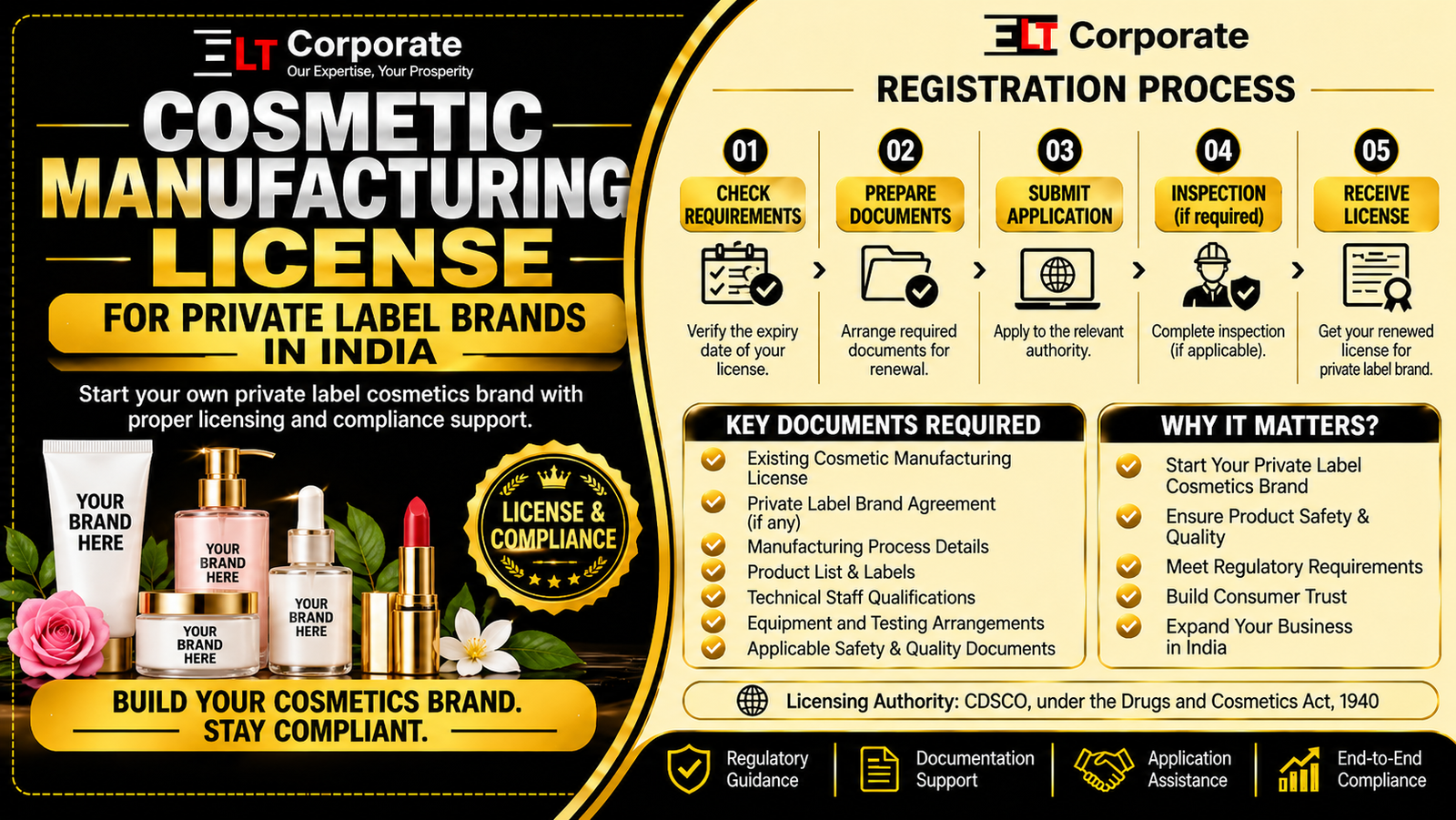
- Form COS-5 is used to apply for a manufacturing licence.
- Form COS-6 is used to apply for a loan licence.
- Form COS-8 is the manufacturing licence.
- Form COS-9 is the loan licence.
The applicant must fulfill the applicable conditions and submit the required documents to the concerned State Licensing Authority.
A cosmetic manufacturing license for private label brands in India should not be confused with a loan licence because both arrangements have different regulatory requirements.
Cosmetics Regulatory helps applicants understand which licensing route is appropriate for their business model.
Get Free Assistance
Share your business details and get guidance on cosmetic manufacturing licences and registration.
SEND ENQUIRY →Chat on WhatsApp
Have a question? Message our team directly for private-label cosmetic licensing assistance.
CHAT NOW →Contact Our Team
Need more information? Visit our contact page to discuss your cosmetic business requirements.
CONTACT US →Documents Required for Cosmetic Manufacturing License for Private Label Brands in India
Documentation is an important part of the licensing process. Incomplete or inconsistent information may result in regulatory queries or delays.
Depending on the application type, the following documents and information may be required:
- Identity and address proof of the applicant.
- Company or business registration documents.
- Constitution documents of the business.
- Manufacturing premises ownership or rental documents.
- Details of manufacturing equipment and machinery.
- Product names and proposed cosmetic categories.
- Details and qualifications of competent technical staff.
- Manufacturing facility information.
- Details of the existing licensed manufacturer, where applicable.
- Required declarations and undertakings.
- GMP compliance self-declaration in Form COS-7.
- Prescribed application fee and supporting information.
The applicable documentation should be checked against Part II of the Second Schedule and the requirements of the concerned authority.
Proper preparation can make the Cosmetic Manufacturing License for Private Label Brands in India application process more organized.
Preparing Your Cosmetic Registration Documents?
Explore the Document Checklist →Cosmetic Manufacturing Rules in India
The Cosmetic Manufacturing Rules in India are primarily governed by the Cosmetics Rules, 2020, framed under the Drugs and Cosmetics Act, 1940.
These rules establish requirements relating to manufacturing licenses, product safety, quality, labeling, and manufacturing practices.
Some important compliance areas include:
Manufacturing License: The appropriate licence or loan licence must be obtained from the State Licensing Authority.
Good Manufacturing Practices: The manufacturing premises, equipment, and processes must comply with the applicable Seventh Schedule requirements.
Product Quality: Cosmetics must meet the standards prescribed under the Ninth Schedule or other applicable quality and safety standards.
Product Claims: Rule 36 prohibits false or misleading claims about cosmetic products.
Labeling: Rule 34 specifies applicable labeling requirements for cosmetic products.
Understanding these provisions is essential for businesses seeking cosmetic manufacturing registration in India.
Cosmetic Quality Standards and BIS Compliance
Product quality is one of the most important considerations when launching a cosmetic brand. A manufacturer should have suitable quality control arrangements to ensure that products meet applicable specifications.
The cosmetic quality standards applicable to a product depend on its category, ingredients, formulation, and relevant regulatory specifications.
Businesses should consider the following:
- Raw material quality verification.
- Finished product specifications.
- Batch manufacturing records.
- Appropriate microbiological testing.
- Stability and compatibility assessment, where applicable.
- Quality control documentation.
BIS Standards for Cosmetics
The BIS Standards for Cosmetics are particularly important because the Cosmetics Rules, 2020, prescribe applicable Indian Standards for specified cosmetic categories under the Ninth Schedule.
Private-label businesses should identify the relevant standard for each product instead of assuming that the same requirements apply to every cosmetic.
A cosmetic manufacturing license for private label brands in India should always be considered alongside applicable product quality requirements.
Cosmetic Product Approval and New Cosmetic Requirements
Not every cosmetic product follows the same regulatory procedure.
Under Rule 23(3), a product falling within the definition of a new cosmetic requires prior permission from the Central Licensing Authority in Form COS-3 before the State Licensing Authority grants the manufacturing licence.
Businesses should assess the product formulation, ingredients, intended purpose, and regulatory classification before introducing a new product.
Cosmetic Product Approval requirements should therefore be checked before commercial manufacturing begins.
Cosmetics Regulatory helps businesses understand the applicable product-related requirements and identify regulatory considerations for proposed formulations.
Cosmetic Labelling Requirements for Private Label Brands
Correct labelling is essential for cosmetic products sold in India. A product may have an appropriate manufacturing arrangement, but incorrect label declarations can still create compliance problems.
The Cosmetic Labelling Requirements under Rule 34 include applicable particulars such as
- Name of the cosmetic product.
- Name and address of the manufacturer.
- Manufacturing licence number.
- Batch number.
- Use-before date or expiry-related declaration.
- Net contents.
- Ingredient declaration, where applicable.
- Necessary warnings and directions for use.
Businesses must also review applicable legal metrology requirements for retail packages.
The Cosmetic Manufacturing License for Private Label Brands in India process should include a review of product labels before commercial distribution.
Cosmetic Packaging Regulations and Product Claims
Packaging should protect the product and remain suitable for its formulation and intended storage conditions.
The Cosmetic Packaging Regulations should be considered when selecting bottles, tubes, jars, pumps, and other containers.
Private-label brands should review:
- Packaging material compatibility.
- Leakage and contamination risks.
- Product storage requirements.
- Packaging quality and durability.
- Mandatory retail package declarations.
- Accuracy of marketing and product claims.
Brands should avoid unsupported statements about product performance or treatment benefits. Claims must not mislead consumers under Rule 36.
Cosmetic Safety and Testing
Product safety should never be overlooked when launching a private-label cosmetic brand.
Cosmetic Safety and Testing involve evaluating the quality and safety of ingredients, formulations, and finished products according to applicable requirements.
Depending on the product, businesses may need suitable testing and supporting documentation relating to:
- Physical and chemical specifications.
- Microbiological quality.
- Stability.
- Packaging compatibility.
- Ingredient compliance.
- Finished product quality.
Manufacturers must maintain the applicable testing and batch records. Cosmetics must also comply with the relevant provisions of Rule 39.
Get Free Assistance
Share your business details and get guidance on cosmetic manufacturing licences and registration.
SEND ENQUIRY →Chat on WhatsApp
Have a question? Message our team directly for private-label cosmetic licensing assistance.
CHAT NOW →Contact Our Team
Need more information? Visit our contact page to discuss your cosmetic business requirements.
CONTACT US →Steps to Obtain a Cosmetic Manufacturing License for Private Label Brands in India
Businesses can follow these steps to organise their licensing process:
Step 1: Finalise Your Products: Prepare a list of proposed products, including face creams, shampoos, serums, lotions, and other cosmetic categories.
Step 2: Select a Manufacturing Model: Decide whether you will use an existing licensed manufacturer or apply for a loan licence.
Step 3: Verify the Manufacturing Facility: Check the manufacturer’s licence, approved product categories, premises, equipment, and quality arrangements.
Step 4: Prepare the Documentation: Arrange business documents, premises details, technical staff information, product details, and applicable declarations.
Step 5: Submit the Application: Apply in Form COS-5 or COS-6, as applicable, to the concerned State Licensing Authority.
Step 6: Complete Regulatory Verification: The authority scrutinises the application and documents. Applicable inspection and verification requirements must be fulfilled.
Step 7: Start Compliant Manufacturing: Manufacturing for sale or distribution should begin only after obtaining the required authorisation and applicable product permissions.
Following these steps can help businesses manage their Cosmetic Manufacturing License for Private Label Brands in India requirements more efficiently.
Legal Requirements for Cosmetic Brands: Common Mistakes to Avoid
The Legal Requirements for Cosmetic Brands involve more than obtaining a manufacturing licence.
New businesses frequently make mistakes such as:
- Selecting a manufacturer without checking its licence.
- Assuming a private-label agreement replaces regulatory authorisation.
- Ignoring applicable product standards.
- Printing labels without reviewing mandatory declarations.
- Using misleading product claims.
- Overlooking testing and quality documentation.
- Failing to assess new cosmetic permission requirements.
Avoiding these mistakes can help businesses establish a more reliable compliance process.
How Cosmetics Regulatory Helps Private Label Cosmetic Brands
Launching a cosmetic brand involves several regulatory decisions. Professional guidance can help businesses understand their obligations before investing in manufacturing and packaging.
Cosmetics Regulatory provides assistance in areas including:
- Cosmetic manufacturing licence consultancy.
- Third-party manufacturing compliance.
- Cosmetic loan licence assistance.
- Application documentation and review.
- Product category assessment.
- Labelling and packaging compliance guidance.
- Quality and testing requirement assessment.
Whether you are launching a new skincare brand or expanding an existing product range, Cosmetics Regulatory can help you understand the applicable regulatory process.
Our aim is to simplify the licensing journey and help businesses make informed compliance decisions.
Conclusion
Private-label manufacturing provides an opportunity for entrepreneurs and established businesses to enter India’s growing cosmetics industry without setting up their own manufacturing infrastructure.
However, businesses must understand the applicable licence, manufacturing arrangement, product quality standards, testing requirements, and labelling obligations before launching their products.
Choosing the right manufacturing model and preparing the correct documentation can help reduce avoidable regulatory complications.
If you are planning to obtain a Cosmetic Manufacturing License for Private Label Brands in India, seek professional guidance before starting the manufacturing process.
Need Help Launching Your Private Label Cosmetic Brand?
Get expert guidance on cosmetic manufacturing licences, third-party manufacturing, loan licence requirements, documentation, product standards, and labelling compliance in India.
Cosmetics Regulatory | Your Partner for Private Label Cosmetic Compliance
Frequently Asked Questions (FAQs)
Q1. Is a cosmetic manufacturing licence required for private-label brands in India?
Yes. Manufacturing for sale or distribution needs the appropriate authorisation.
Q2. Can I launch a cosmetic brand without my own factory?
Yes. You may use an appropriately licensed third-party manufacturer.
Q3. What is a cosmetic loan licence?
It allows an eligible applicant to use another licensed manufacturer’s facilities.
Q4. Which forms are used for manufacturing and loan licences?
Form COS-5 is for manufacturing and Form COS-6 for a loan licence.
Q5. Who issues cosmetic manufacturing licences in India?
The concerned State Licensing Authority issues these licences.
Q6. Do private-label cosmetics need testing?
Products must meet applicable quality and safety requirements.
Q7. Can Cosmetics Regulatory help with private-label licensing?
Yes. Cosmetics Regulatory guides businesses on licences, documents, and compliance.